
Governments desperate for cash to protect their citizens from the growing impacts of the climate crisis are being put in a “beyond absurd” situation this week at global finance talks: they are being urged not to mention the climate, even as they address the current oil crisis.
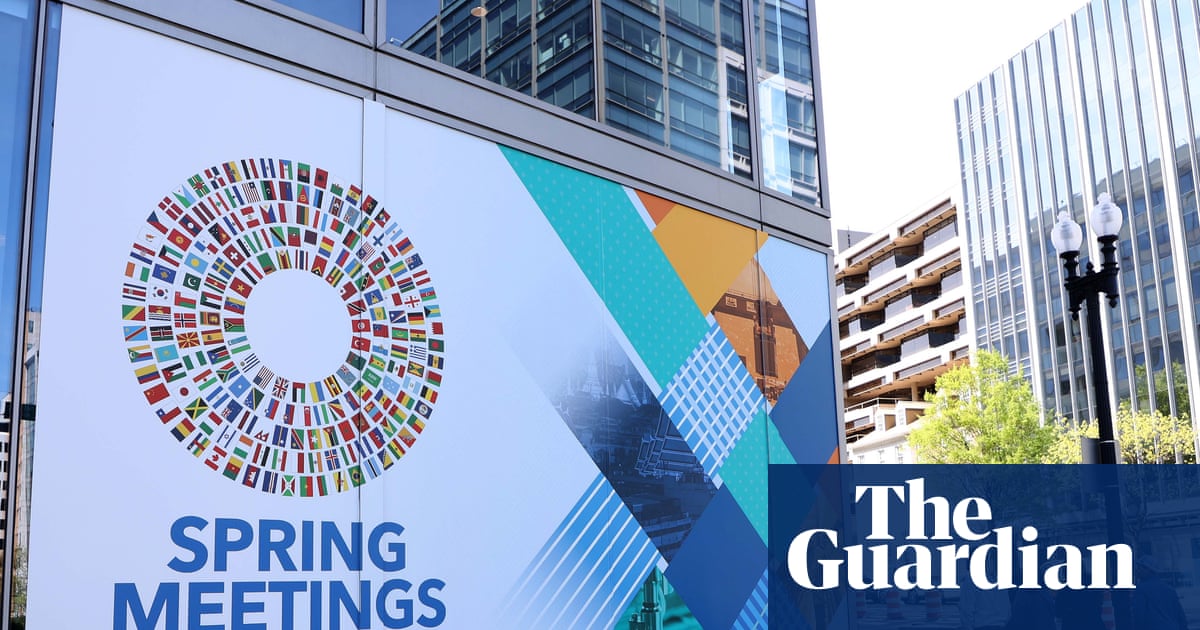
The International Monetary Fund (IMF) and the World Bank Group (WBG) spring meetings take place this week amid a fragile ceasefire in Iran and upended geopolitics. One of the priorities was to forge a new “climate change action plan” (CCAP) for the world’s biggest provider of funds to developing countries, to replace the current strategy, which expires in June.
Now, it looks like the new plan may be shelved, along with substantive discussion of the climate crisis.
With the oil crunch still biting, the delegates from up to 189 countries at the conference in Washington DC might have been expected to discuss investments in renewable energy, which many see as crucial to energy security and an antidote to volatility. Climate finance is also a pressing issue for poor countries already paying billions each year to repair the damage from droughts, floods and storms.
If these discussions are instead largely confined to whispers in corridors, the reason is clear: the US president, Donald Trump. Insiders have told the Guardian the White House is forcing countries to choose between opening up a potentially unbridgeable rift or playing down the climate crisis and trying to squeeze in green priorities by the back door.
Last autumn, the US Treasury secretary, Scott Bessent, demanded the removal of some climate finance targets from the World Bank’s aims and insisted it must “finance all affordable and reliable sources of energy … [with] an all-of-the-above approach to energy that includes financing for gas, oil and coal”. The US is the biggest shareholder in the World Bank, with about 17% of its capital.
Other countries, including large developed economies, have reacted with alarm. Senior staff of several international finance and development institutions have said the US has piled pressure on the World Bank, the IMF and other publicly funded institutions over the climate.
They said that, although the climate was still on the agenda, people at a senior level were “self-censoring” and removing the term from reports and projects. The Guardian understands some leading countries prefer not to push for a new CCAP.
That would be disastrous for the developing world, experts said. “It is beyond absurd that, in the middle of an escalating oil crisis, a World Bank meeting could sideline talk of climate change,” said Mohamed Adow, the director of the Power Shift Africa thinktank.
“Fossil fuels and the climate emergency are inextricably linked. This moment is a huge opportunity to accelerate the shift away from fossil-fuel dependence, with potentially historic benefits for the world. It will be a tragedy if politicians fail to do so.”
Catherine Abreu, the director of the International Climate Politics Hub, said: “The spring meetings will be a big test of these institutions. Will we see the World Bank and IMF unable to respond to the majority of their members, because they are swayed by these powerful minorities?”
Under its current CCAP, the World Bank Group aims to devote 35% of all its funding to climate-related activities, half of which should be for adaptation, and the group has also moved to end most finance to fossil fuels, though loopholes remain. The World Bank is the biggest single source of climate funding, and many donor countries channel their climate finance largely through the multilateral development banks.
At the Cop29 UN climate summit in Azerbaijan in 2024, countries agreed that at least $1.3tn a year should flow to the developing world by 2035, to help countries cut greenhouse gas emissions and cope with the impacts of extreme weather. Developed countries committed $300bn a year of that total, and reaching the target cannot happen without the World Bank.
In the World Bank Group’s last financial year, from 1 July 2024 to 30 June 2025, 48% of financing qualified as having climate co-benefits under its methodology.
A spokesperson for the World Bank Group said: “The World Bank Group supports public and private clients in achieving their smart development goals. This includes building low-carbon, resilient infrastructure and energy systems that manage emissions responsibly so countries can create jobs and sustain growth.
“We will finance what works best for countries, using a least-cost, reliable mix to meet their needs, while managing emissions responsibly. It is not an either/or and we are continuing to see strong demand for support for adaptation and mitigation from our clients. Over the last decade, 215 million people have gained new or improved access to electricity through our current energy programmes, and we expect this number to grow to 575 million.”
Much could still be achieved without formally labelling projects as climate-related, Lord Stern, a former World Bank chief economist and now a professor at the London School of Economics, told the Guardian. “You don’t have to plant big climate flags on these things, it’s just a good investment,” he said.
“US pressure is coming on the World Bank, but they can continue to do agriculture, forests, water, energy, public transport. These things are highly relevant to tackling the climate crisis – without highlighting climate change,” he added.
He also pointed to mass transit systems, such as urban railways, in cities in the developing world. “Metro systems in cities are a big part of the climate story. Why would the US oppose metro systems in overcrowded cities? Building a metro is not a covert climate action; it’s just doing things better.”
There is still much work to be done on clarifying what should make up the $300bn and $1.3tn targets. Stern said: “The way climate finance is counted is something I hope will develop. Without jiggery-pokery, there are lots of things that we should be supporting that should be counted towards the global climate finance goal.”








Leave a comment