
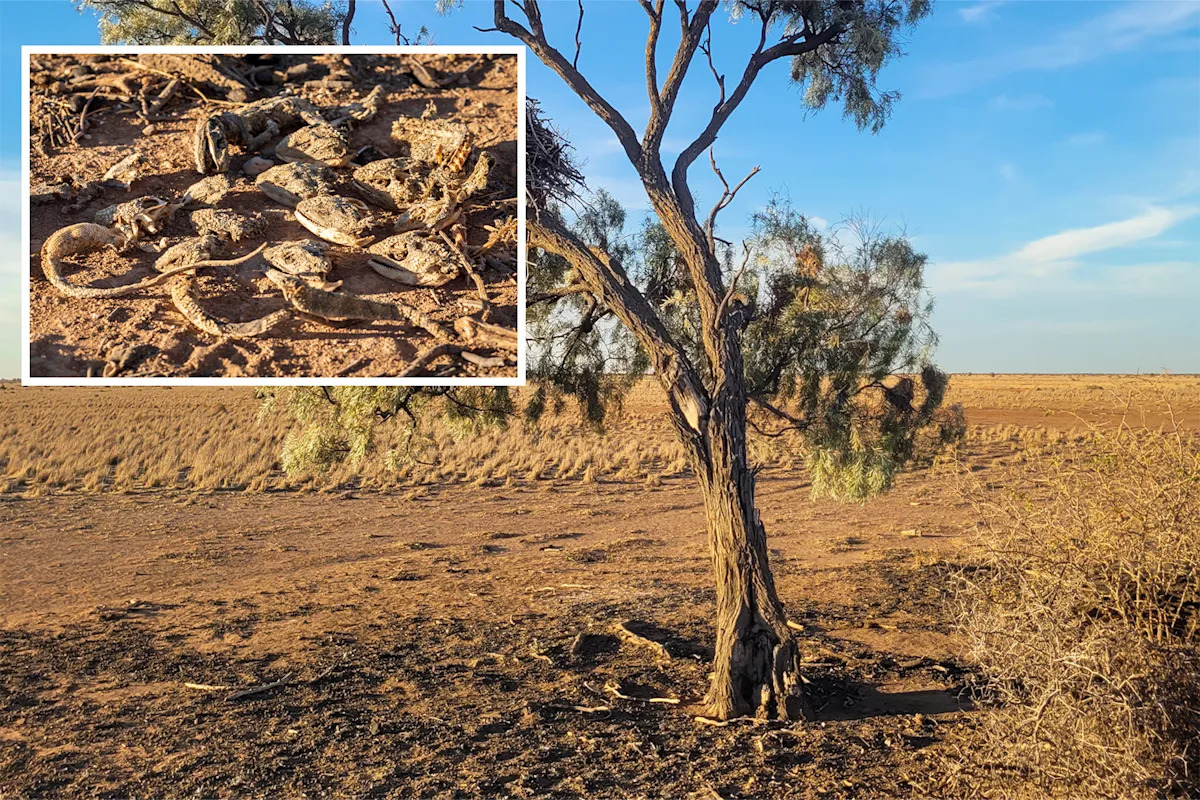
Over a dozen “mummified” heads were discovered under a gnarled ironwood tree during an expedition across a sprawling Australian property.
Zoologist Wyn Russell told Yahoo News the semi-arid NSW Riverena landscape had been grazed by cattle, exposing curiosities that would otherwise be hidden by native grass.
“It’s quite bare and open, and there aren’t many trees out there,” he said.
Russell was trekking across the property, conducting a survey of rare and endangered creatures for ecology company Biosis during the summer.
Survival in this environment is tough, and with little vegetation available, falcons, whistling kites, and smaller birds would sometimes nest in the same tree.
What stood out was a sprawling nest that dominated nearly every branch of a large tree, which had clearly been fashioned by Australia’s largest predatory bird, the wedge-tailed eagle.

Over a dozen bearded dragon heads were found underneath a wedge-tailed eagle nest. Source: Wyn Russell/Biosis
Underneath its branches were a few bones from creatures caught by parent birds and fed to two hungry chicks over several seasons.
But what “surprised” Russell was the prevalence of dried-out bearded dragon remains.
He quickly collected them into a pile and then imagined how they would have accumulated.
“There were skulls and tails, and those would have been the bits that wouldn’t have been easy to swallow for a young chick,” Russell said.
“They would have just fallen down and slowly dried out in the dry heat.”
Why were there so many dragon skulls?
The eagles likely have a complex diet of prey animals, including rabbits, young kangaroos, and even dead livestock.
“But those don’t preserve quite as well as a whole dragon head, which is discarded and then mummifies,” Russell said.
RELATED
The lizards had likely been caught on fence posts and shrubs, and then fed to chicks in the sprawling nest. Source: Wyn Russell/Biosis
Early in the mornings, Russell and his team would often spot bearded dragons sitting on the top of fence posts and shrubs to bask in the sun.
Initially, the lizards would freeze, but when they walked closer, they’d jump down into the foliage and disappear quickly.
“Birds of prey have quite keen eyesight, so they’re able to pick them up,” he said.
Why do researchers examine nests?
By examining bird nests, ecologists can build a picture of which species inhabit a landscape.
In 2017, a feature from an elusive night parrot was found in the nest of a finch at Kati Thanda-Lake Eyre, South Australia, a state where it was previously thought to be extinct.
Ancient hunting grounds are also a valuable tool for paleontologists.
In 2025, remains of a previously unknown extinct species were found in a cave used by owls for thousands of years.
Do you have a story tip? Email: newsroomau@yahoonews.com.
You can also follow us on Facebook, Instagram, TikTok, Twitter and YouTube.






Leave a comment