

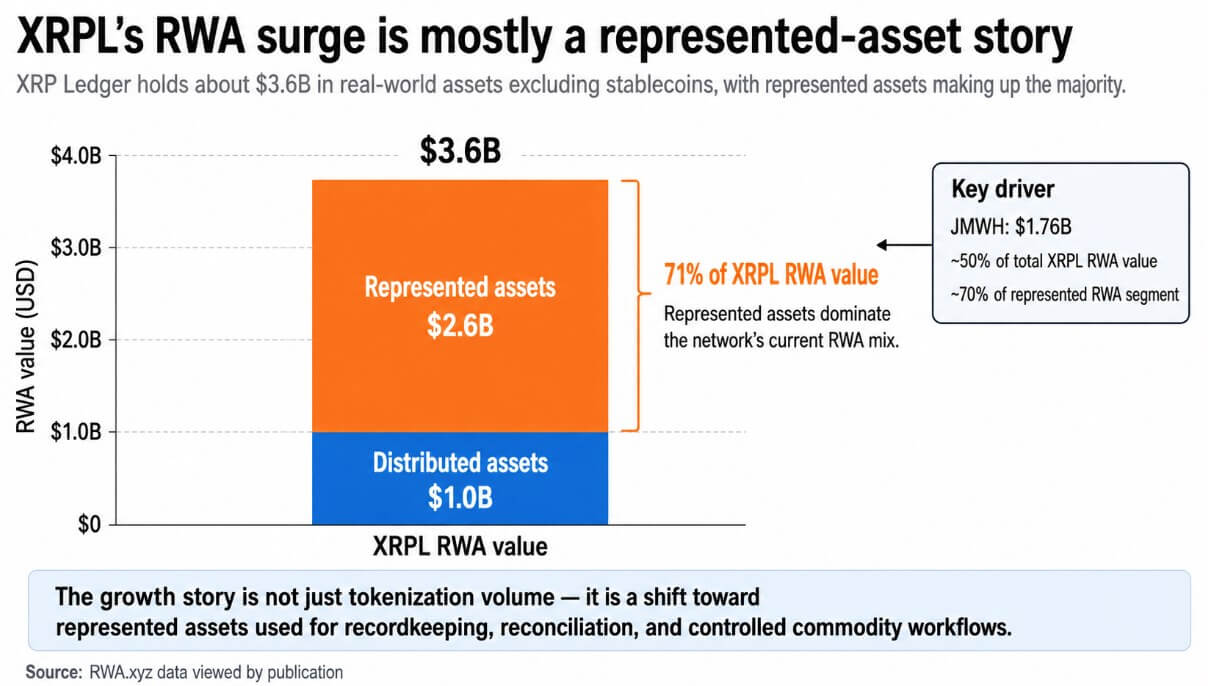
XRPL currently holds about $3.6 billion in real-world assets, excluding stablecoins, split roughly between $1 billion in distributed assets and $2.6 billion in represented assets.
That 71% tilt toward represented assets means XRPL’s RWA growth is concentrated in a model in which blockchain serves as a record-keeping and reconciliation layer, with tokens anchored to real-world contracts and commitments held within controlled platform structures.
RWA.xyz defines distributed assets as tokenized assets that can be moved off the issuing platform and transferred peer-to-peer. Represented assets stay inside the issuing platform, with blockchain recording and reconciling claims tied to real-world assets.
Most RWA coverage focuses on the distributed category. XRPL’s $2.6 billion in represented assets sits in the infrastructure-and-recordkeeping segment of the market.
RWA.xyz’s asset page shows JMWH with a total value of $1.76 billion, up 104.79% over 30 days, and an inception date of Jan. 13.
Each JMWH token represents one real megawatt-hour of energy backed by energy companies. That single asset accounts for roughly half of XRPL’s total RWA value and about 70% of its represented RWA segment.
Why energy fits this model
Commodities, and energy in particular, present operational problems that go well beyond investor access.
Production allocation, contract execution, delivery confirmation, consumption tracking, billing, ESG reporting, and audit trails are the core workflows, and they require shared, trustworthy records among parties with different back-office systems.
Justoken, the issuer behind JMWH, focuses on commodities, energy, and natural resources. Its Enertoken product, developed in partnership with Argentine energy producer YPF Luz, positions blockchain as infrastructure for energy production and trading.
A March 2026 announcement described Enertoken as enabling companies and large consumers to contract, manage, and monitor energy digitally, integrating cost simulation, contract execution, consumption tracking, billing, and real-time reporting while improving auditability and ESG compliance.
RippleX’s Luke Judges described in an interview that JMWH’s design is a verifiable record of ownership and fulfillment, with the blockchain serving as the ledger for those commitments.
Why XRPL fits this use case
XRPL’s native feature set aligns with controlled institutional commodity workflows.
Its Multi-Purpose Token documentation describes compliance, control, and metadata as embedded directly into the token layer, with native authorization, freeze, clawback, rich metadata, and delegated administration capabilities.
For energy operators, the ability to freeze or restrict token movement fits the represented-asset model.
Metadata embedding supports the traceability and certification data that energy and sustainability workflows demand.
Tokenized commodities across all networks now stand at $8.1 billion in distributed and represented counts, up 7.43% over 30 days, while tokenized US Treasuries sit at nearly $15 billion.
Commodities are already large enough as a category that a single energy-linked represented asset can materially shift a network’s RWA profile.
XRPL’s current composition of 301 RWA projects and $150.8 million in 30-day RWA transfer volume reflects a network-building effort focused on commodity and energy infrastructure.
| Element | Commodity / energy workflow need | Why XRPL fits |
|---|---|---|
| Contract execution | Track commitments between issuers, producers, and buyers | Native controls and low-complexity asset issuance |
| Consumption tracking | Monitor real-world energy use and allocation | On-chain metadata and recordkeeping |
| Billing and reporting | Reconcile invoices and produce real-time reporting | Shared ledger reduces back-office friction |
| Audit trails | Preserve verifiable records across multiple parties | Immutable records and traceability |
| Compliance controls | Restrict movement where needed | Authorization, freeze, and clawback features |
| ESG / certification data | Attach sustainability and origin information | Rich metadata at the token layer |
| Delegated administration | Let institutions manage assets without custom smart contracts | Native delegated token management |
Evolving as a commodity hub
If JMWH proves to be an entry point for a broader shift in the category, more energy, commodity, and natural resource workflows will adopt the same represented asset model on XRPL.
Issuers needing compliance controls, audit trails, metadata, and low-complexity delegated administration have a functional fit within XRPL’s native feature set.
YPF Luz is a major Argentine energy producer. If the Enertoken model scales or attracts comparable partnerships in other markets, XRPL’s RWA value could push toward $4.5 billion to $5.5 billion over the next one to two quarters.
RWA.xyz’s 30-day data show commodities growing across multiple networks, and the Enertoken model offers a documented proof of concept for what energy-sector blockchain adoption can look like when the goal is operational infrastructure.
One-hit wonder
JMWH alone accounts for roughly half of XRPL’s total RWA value and the majority of its represented asset segment.
If the growth reflects a single large-scale tokenization phase by one issuer, XRPL’s position in the RWA league table could stall or reverse as rapidly as it rose.
The measurement uncertainty around the dashboard jump adds to that risk. If part of the step-up reflects data normalization or reclassification, the true growth in committed real-world energy value may be smaller than the headline number implies.
The represented asset model also carries a structural ceiling. Tokens held within controlled platforms prioritize auditability, compliance, and reconciliation. Capital is drawn to on-chain yield and DeFi composability, driving flows toward open distribution models, leaving commodity infrastructure plays to compete on operational fit.
If the RWA market continues rewarding open distribution, XRPL’s commodity niche could remain exactly that, with total RWA value drifting back toward $2.4 billion to $3 billion if represented-asset growth fails to broaden beyond a handful of controlled programs.
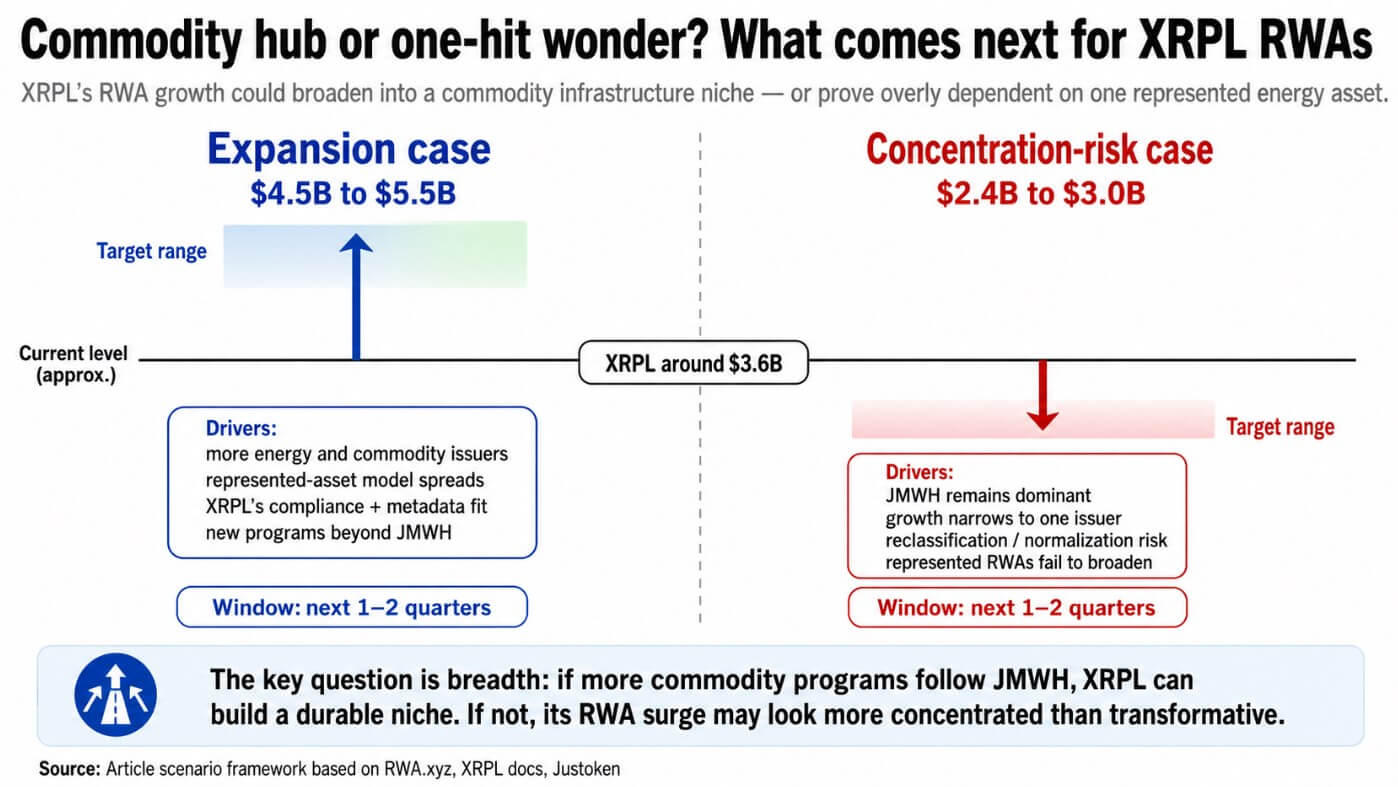
The evidence supports an infrastructure thesis for XRPL, and any XRP token demand beyond network fees and settlement mechanics stays indirect and hard to quantify.
Whether Justoken and YPF Luz expand Enertoken beyond its current phase, and whether comparable issuers in energy, agriculture, or other commodity sectors adopt XRPL’s represented-asset infrastructure, will determine XRPL’s positioning.
A pipeline of new programs across multiple commodity categories would confirm durable category specialization. A market dominated by JMWH alone would confirm concentration risk and leave the network’s RWA profile exposed to a single issuer’s roadmap.
The post Why XRP Ledger is becoming a $3.6B hot spot for tokenized energy commodities appeared first on CryptoSlate.












Leave a comment