
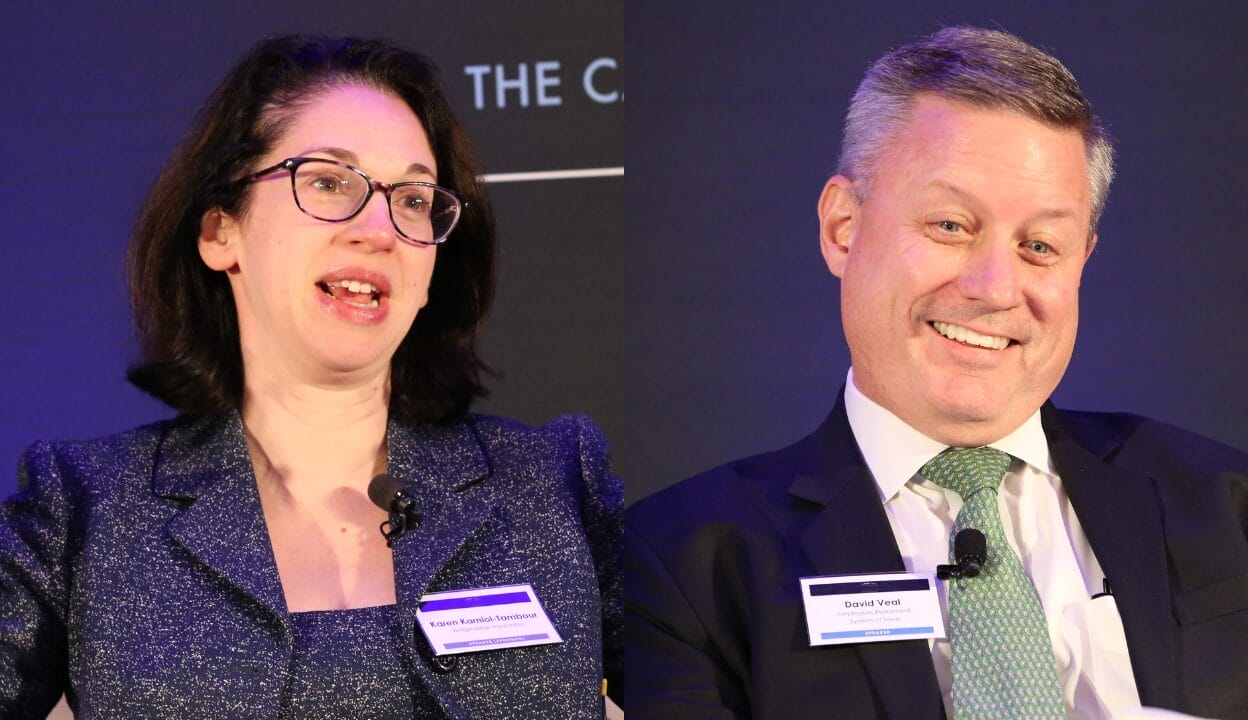
Two major forces are reshaping markets and economies at the same time, and most institutional portfolios are not built for either of them, the Top1000funds.com Fiduciary Investors Symposium at Harvard University has heard.
Karen Karniol-Tambour, co-chief investment officer of Bridgewater Associates, said the first force is a radical change in the geopolitical and macroeconomic paradigm – a shift away from a world organised around efficiency and towards one that Bridgewater has called “modern mercantilism”. The second force is the disruption wrought by AI.
“Every vulnerability you have as a country can and will be weaponised, and so you have to focus on dealing with those and focusing on resilience,” Karniol-Tambour said.
The technological shift was “a generational issue, because the science bet that was made is paying off”.
“It’s ushering in a world where this is starting to be adopted and change everything, so you have these two massive forces at work that are very quickly changing the environment that we’re in and are really going to define what the next decade or so will be like for asset owners,” she said.
The starting point for most asset owners is a portfolio shaped by forces of a different era. Fixed income in a typical institutional portfolio has fallen from a sizeable allocation in 2008 to about 15 per cent today, Karniol-Tambour said, with corresponding increases in equities both public and private, heavily concentrated in the US and specifically in the so-called Magnificent Seven.
“Everyone in [this] room, more or less, is holding a portfolio that was shaped by the world we came out of: very concentrated in the US, very concentrated in equities, very, very little fixed income,” she said. The question now is, how does that relate to the world we’re going into?” she said.
Asset owners should interrogate three aspects of what they hold: the geographic footprint of the portfolio; its strategic AI exposure; and its exposure to real assets. The US share of public equity market capitalisation is at historic highs, and is likely to rise further as SpaceX, OpenAI and Anthropic become listed. Stripping out the AI names, the rest of the US was declining in relative importance after more than a decade of rising.
The most diversifying geographic exposure most portfolios can add is Asia, Karniol-Tambour said. It is less correlated to the US than Europe, the UK or Australia across growth, inflation, monetary policy and markets, and looks like the best route outside the US into the AI ecosystem.
However, measuring AI exposure is becoming more difficult in private markets. Karniol-Tambour said most institutional portfolios hold even less AI than the market weight.
“Most private [equity] was invested [in AI] a while ago, and so if the median portfolio has maybe 40 per cent privates, that tends to be underinvested in AI,” she said.
“Valuations have changed a lot, and at this point, there’s a lot that’s priced in to happen over the next few years.”
Real assets at the nexus
Karniol-Tambour said it’s in the realm of real assets where the twin forces converge.
“Both are these massive pushes to go build things in the real world,” she said, whether defence, AI infrastructure or rare earths.
The assets that would actually benefit from the pressure these two forces put on the physical world add up to about a tenth of what’s held in financial assets, Karniol-Tambour said, “and so that tells me that overall exposures to real assets are low”.
“Overall, most portfolios just don’t have enough exposure to how much these two big forces are impacting the world.”
David Veal, CIO of the Employees Retirement System of Texas, said the “old world” portfolio Karniol-Tambour had described was “almost exactly our portfolio at the moment”.
But in addition to geographic footprint, strategic AI exposure and exposure to real assets, Veal said asset owners should also be asking themselves “do you have the right governance?”
He said ERS holds about a 16 per cent in real assets, comprising of 10 per cent in real estate and 6 per cent in infrastructure.
“Infrastructure has… done exactly what it’s supposed to do in inflationary times: given us 10 per cent-plus returns exactly when we needed them, and our bonds were not performing that way for us,” Veal said.
A 1 per cent allocation to gold, “which is kind of out of benchmark for us” has been added and required new governance rules.
“You don’t want to always own it [gold], but, but when you do, it’s a really nice thing to have in the portfolio, so ‘how do you govern that?’ I think is one of those key questions.”
Veal said the fund has also culled its equity managers roster. It had 28, mostly fundamental managers, when he arrived five years ago, and he has cut that to 10, with a meaningful allocation to an equal-weighted S&P strategy.
“If we do see mean reversion from the AI trade, the equal-weighted version of the index will do really, really well.”
The risk that a cheaper approach could disrupt the economics of the AI build-out, after the shudder DeepSeek sent through markets, was one Bridgewater had been weighing.
“The more you own a diversified basket, the less likely it is that you will get hurt by shifts in winners and losers within AI,” Karniol-Tambour said.
Each dollar of AI capex ran through a chain of suppliers, and “there is going to be an existential battle in every single one of those nodes”. So far demand had spared them.
“No one’s hurt Nvidia,” she said. “Anybody capable of producing chips that can play a role in AI has done well alongside them because demand is so high.”
Karniol-Tambour said the geopolitical tension that made China hard to hold was precisely what made it the best diversifiers available. China’s top-down system would take AI advances and “really get them into the economy well utilised” faster than the US.
“I don’t know if that makes them a winner, but it definitely makes them a serious contender, certainly ahead of any other country I could think of,” she said.
Veal said his fund could not invest in listed Chinese securities and had built its own ex-China exposure with a Boston firm, RhumbLine Advisers. The rising military might of China has spurred ERS to ponder a more level playing field.
“When you think about US Treasuries and US dollar, that’s always been backed by the most powerful military in the world,” Veal said. “If there’s a more level playing field going forward, what does that mean?”
Karniol-Tambour said she had been disappointed by Europe’s inability to work together. The next leg would come as China “continues to eat Europe’s lunch on more and more industries”, prompting the same turn towards protectionism and resilience the US had already taken.











Leave a comment