
The Structural Problem With Saving Money in a Fiat World
Every monetary system ever devised has embedded within it a set of assumptions about who bears the cost of economic management. In the system most people alive today were born into, that cost falls disproportionately on savers. Not through accident or negligence, but through deliberate design. Understanding this architecture is the starting point for understanding how gold protects against inflation, and why that protection operates at a level most conventional investment strategies never reach.
When big ASX news breaks, our subscribers know first
Why Fiat Currency Systems Are Built to Erode Purchasing Power
The 2% Inflation Target Is Not a Safety Net — It Is a Guaranteed Loss
Central banks in the United States, the European Union, the United Kingdom, and across most of the developed world have formally adopted a 2% annual inflation target as their primary price stability mandate. The framing is typically reassuring: low, stable inflation is presented as a sign of a well-managed economy.
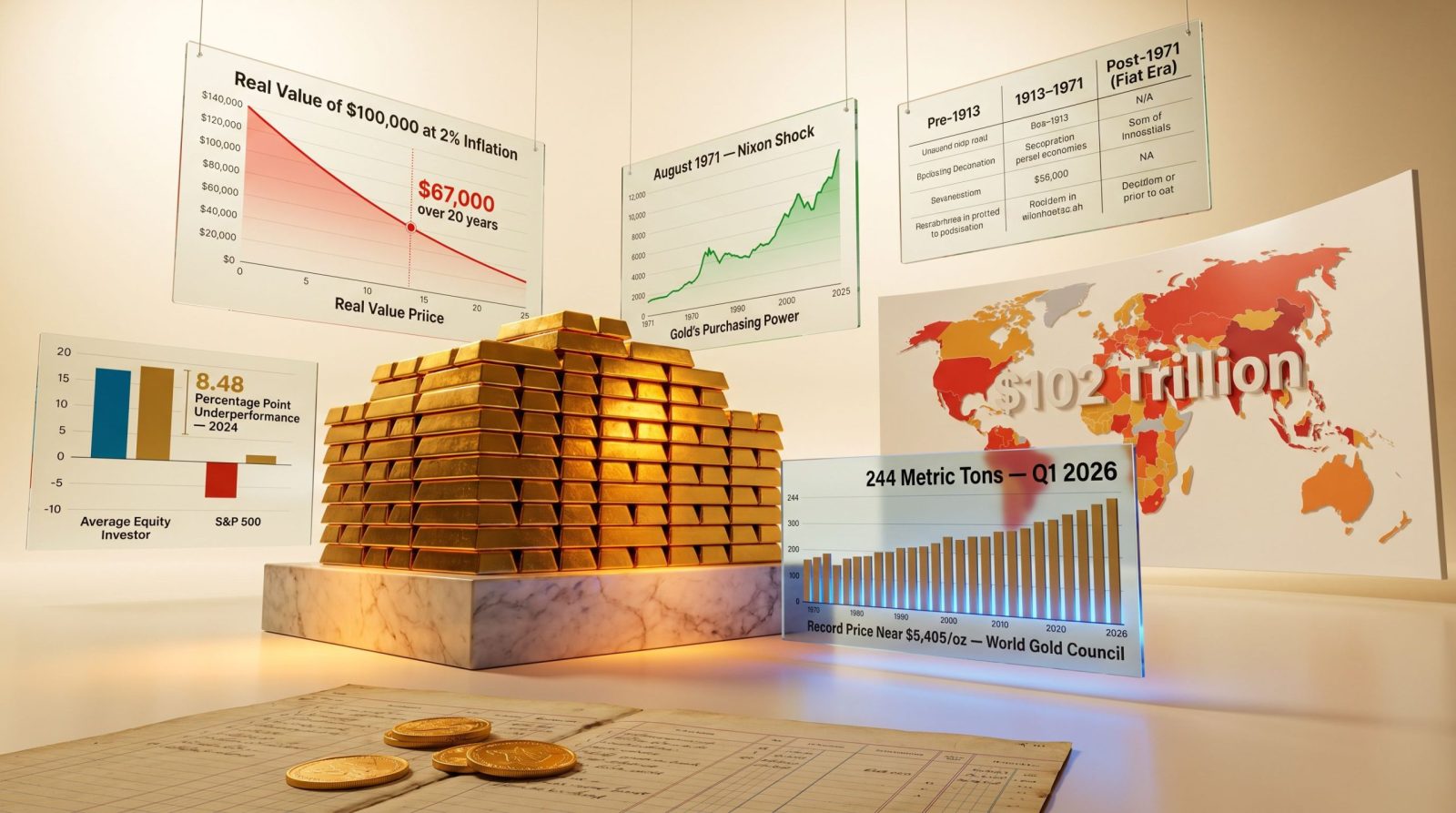
What that framing conceals is the compounding mathematics beneath it. At a sustained 2% annual inflation rate, the real purchasing power of $100,000 in savings declines to approximately $67,000 in real terms over 20 years, even if the nominal balance remains unchanged. No theft occurs. No crisis triggers the loss. The erosion is silent, automatic, and guaranteed by policy design.
This is the core distinction between nominal returns and real returns. A savings account yielding 1% annually while inflation runs at 2% is not generating wealth — it is losing it at a rate of 1% per year in real terms. Most personal finance frameworks focus almost entirely on nominal performance, which is why the structural erosion of purchasing power goes largely unacknowledged until it is too late to reverse. For a deeper look at gold as an inflation hedge, the case begins precisely here.
How Money Creation Differs From Commodity-Backed Systems
The mechanism behind this erosion is monetary dilution. In a fiat system, the supply of currency is not constrained by any physical commodity. Central banks can expand their balance sheets, and commercial banks can extend credit through fractional reserve lending, in ways that grow the money supply far faster than the underlying supply of goods and services. When more currency units chase the same quantity of real goods, each unit purchases less. That is inflation, expressed at its most fundamental level.
This dynamic did not always define monetary life. Research published by the Federal Reserve Bank of St. Louis documents that in the pre-1913 era, before the establishment of the Federal Reserve, U.S. price behaviour followed a fundamentally different pattern. Inflation spikes occurred during periods of war, but they were followed by prolonged deflationary periods that largely reversed those price increases. Across generations, prices trended downward, because commodity-backed money passed productivity gains directly through to consumers in the form of lower prices.
Key Insight: The shift from commodity-backed to fiat monetary systems did not merely change the level of prices. It changed the direction of long-run price trends permanently. Savers who once benefited passively from falling prices must now actively speculate simply to break even in real terms.
What History Reveals About Gold and Purchasing Power
August 1971: The Monetary Event That Changed Everything
On 15 August 1971, President Richard Nixon suspended the U.S. dollar’s convertibility into gold, effectively ending the Bretton Woods international monetary system. The decision was presented as temporary. It became permanent. The consequences of the 1971 Nixon Shock reverberate through every aspect of modern monetary life.
The macroeconomic consequences were immediate and lasting. Before 1971, inflationary episodes were followed by mean reversion — prices rose during stress and fell during recovery. After 1971, that correction mechanism disappeared. Prices stopped reverting. They simply continued upward, with the pace of increase becoming the only variable.
Measuring Goods in Gold: A Perspective Most Investors Never Apply
One of the most analytically powerful, yet rarely used, frameworks for understanding gold’s inflation-hedging function is to invert the conventional measurement lens. Instead of asking how many dollars an ounce of gold costs, ask how many ounces of gold a given real good costs over time.
When essential goods — including energy, housing, and food — are priced in gold rather than in fiat currency, a consistent pattern emerges across multi-decade timeframes: real goods become cheaper in gold terms, not more expensive. The nominal price of oil or housing measured in dollars has risen dramatically since 1971. Measured in gold, however, those same goods have remained broadly stable or declined in real cost.
This is the operational definition of purchasing power preservation: gold does not generate returns in the conventional sense. It maintains the real-world exchangeability of stored wealth across time, regardless of what any government or central bank decides to do with its currency.
Pre-Fed vs. Post-1971 Era: A Structural Comparison
| Era | Price Trend | Monetary Anchor | Saver Outcome |
|---|---|---|---|
| Pre-1913 (Pre-Fed) | Deflationary trend (long-run) | Commodity-backed (gold standard) | Purchasing power grew passively |
| 1913 to 1971 | Moderate inflation with partial gold link | Bretton Woods gold-exchange standard | Mixed; dollar partially constrained |
| Post-1971 (Fiat era) | Persistent inflation; no deflationary reversals | Pure fiat; no commodity anchor | Savings erode without active investment |
How Gold Actually Protects Against Inflation: The Three Core Mechanisms
Featured Insight: Gold protects against inflation through three primary mechanisms: supply scarcity that resists monetary dilution, sustained institutional demand during currency debasement episodes, and long-term purchasing power preservation that fiat currencies structurally cannot replicate.
1. Supply Scarcity and Dilution Resistance
Annual gold mining output adds approximately 1 to 2% to total above-ground supply, a rate that has remained broadly stable for decades and cannot be accelerated through policy decisions. Unlike fiat currency, where the money supply can be expanded in response to fiscal pressure or political necessity, the global gold supply is governed by geology, not governance.
This supply inelasticity is the foundational reason gold resists monetary dilution. When a government needs to fund expenditure, it can instruct its central bank to expand the money supply. When investors need more gold, they must wait for miners to extract it from the earth at a pace that geology, ore grade, and extraction economics determine.
It is worth noting that gold ore grades have been declining globally over several decades, meaning the average gold content per tonne of rock processed is lower today than it was in the mid-20th century. Many major deposits now operate at grades below 1 gram per tonne. This geological reality reinforces supply inelasticity: producing additional gold is becoming progressively more capital-intensive and technically demanding, which acts as a further structural brake on supply expansion.
2. Institutional Demand During Currency Stress
The second mechanism through which gold functions as an inflation hedge is demand dynamics. During periods of elevated inflation, currency debasement, or geopolitical stress, institutional and sovereign demand for gold systematically accelerates. Furthermore, the scale of central bank gold reserves in 2025 underscores just how seriously sovereign institutions treat this dynamic.
According to World Gold Council data, central banks purchased a net 244 metric tons of gold in Q1 2026, representing the fastest pace of accumulation in over a year, even as prices reached record levels near $5,405 per ounce. The significance of this data point is not the volume alone. It is the price at which that volume was purchased. Institutions with deep sovereign risk visibility were buying gold at all-time nominal highs, explicitly prioritising monetary insurance over entry price optimisation.
When the entities responsible for managing fiat monetary systems are simultaneously accumulating gold at scale and at record prices, the analytical signal embedded in that behaviour carries considerable weight.
3. Long-Term Purchasing Power Preservation vs. Short-Term Volatility
Gold’s inflation protection operates most reliably across extended holding periods of ten years or more. Within shorter windows, particularly during moderate inflation environments accompanied by rising real interest rates, gold can underperform yield-bearing alternatives such as Treasury Inflation-Protected Securities or broad equity indices.
This distinction between speculative gold trading and structural gold allocation is critical. Investors who treat gold as a short-term tactical trade are using the instrument in a way that is inconsistent with its fundamental properties. Those who hold gold as a structural component of a long-term purchasing power preservation strategy are using it precisely as its monetary architecture suggests.
The Behavioral Economics of Inflation: Why Most Investors Fail
The Performance Gap Is Behavioral, Not Asset-Based
The fiat system’s structural pressure on savers does not only manifest in mathematical purchasing power loss. It generates a behavioural environment that systematically degrades investment decision quality. Savers who understand they are losing real value by holding cash are compelled to speculate, and speculative activity under chronic financial anxiety produces predictable errors.
DALBAR’s 2024 Quantitative Analysis of Investor Behavior, a longitudinal study tracking U.S. investor returns since 1994, documents the scale of this problem in precise terms. In 2023, the average equity fund investor earned 20.79%, compared to the S&P 500’s return of 26.29% — a gap of 5.5 percentage points. In 2024, that underperformance gap widened to 8.48 percentage points, the second-largest recorded in a decade.
Critical Finding: The DALBAR research consistently identifies behavioural causes, not asset selection, as the primary driver of this underperformance. Panic selling during volatility, narrative-chasing, and mistimed reallocation decisions explain the gap. These are the behavioural fingerprints of inflation anxiety operating within a fiat monetary framework.
The Speculation Burden the Fiat System Imposes
There is a less-discussed dimension to this behavioural dynamic. A monetary system that guarantees ongoing purchasing power erosion for cash holders effectively forces ordinary savers into constant speculative activity. The act of doing nothing carries a guaranteed real cost. So investors are compelled to act, and it is precisely that compulsion to act — particularly under stress conditions — that drives the behavioural errors DALBAR’s data captures.
Gold allocation reduces this speculative burden because its core function does not require ongoing monitoring, anticipation of Fed decisions, or evaluation of corporate earnings cycles. It holds value through what it is, not through what any external institution decides. For investors whose behavioural risk profile makes reactive decision-making a documented pattern, this reduction in cognitive load has real financial value beyond any nominal return consideration.
Gold vs. Other Inflation Hedges: A Comparative Framework
| Asset Class | Inflation Hedge Mechanism | Key Limitation | Best Environment |
|---|---|---|---|
| Gold | Supply scarcity; currency debasement hedge | Underperforms in moderate inflation + high real rates | Extreme inflation; currency stress; long-term holds |
| TIPS | CPI-linked principal adjustment | Government credit dependency; underperforms in deflation | Moderate, predictable inflation |
| Real Estate | Hard asset; rental income pass-through | Illiquid; leverage risk; local market dependency | Sustained moderate-to-high inflation |
| Broad Equities | Nominal earnings can grow with prices | High behavioural risk; underperforms in stagflation | Low-to-moderate inflation with growth |
| Commodities | Direct input price exposure | High volatility; no yield; cyclical | Supply-shock inflation episodes |
| Cash | None — erodes structurally at the inflation rate | Guaranteed real loss at 2%+ inflation | Deflation environments only |
Why Gold Occupies a Unique Position
Unlike every yield-bearing inflation hedge, gold carries no counterparty risk. TIPS depend on the creditworthiness of the issuing government. Real estate involves lease structures, local market dynamics, and financing risk. Equities depend on corporate management, competitive positioning, and economic growth. Gold depends on none of these. Its value proposition exists entirely outside the network of counterparty relationships that the fiat financial system is built upon.
Consequently, gold in the monetary system occupies a structurally distinct position — one that gold in the monetary system analysis confirms sits apart from every other conventional asset class. Global public debt reached approximately $102 trillion as of 2024, according to data referenced across sovereign debt monitoring frameworks. At that scale, the political and economic incentives to allow genuine deflation are effectively zero, which further reinforces the macroeconomic rationale for gold as a long-duration purchasing power preservation instrument.
The next major ASX story will hit our subscribers first
A Practical Framework for Gold Allocation as an Inflation Strategy
Physical Gold vs. Paper Gold: A Distinction That Matters
Not all gold exposure is equivalent from an inflation-hedging perspective. The form of gold ownership matters for the depth of protection it actually provides. In fact, the decision between physical gold vs ETFs is one of the most consequential choices an investor can make when structuring a genuine inflation defence.
- Physical gold bullion (bars and coins) provides direct ownership with no counterparty risk, making it the purest expression of the monetary preservation rationale
- Gold ETFs and paper gold products offer price exposure and liquidity but reintroduce custody and counterparty dependencies that partially undermine the core inflation-hedging logic
- Gold IRAs within tax-advantaged retirement structures allow long-term purchasing power preservation within existing retirement planning frameworks
- Allocated versus unallocated gold accounts represent a meaningful distinction in the institutional gold market: allocated accounts hold specific, identified bars in your name, while unallocated accounts represent a claim on a pool of gold that the institution technically owns
Financial research broadly suggests a 5 to 15% portfolio allocation to gold as a meaningful inflation hedge, providing structural protection without eliminating diversification across yield-generating assets.
Step-by-Step: Evaluating Whether Gold Belongs in Your Inflation Strategy
- Assess your real cash exposure — what proportion of your net worth sits in fiat currency instruments that guarantee real loss at current inflation rates?
- Clarify your holding horizon — gold’s inflation protection is most robust across ten-plus year periods; shorter timeframes introduce price timing risk that can obscure the structural benefit
- Evaluate your behavioural risk profile — if market volatility consistently triggers reactive portfolio decisions, gold’s lower behavioural complexity relative to equities may reduce real-world performance gap risk
- Determine your counterparty tolerance — physical gold eliminates counterparty risk entirely; ETFs and paper gold products partially reintroduce it
- Size the allocation appropriately — a 5 to 15% weighting provides meaningful inflation protection without eliminating the diversification benefits of yield-generating asset classes
- Monitor the monetary environment — real interest rate levels, central bank policy direction, and sovereign debt trajectories should inform the weighting of gold within a broader inflation protection strategy over time
Frequently Asked Questions: How Gold Protects Against Inflation
Does gold always go up when inflation rises?
Gold does not produce guaranteed short-term gains during every inflationary episode. Its protection is most consistent over extended holding periods and is strongest during unexpected or extreme inflation and currency debasement events. During moderate inflation periods accompanied by rising real interest rates, gold can underperform yield-bearing instruments such as TIPS. Research from Goldman Sachs on commodity hedges reinforces this nuanced view.
Why do central banks buy gold if it pays no yield?
Central banks accumulate gold because it carries no counterparty risk, no default risk, and no dependency on any other sovereign’s fiscal management. In an environment where global public debt exceeds $102 trillion, gold represents a monetary reserve that no other nation’s policy decisions can dilute. Net purchases of 244 metric tons in Q1 2026 at record prices near $5,405 per ounce reflect this institutional logic in action.
Is physical gold better than a gold ETF for inflation protection?
Physical gold provides direct ownership with no counterparty risk and most fully captures gold’s core function as a monetary preservation instrument. Gold ETFs offer liquidity and price exposure but reintroduce custody and counterparty dependencies. For investors prioritising gold’s structural inflation-hedging properties over short-term trading flexibility, physical ownership is the more complete expression of the rationale.
What did pre-Fed price history actually look like?
Research from the Federal Reserve Bank of St. Louis documents that the pre-1913 era was characterised by inflation spikes during wartime followed by prolonged deflationary periods that largely reversed those price increases. Across generations, prices trended downward — a direct consequence of commodity-backed money and rising productivity passing efficiency gains through to consumers. That pattern ended permanently when the dollar-gold link was severed in 1971.
How much gold should I hold to hedge inflation?
Financial research commonly suggests a 5 to 15% portfolio allocation to gold as a meaningful inflation hedge. The appropriate level depends on individual holding horizon, behavioural risk profile, existing fiat currency exposure, and the broader macroeconomic environment. Allocation should be reviewed periodically against real interest rate conditions and central bank policy direction.
This article is for informational and educational purposes only and does not constitute financial or investment advice. All investments, including precious metals, carry risk and may result in partial or total loss of capital. Past performance is not indicative of future results. Readers should consult a qualified financial adviser before making any investment decisions.
Want to Stay Ahead of the Next Major ASX Mineral Discovery?
While gold remains a cornerstone of long-term purchasing power preservation, Discovery Alert’s proprietary Discovery IQ model scans ASX announcements in real time — instantly identifying significant mineral discoveries across gold and 30+ other commodities before the broader market reacts. Explore historic discovery returns on Discovery Alert’s dedicated discoveries page and begin your 14-day free trial to position yourself at the forefront of the next major find.













Leave a comment