
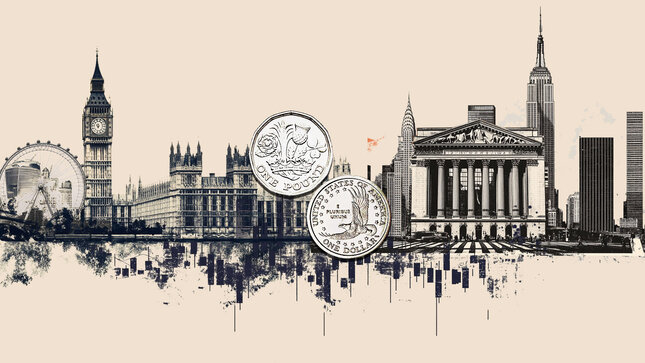
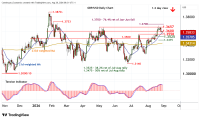
The GBP/USD pair climbs back to the 1.3235 region during the Asian session and fails the weekly bearish gap opening amid a modest US Dollar (USD) downtick, though the upside potential seems limited.
Mediators Qatar and Pakistan announced a formal 60-day roadmap aimed at securing a final US-Iran peace deal, which, in turn, keeps a lid on the safe-haven buck and prompts some intraday short-covering around the GBP/USD pair. However, geopolitical developments over the weekend, along with the US Federal Reserve’s (Fed) hawkish tilt, could act as a tailwind for the Greenback.
Iran closed the Strait of Hormuz again on Saturday in response to the renewed hostilities by Israel in Lebanon. Moreover, Iranian negotiators walked out of the peace talks in Switzerland in response to US President Donald Trump’s threat to strike Iran again. This keeps geopolitical risk premiums in play, which favors the USD bulls and backs the case for the emergence of fresh selling around the GBP/USD pair.
Meanwhile, reports suggest that UK Prime Minister Keir Starmer could announce his resignation as early as Monday, paving the way for the former Manchester Mayor Andy Burnham to replace him. The UK political turbulence, in turn, might continue to undermine the British Pound (GBP) and contribute to keeping a lid on the GBP/USD pair, warranting caution before placing aggressive bullish bets.
Moreover, reduced bets for interest rate hikes by the Bank of England (BoE) suggest that any subsequent move up could be seen as a selling opportunity. Hence, strong follow-through buying is needed to confirm that the GBP/USD pair has bottomed out in the near-term and before positioning for any meaningful recovery from the lowest level since late March, touched on Friday.
Pound Sterling FAQs
The Pound Sterling (GBP) is the oldest currency in the world (886 AD) and the official currency of the United Kingdom. It is the fourth most traded unit for foreign exchange (FX) in the world, accounting for 12% of all transactions, averaging $630 billion a day, according to 2022 data.
Its key trading pairs are GBP/USD, also known as ‘Cable’, which accounts for 11% of FX, GBP/JPY, or the ‘Dragon’ as it is known by traders (3%), and EUR/GBP (2%). The Pound Sterling is issued by the Bank of England (BoE).
The single most important factor influencing the value of the Pound Sterling is monetary policy decided by the Bank of England. The BoE bases its decisions on whether it has achieved its primary goal of “price stability” – a steady inflation rate of around 2%. Its primary tool for achieving this is the adjustment of interest rates.
When inflation is too high, the BoE will try to rein it in by raising interest rates, making it more expensive for people and businesses to access credit. This is generally positive for GBP, as higher interest rates make the UK a more attractive place for global investors to park their money.
When inflation falls too low it is a sign economic growth is slowing. In this scenario, the BoE will consider lowering interest rates to cheapen credit so businesses will borrow more to invest in growth-generating projects.
Data releases gauge the health of the economy and can impact the value of the Pound Sterling. Indicators such as GDP, Manufacturing and Services PMIs, and employment can all influence the direction of the GBP.
A strong economy is good for Sterling. Not only does it attract more foreign investment but it may encourage the BoE to put up interest rates, which will directly strengthen GBP. Otherwise, if economic data is weak, the Pound Sterling is likely to fall.
Another significant data release for the Pound Sterling is the Trade Balance. This indicator measures the difference between what a country earns from its exports and what it spends on imports over a given period.
If a country produces highly sought-after exports, its currency will benefit purely from the extra demand created from foreign buyers seeking to purchase these goods. Therefore, a positive net Trade Balance strengthens a currency and vice versa for a negative balance.









Leave a comment