

This article adheres to strict editorial standards. Some or all links may be monetized.
JPMorgan Chase CEO Jamie Dimon isn’t taking comfort in the stock market’s seemingly endless euphoria that defied a war in the Middle East and the ensuing spike in inflation. Instead, he believes there’s trouble brewing for the U.S. economy.
During a June 16 appearance at the Council on Foreign Relations CEO Speaker Series (1), Dimon was blunt in forecasting an eventual stock market contraction. For him, the only question left to answer is when.
Top Picks
-
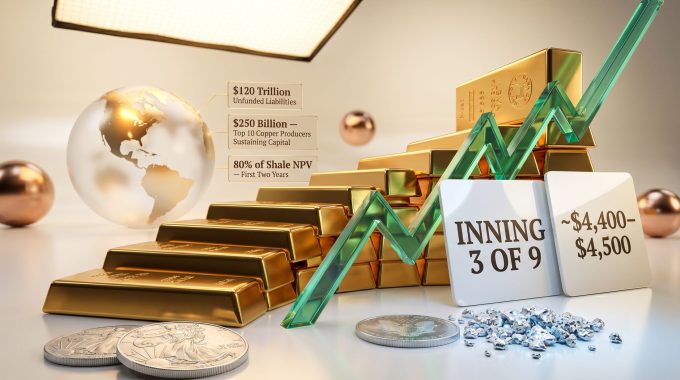
JP Morgan sees gold hitting $6,000/oz before 2027 — and a Gold IRA lets you hold the physical metal while deferring the tax bill. Get your free guide from Goldco
“We’re in a bull market. It’s like a little tsunami,” he said. “When that kind of thing happens, it’s very hard to stop. But it will stop.”
What caught Dimon off guard about the economy
Starting off, Dimon argued that a set of economic developments has insulated the U.S. economy from amplified turmoil so far this year.
He listed a low 4% unemployment rate, a capital spending boom among hyperscalers to build out data centers to fuel the AI boom and a fresh wave of deregulation from the Trump administration that contributed to growing balance sheets among giant Wall Street banks. He also pointed out that the U.S. economy grew by about 2% in early 2026.
Still, Dimon said he’s been caught off guard by Wall Street’s complacency with global volatility, especially given the pervasive geopolitical tensions with Iran, Russia and China that may not be resolved anytime soon. The U.S. war with Iran, in particular, led to the closure of the critical Strait of Hormuz commercial waterway, blocking the transit of oil, fertilizers and other energy products, causing a surge in commodity prices.
For nearly four months, financial markets mostly brushed it aside. In fact, the Nasdaq and S&P 500 have risen by approximately 20% and 14%, respectively, in the second quarter of 2026, putting them on track for their largest quarterly gain since 2020 (2).
“I am surprised … that stuff is really important for the free world, but it’s not necessarily the economy today,” Dimon said.
“I do think the probability of something bad happening is higher than I think it’s probably embedded in the market,” he also said, adding he believed investors were minimizing the odds of inflation that sticks around longer than they anticipate.
Dimon’s recent economic anxiety
Dimon has been piping up about his economic worries in recent months, and it’s not unusual for Dimon to share cautious or pessimistic assessments on the state of the economy.
Earlier this year, he cited parallels between the current environment in 2026 and the era before the 2008 financial crisis (3). He’s concerned a stretch of excitement among Wall Street investors is inflating stock valuations, and he expects the present credit cycle will come to an end, although he’s not sure when.
Much of that enthusiasm from investors stems from over $700 billion in AI-related spending from the largest tech companies, with scarce signs of reaching a ceiling (4). But Dimon still isn’t convinced.
“There will be a cycle one day,” he said in February (5). “I don’t know what confluence of events will cause that cycle. My anxiety is high over it. I’m not assuaged by the fact that asset prices are high. In fact, I think that adds to the risk.”
Hedge your portfolio
For now, the U.S. economy is continuing to defy recession predictions from analysts and Wall Street titans. The euphoria among Wall Street investors, though, isn’t reaching Main Street, with Americans grappling with more than a year of wage gains erased by the spike in gas prices (6).
Investors also have another concern to watch — stretched valuations, particularly among technology stocks. Semiconductor costs have surged, raising concerns that higher expenses could eat into the profits of some of the world’s largest companies, who pass those costs onto consumers (7). For example, Apple recently increased prices on many products due to higher component expenses, sending its stock toward its worst single-day performance in more than a year (8).
While the S&P 500 has recovered from its recent pullback, the larger economic risks haven’t disappeared. With inflation reaching 4.2% in May (9) — the highest level in three years — the Federal Reserve has kept rates steady while leaving the door open to future increases (10).
That uncertainty is exactly why diversification matters.
Diversify with a safe haven asset
One way investors have historically protected themselves during uncertain periods is by turning to assets that don’t always move in the same direction as stocks.
Gold has long been viewed as a safe haven asset because it tends to hold its value when markets become shaky. Unlike equities, gold’s performance isn’t tied to one single company, economy or currency.
Even some longtime skeptics like Dimon have acknowledged its role during turbulent times.
“I’m not a gold buyer — it costs 4% to own it,” Dimon said at Fortune’s Most Powerful Women conference in October 2025, adding, “It could easily go to $5,000, $10,000 in environments like this. This is one of the few times in my life it’s semi-rational to have some in your portfolio (11).”
If you’re looking for ways to make the most of this inflation-hedging asset, you might want to consider opening a gold IRA with the help of Goldco, which allows you to invest in gold and other precious metals in physical forms while also providing the significant tax advantages of an IRA.
With a minimum purchase of $10,000, Goldco offers free shipping and access to a library of retirement resources. Plus, the company will match up to 10% of qualified purchases in free silver.
If you’re curious whether this is the right investment to diversify your portfolio, you can download your free gold and silver information guide today.
Add real estate to the mix
For those worried about the next market pullback, real estate can offer another way to diversify beyond traditional stocks and bonds.
Unlike equities — which can move sharply based on investor sentiment, earnings forecasts or economic headlines — real estate prices tend to be tied to longer-term forces like housing demand, population trends and the limited supply of land. Real estate can also provide some protection against inflation. As the cost of living rises, rents often increase alongside it, while the cost of building new homes tends to climb as well.
Still, traditional real estate investing comes with barriers. Buying a rental property requires significant capital up-front, and the ongoing responsibilities — from finding tenants to covering repairs — can quickly turn it into a second job.
For those who want the benefits of real estate exposure without becoming a full-time landlord, platforms like mogul might be worth a look.
Founded by former Goldman Sachs real estate investors, mogul handpicks the top 1% of single-family rental homes nationwide for you. This way, you can invest in institutional-quality offerings for a fraction of the usual cost — while receiving monthly rental income, real-time appreciation and tax benefits.
The team at mogul carefully vets each property, requiring a minimum 12% return even in downside scenarios. Across the board, the platform features an average yearly return of 18.8%. Their cash-on-cash yields, meanwhile, average between 10% to 12% annually. With investments typically ranging between $15,000 and $40,000 per property, offerings often sell out in under three hours.
Getting started is a quick and easy process. You can sign up for an account and then[ browse available properties](https://moneywise.com/c/1/467/2055?placement=6). Once you verify your information with their team, you can invest like a mogul in just a few clicks.
Add multifamily and industrial real estate to the mix
For those with more capital on hand, there are other options.
Institutional investors have long looked to private-market real estate as a way to help stabilize their portfolios. The asset class offers a mix of potential tax benefits, regular cash flow, a hedge against inflation and returns that are less correlated with public equities.
Accredited investors can now tap into this opportunity through platforms such as Lightstone DIRECT, which gives accredited investors access to single-asset multifamily and industrial deals.
Lightstone DIRECT’s direct-to-investor model ensures a high degree of alignment between individual investors and a vertically-integrated, institutional owner-operator — a sophisticated and streamlined option for individual investors looking to diversify into private-market real estate.
With Lightstone DIRECT, accredited individuals can access the same multifamily and industrial assets Lightstone pursues with its own capital, with minimum investments starting at $100,000.
A finer asset billionaires love
When the stock market is climbing, it’s easy to assume the good times will continue. But with valuations stretched and the Shiller P/E ratio soaring past 40x — you might want to consider whether your portfolio can withstand a market pullback.
That’s why most ultrawealthy investors don’t rely solely on stocks to preserve their fortunes. While billionaires like Jeff Bezos and Bill Gates have significant exposure to equities, they also hold assets that may not rise and fall with the broader market.
Fine art is one example. Post-war and contemporary art has outpaced the S&P 500 by 15% from 1995 to 2025, while showing a near-zero correlation with traditional equities.
Until recently, this world was off-limits to most everyday investors. Now, with Masterworks, you can buy fractional shares in multimillion-dollar works by icons like Banksy, Picasso and Basquiat. While art can be illiquid and typically requires a long-term hold, it offers unique portfolio diversification.
Masterworks has sold 27 artworks so far, yielding net annualized returns like 14.6%, 17.6% and 17.8%.*
Moneywise readers can get priority access to diversify with art: Skip the waitlist here.
*Past performance is not indicative of future returns. Investing involves risk. See important Regulation A disclosures at Masterworks.com/cd
— With files from Joseph Zeballos-Roig
You May Also Like
Join 250,000+ readers and get Moneywise’s best stories and exclusive interviews first — clear insights curated and delivered weekly. Subscribe now.
Article sources
We rely only on vetted sources and credible third-party reporting. For details, see oureditorial ethics and guidelines.
@cfr (1); CNBC (2),(5),(8),(9),(10); Bloomberg (3),(4),(11); The Wall Street Journal (6); CBS (7)
This article provides information only and should not be construed as advice. It is provided without warranty of any kind.











Leave a comment