
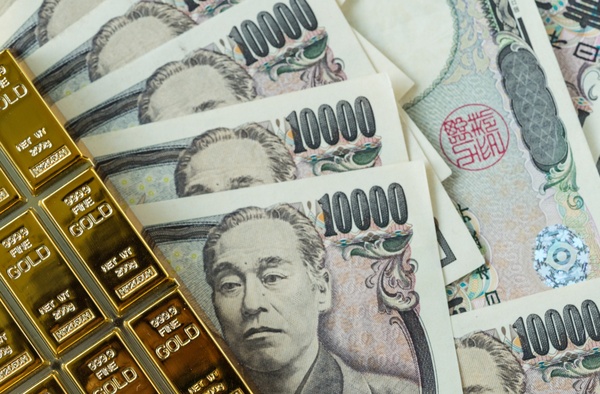
Picture two Japanese savers 10 years ago. Both had money set aside. One left it in yen, while the other bought gold and forgot about it.
Ten years later, the gold holdings are up 375%.
The precious metal didn’t do anything remarkable. Over the same decade, gold in U.S. dollars rose 205%. Same metal, same time period. The extra 170 percentage points the Japanese saver picked up came from one place, and it wasn’t the gold. It came from the yen falling apart underneath everyone who held it.
That’s the whole lesson, and last week, the world got a look at what happens when a government finally decides it can’t watch anymore.
Government Intervention to the Rescue
On Friday, July 31, the U.S. joined Japan in buying yen on the open market, something that hasn’t happened since 1998. Washington and Tokyo have coordinated in currency markets more recently, in 2011, but that was to push the yen down after the East Japan earthquake. This time, they’re trying to hold it up.

The yen had fallen to a 40-year low, hitting 163.86 to the dollar on July 23. The previous day, Japan moved first, sending the yen up 2.4% in a single session. The U.S. stepped in the next day, and the yen gained another 1.2%. Estimates put the cost of Friday alone somehwere between $53 billion and $90 billion.
Why Did Washington Care?
So why did the Trump administration bother to intervene in another country’s monetary concerns?
Well, for one, Japan is the largest foreign holder of U.S. Treasury debt on the planet. When a country has to defend its currency, it usually pays for it by selling reserves, and Japan’s reserves are largely our government bonds. A serious defense of the yen, we realized, could include dumping billions of U.S. debt into the market.
In the chart below, you can see what’s already happened. Japanese holdings stood at $1.24 trillion back in February, according to Treasury Department data. By May, they were down to $1.14 trillion, essentially back to where they were a full year earlier. That includes a $67 billion drop between April and May. An entire year of accumulation, gone.

Now consider the market they’d be selling into. The 10-year Treasury yield is among its highest levels since early 2025, while the 30-year is near its highest in 19 years. Add Japanese insurers, pension funds and banks liquidating into that, and you have a problem that doesn’t stay in Tokyo.
Now look at how the rescue was built. When the New York Fed went in, it reportedly sold euros to buy yen, not U.S. dollars. This puzzled a lot of people. Why didn’t the U.S. just use its own currency? At the same time, the Fed pointed Japanese authorities to a facility that lets a foreign central bank borrow dollars against its Treasury holdings rather than sell them.
Put simply, this operation was engineered so Japan wouldn’t have to sell U.S. debt. The administration looked at the prospect of its largest foreign creditor liquidating and decided a first-in-a-generation intervention was worth the political risk.
Japan Has Tried This Before
The thing is, the plan may not work.
Go back and look at the first chart. On April 30 of this year, Japan tried this alone. The yen jumped 2.14% in a session, an even bigger one-day move than July 30. Just 20 trading sessions later, the whole thing was right back where it started.
The research shop at MUFG, Japan’s largest bank, makes the same point using history. Even the successful 1998 operation took another two months and “shifts in the underlying dynamics of the Asian Financial Crisis” before the downward trend broke. Intervention treats the symptom, not the cause.
Today, the “underlying dynamics” are challenging. Japan shut most of its nuclear capacity after Fukushima and never fully reversed course, so energy runs close to a quarter of its import bill. The country is the world’s second-largest importer of liquified natural gas (LNG) after China. With oil elevated due to the U.S.-Iran conflict, Tokyo just cut its growth forecast for the year ending March 2027 from 1.3% to 0.9%, while the Bank of Japan expects inflation clearly above its 2% target.
Torsten Slok at Apollo argues the yen no longer trades on interest rates at all. For decades it did. Investors borrowed cheaply in yen, bought higher-yielding assets elsewhere and pocketed the spread. That trade finally broke down in April 2025 after the Liberation Day tariffs.

What Protected Portfolios
Let’s go back to the two Japanese savers.
Gold didn’t magically become more valuable to Japanese households. The yen became less valuable, and the yellow metal simply held its ground. You can see the same effect in this year alone. Gold’s monthly average price is down 5% in dollars in 2026 but only around 1% in yen.

It’s too bad that relatively few Japanese investors participate in gold. A 2025 World Gold Council (WGC) survey found that only 23% to 28% of Japanese investors own any gold at all, while nearly three-quarters own stock. In a country running above-target inflation, importing all its energy and watching its government spend tens of billions propping up the currency, most households owned none of the one thing that would have shielded them.
Those who did held between 1% and 10% of their portfolios, which is close to where I’ve always said investors should be.
Interested in opportunities in gold investing? Send an email to [email protected] with the subject line GOLD.
All opinions expressed and data provided are subject to change without notice. Some of these opinions may not be appropriate to every investor. By clicking the link(s) above, you will be directed to a third-party website(s). U.S. Global Investors does not endorse all information supplied by this/these website(s) and is not responsible for its/their content.












Leave a comment