

The British Pound (GBP) claws back its early losses against the US Dollar (USD) and flattens at around 1.3495 during the European trading session on Thursday. The GBP/USD pair bounces back as the US Dollar (USD) comes under pressure with investors prioritizing easing fears of the Federal Reserve’s (Fed) interest rate hikes in the near term over ongoing Middle East tensions.
At press time, the US Dollar Index (DXY), which gauges the Greenback’s value against six major currencies, trades 0.1% lower to near 99.90.
Traders have trimmed Fed interest rate hike bets due to easing United States (US) upside inflation risks and growing downside labor market risks.
According to the CME FedWatch tool, the odds of the Fed holding policy rates steady in the September meeting have increased to almost 60% from 30.4% seen a month ago.
US inflation data seen as broadly in line, giving the Fed room to stay on hold
Analysts at Commerzbank note that “July US CPI came in broadly in line with expectations,” with the report indicating that “underlying inflation remains above the Fed’s target but showed no broad-based re-acceleration, giving policymakers more room to remain on hold.” Echoing that assessment, the Danske Bank research team highlights that “in the US, July CPI was broadly in line with expectations, with headline inflation at 3.4% y/y and core inflation at 2.5% y/y.” They add that “the monthly details were also close to expectations, as headline inflation increased 0.1% m/m and core inflation increased 0.2% m/m,” reinforcing the view that inflation is moving closer to target-consistent levels without signs of renewed upward momentum.
Going forward, investors will focus on the US Producer Price Index (PPI) data for July, which will be published at 12:30 GMT. The headline and the core PPI growth are expected to have cooled down to 4.9% and 4.2% Year-on-Year (YoY), respectively.
Meanwhile, the recovery move in GBP/USD seems to be supported by the British currency too. The United Kingdom (UK) currency attracted bids after the release of the Q2 Gross Domestic Product (GDP) data during the day.
UK growth beats expectations but fails to shift BoE outlook
According to TD Securities, “UK GDP surprised to the upside in June, coming in at 0.3% m/m (TDS: 0.0%; mkt: -0.1%; prior: 0.0%), and driven by strength in the services sector of 0.4% m/m (TDS/mkt: 0.0%; prior: 0.1%).” The bank notes that services growth was “broad-based, with only wholesale trade showing any real contraction.” Despite the stronger monthly print, TD points out that “ultimately though, on a quarterly basis, UK economy grew in line with market expectations of 0.4% q/q, which is just above the BoE projections of 0.3% q/q,” suggesting the upside surprise does little to alter the broader policy narrative.
GBP/USD Technical Analysis
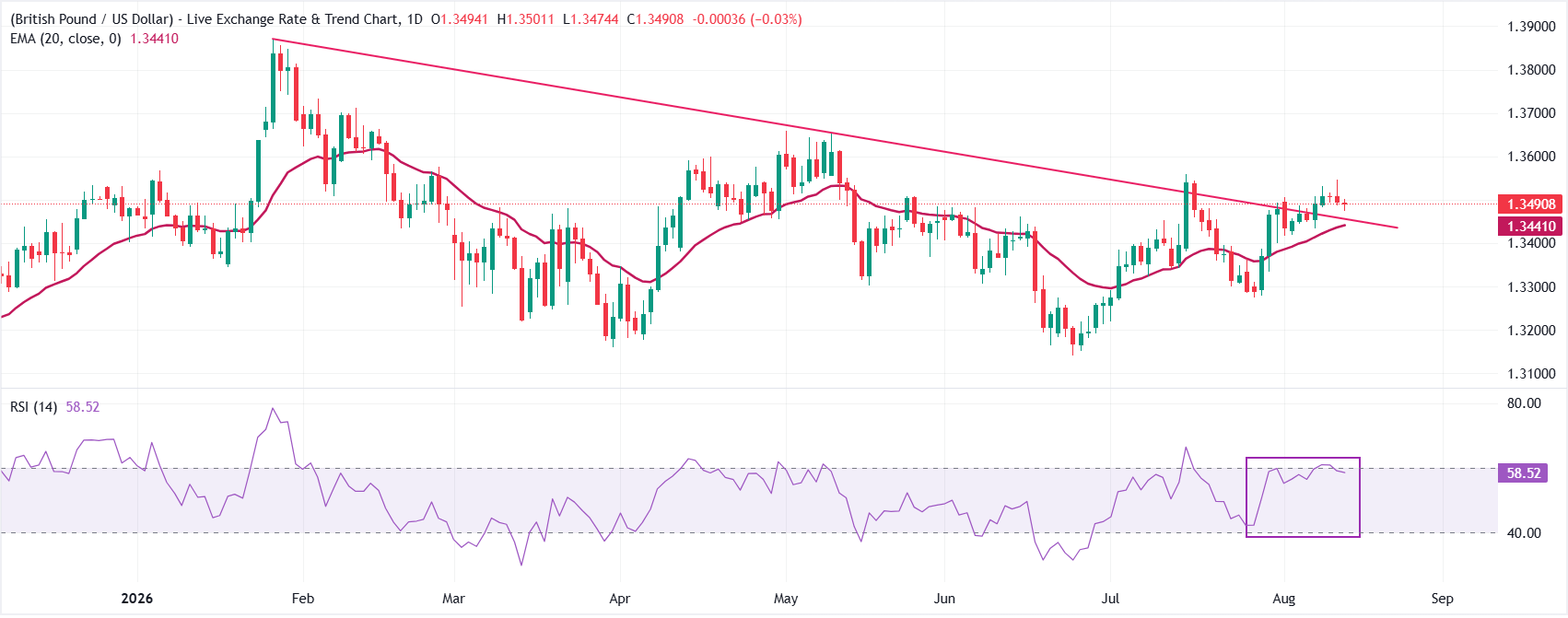
In the daily chart, GBP/USD trades at 1.3491. The pair holds a bullish near-term bias as spot advances above the 20-period Exponential Moving Average (EMA) at 1.3441 and above the broken downward resistance trend line, now acting as support around 1.3457. The Relative Strength Index (14) at 58.5 stays in positive territory without reaching overbought conditions, which suggests steady upside momentum while the recent breakout above the trend barrier is being defended.
On the downside, immediate support is clustered between the trend-line break at 1.3457 and the 20-period EMA at 1.3441, with the current price area around 1.3491 acting as a near-term pivot. As long as GBP/USD holds above this support band, bulls could look for the pair to consolidate gains and extend the advance, while a daily close back below 1.3457 would hint at a false break and expose the EMA area as the next line of defense.
(The technical analysis of this story was written with the help of an AI tool. Know more.)
Economic Indicator
Gross Domestic Product (QoQ)
The Gross Domestic Product (GDP), released by the Office for National Statistics on a monthly and quarterly basis, is a measure of the total value of all goods and services produced in the UK during a given period. The GDP is considered as the main measure of UK economic activity. The QoQ reading compares economic activity in the reference quarter to the previous quarter. Generally, a rise in this indicator is bullish for the Pound Sterling (GBP), while a low reading is seen as bearish.












Leave a comment