
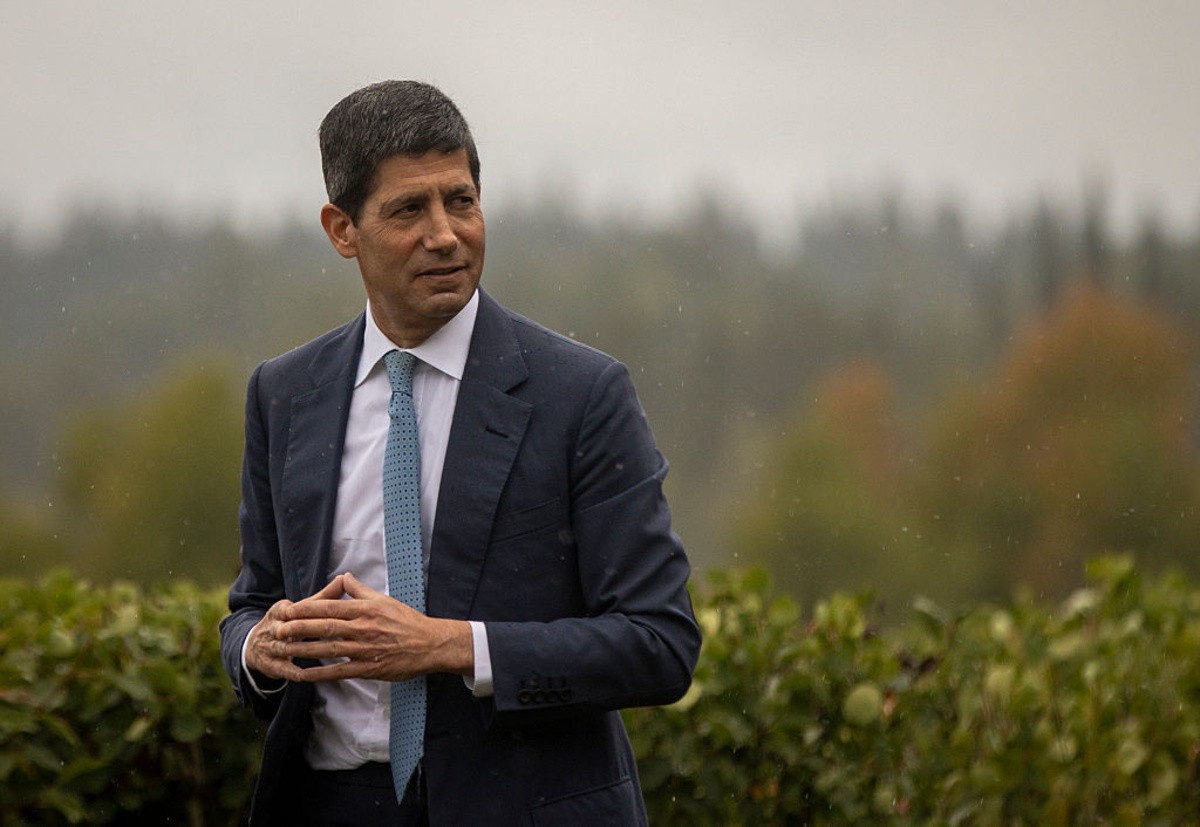
Natalie Behring/Getty Images
Federal Reserve Chair Kevin Warsh stood before the most consequential lectern in global finance Friday morning and delivered the clearest statement of his six-month tenure: after 65 months of above-target inflation, the Fed has more work to do — and will use interest rates to do it. By midday, September rate-hike odds had jumped from roughly 35% to more than 55%, and anyone carrying a credit card balance, a home equity line of credit, or an adjustable-rate mortgage past its initial fixed period was 19 days closer to paying more for it.
The market’s response carried a second, less-covered signal: while the 2-year Treasury yield — the maturity that tracks near-term rate expectations most directly — rose more than 6 basis points to approximately 4.30%, its highest level since late July, the 30-year yield edged lower, falling about 3 basis points to approximately 5.16%. That divergence — short-term rates up, long-term rates down — is the yield curve pattern bond-market professionals call a “bull flattener,” and it carries specific meaning for readers who need to make housing decisions before the September 16 rate vote: the 30-year Treasury yield is the primary benchmark that feeds into fixed-rate mortgage pricing, and it went the wrong direction for the bearish call on housing costs.
The bond market’s split reaction — punishing short-term borrowers while sparing long-term ones — is the story beneath the hawkish headline, and it is the signal that will matter most to readers who have a variable-rate balance, a pending mortgage application, or a rate-sensitive financial decision in the next 19 days.
Warsh’s Six Principles Replace Forward Guidance
Warsh rejected what he called a “reaction function” — the practice, favored by economists, of publishing the specific data thresholds that would trigger a rate move — and instead offered six governing principles for his approach to monetary policy.
The Fed, he said, should interrogate incoming data rather than rely on stale projections; accept that matching supply against demand is inherently imprecise; treat the 2% PCE inflation target as “firm and fixed” — his clearest public statement that there is no higher target under consideration; pursue both the employment and price-stability mandates without treating them as a trade-off; rely on short-term interest rates as the primary tool rather than unconventional measures; and keep the supply of money itself central to policy thinking.
“I stand here today committed to a discipline, not a decision,” Warsh said in the speech’s closing line — a formulation designed to preserve optionality heading into the September 16 FOMC meeting without providing the forward guidance that markets had been asking for. His opening, however, was deliberately philosophical rather than cautious: the speech was titled “In Our Time,” and Warsh opened by declaring the United States at “a hinge point in history.”
Inflation Numbers Paint a Concerning Picture
The speech’s most immediate market-moving passage was Warsh’s inflation warning — his refusal to interpret the summer’s relatively softer inflation readings as meaningful progress toward the 2% target.
The Fed’s preferred inflation gauge, the 12-month Personal Consumption Expenditures (PCE) price index, stood at 3.7% — nearly double the 2% target. But Warsh reached for a more granular and revealing metric: the six-month annualized PCE rate was running at 4.1%, a figure that suggests the deceleration visible in the headline annual number may be a statistical artifact of how high prices were a year ago rather than genuine underlying improvement.
He also described the breadth of price pressure across the economy. Of the 199 individual components he tracks in the PCE basket, 54% showed gains above 3% over the prior 12 months — down from the pandemic peak but still well above the 32% that saw such increases in the two decades before the pandemic. That figure matters because headline inflation rates can moderate even when price pressures remain broadly distributed; Warsh’s component analysis shows the problem is not concentrated in a few volatile categories.
“While this summer’s PCE and CPI readings were better than expected, they do not tell me that underlying trends have meaningfully improved,” Warsh said. On wage growth — often cited by dovish economists as a reason to hold — he was pointed: “In tracking underlying inflation, wage growth has not proven a reliable indicator of future inflation for a very long time.”
Warsh also took direct institutional responsibility for the inflation episode rather than attributing it to supply-chain forces, geopolitical disruptions, or fiscal policy. The Fed bears direct responsibility, he said, for all 65 months of sustained elevated inflation — and that responsibility belongs squarely with the central bank.
What the Bull Flattener Means for Your Rate
The bond market’s reaction divided cleanly along the curve and told two different stories to two different groups of borrowers.
For holders of variable-rate debt — credit card balances, home equity lines of credit, and adjustable-rate mortgages past their initial fixed period — the 2-year yield’s jump to approximately 4.30% is the relevant signal. The prime rate currently sits at 6.75%, and a 25-basis-point September hike would push it to 7.00% within days of the vote. For a credit card at the US average annual percentage rate — roughly prime plus 15% — every $10,000 in outstanding balance would cost approximately $25 more per year after a single quarter-point hike. A $100,000 home equity line of credit would add approximately $250 per year.
For prospective homebuyers or anyone holding a fixed-rate mortgage application open, the signal from the 30-year yield is different and more encouraging than the headline rate-hike narrative suggests. The 30-year Treasury fell about 3 basis points on Friday to approximately 5.16% — the opposite of what a pure “rates-going-up” narrative would predict. This is the bull-flattening pattern: short-term rates rise because markets expect the Fed to hike in September, but long-term rates fall because those same markets are simultaneously concluding that the hike will succeed at restoring inflation credibility, reducing the long-run risk premium they demand to hold 30-year bonds.
The 30-year fixed mortgage averaged 6.66% as of August 27, according to Freddie Mac’s Primary Mortgage Market Survey. The Mortgage Bankers Association’s weekly survey showed the 30-year conforming mortgage at 6.78% for the period ending August 21. Neither figure moved meaningfully higher after the speech — and may not, if the 30-year Treasury continues to hold near current levels.
The 10-year Treasury yield — the benchmark that feeds into 30-year fixed mortgage pricing most directly — was little changed at approximately 4.68% after the speech, consistent with the bull-flattening signal at the long end of the curve.
“We Have Work to Do”
The passage that moved markets most directly came when Warsh set an explicit condition for further action. “We must be confident that underlying inflation is moving to our objective, clearly and at sufficient speed,” he said. “Otherwise, we have work to do.” That’s our job, our mandate and our charge to keep.
Economists and traders parsed “sufficient speed” immediately. Heather Long, chief economist at Navy Federal Credit Union, called it a clear opening: “Warsh opened the door to a Fed rate hike. A hike probably won’t come in September, but it will by October or December,” she said. Long added that Warsh explicitly said this summer’s encouraging inflation readings don’t indicate “meaningful” improvement, and that bond markets reacted swiftly by pricing in a hike.
Vail Hartman, US rates strategist at BMO, offered a more direct verdict: Hartman called it “a deliberately hawkish speech that will put to rest any concerns about the Fed’s willingness to raise rates to restore price stability.”
A more skeptical read came from David Russell, head of global market strategy at TradeStation: “Kevin Warsh continues to pay lip service to price stability without much clarity on when hikes will come,” Russell said. Warsh’s inflation acknowledgment slightly boosts September hike odds, Russell concluded.
By midday, traders on CME FedWatch priced a September hike at 55.7% — up approximately 20 percentage points from Thursday. Prediction market platform Kalshi showed 48% odds, and Polymarket showed 49% — both up sharply from pre-speech levels.
Notably, Warsh suggested rates are not currently restrictive, pointing to “robust business investment in AI equipment and infrastructure and strong consumer spending” as evidence that the 3.50%–3.75% target range has not been slowing the economy sufficiently to return inflation to target. That framing implies a hike would not be policy tightening above neutral — it would be achieving neutral.
AI at the Frontier, But Sidelined as a Policy Lever
In keeping with the symposium’s theme — “Financial Innovation: Implications for Payments and Policy” — Warsh devoted substantial time to artificial intelligence, calling it “a new variable, potentially a new factor of production” and noting that annualized AI token sales at the two leading labs now exceed $100 billion, up more than 500% in a single year.
But he drew a sharp boundary that directly addressed a concern raised repeatedly by TechTimes and others about his AI-adjacent relationships: the Fed’s newly formed task force on AI, productivity, and jobs — co-led by venture capitalist Marc Andreessen, Stanford economist Charles I. Jones, and Microsoft executive Asha Sharma — will have no effect on current policy decisions. Any productivity gains from AI, Warsh said, remain too speculative and too distant in their timing to factor into near-term rate-setting. Short-term interest rates, he reiterated, are the Fed’s primary tool — not AI thesis management.
That statement carries significance beyond the speech. Prior to Jackson Hole, critics inside and outside the Fed had argued that Warsh’s willingness to hold rates while citing a future AI disinflation benefit represented exactly the kind of unconventional-thesis-driven forbearance his six governing principles now explicitly reject.
Political Crosscurrents
The speech arrived against a backdrop of unusual political friction that Warsh did not address from the podium. Political pressure has been building for months: President Trump has repeatedly and publicly called for lower interest rates. Warsh’s recommitment to the 2% PCE target as a “firm, fixed target” was read by economists as an implicit response to weeks of speculation — fueled in part by Warsh’s own muddled July press conference — that he might be open to raising or revising the benchmark.
Senator Elizabeth Warren, in a letter released ahead of the speech, urged Warsh to use Jackson Hole as an opportunity to address what she described as a failure to clearly acknowledge the inflationary effects of the administration’s tariff policies, and to “start rebuilding your credibility” as an independent Fed Chair. Warren also noted that core PCE — running at 3.3% in July — remained substantially above the 2.8% level from February 2026, before the conflict with Iran drove energy-linked price pressures higher.
Warsh did not address tariffs or Bessent’s bond buyback program — a decision that CNBC noted was notable given the backdrop of an intervention that analysts from Evercore ISI to Druckenmiller had criticized as working at cross-purposes with the Fed’s inflation mandate.
Bitcoin Gives Back Recent Gains
The hawkish tone rippled across risk markets. Bitcoin, which had been trading near $80,000 before the speech after a strong week driven in part by the Treasury’s bond buyback announcement, gave back some of those gains following the address, trading near $78,000–$79,000 by early afternoon — down roughly 1–3% on the day.
With Warsh signaling that the Fed remains squarely focused on inflation and is not coordinating with the Treasury on yield management, the temporary risk-asset tailwind from the compressed long-yield environment began to fade. The dollar index rose 0.4% to 99.55 after the speech.
What Comes Next Before September
Markets now have roughly three weeks of economic data to absorb before the September 16 rate decision. The August nonfarm payrolls report is scheduled for September 4 — which options markets view as carrying higher implied volatility than even the Jackson Hole address itself. August CPI is expected around September 10.
Warsh made clear he will not pre-announce what numbers would move the needle. His closing words in Wyoming function as the clearest available summary of his approach: a commitment to the discipline of fighting inflation, not to any particular decision about how or when that fight concludes. The September 16 vote — which will also produce the Fed’s updated Summary of Economic Projections, including the “dot plot” — will be the first formal test of whether that discipline translates into action.
For readers making financial decisions in the next three weeks, the signal is mixed but directional: variable-rate debt will likely get more expensive if the data holds, while long-term mortgage rates may not worsen as dramatically as the headline hawkishness would suggest — because the bond market’s own behavior on Friday said that a September hike would restore, not undermine, the Fed’s long-run inflation credibility.
Frequently Asked Questions
Will the Fed actually raise interest rates in September 2026?
As of Friday afternoon, CME FedWatch placed September hike probability at roughly 55–57%, up from about 35% before the speech. That makes a hike slightly more likely than a hold — but Heather Long of Navy Federal Credit Union cautions that the more likely scenario for the actual vote may be October or December, with September serving as the tipping-point threat that keeps downward pressure on inflation. The next two major data points — August payrolls on September 4 and August CPI around September 10 — will substantially shape the outcome before the September 16 decision.
How does a Fed rate hike affect my credit card or home equity line of credit?
Variable-rate products tied to the prime rate — which includes most credit cards, home equity lines of credit (HELOCs), and adjustable-rate mortgages past their initial fixed period — move almost immediately when the Fed changes its target range. The prime rate is currently 6.75% (the federal funds upper bound of 3.75% plus 3 percentage points). A 25-basis-point hike would raise the prime rate to 7.00% within days of the September 16 vote, directly increasing your interest charges on any outstanding variable-rate balance.
Why did the 30-year Treasury yield fall after a hawkish speech, and what does that mean for mortgages?
This is the bull-flattening signal: bond markets raised near-term rate-hike expectations (pushing the 2-year yield up) while simultaneously concluding that a credible hike will succeed at restoring long-run inflation credibility (pulling the 30-year yield down). The 30-year Treasury is the primary benchmark behind fixed-rate mortgage pricing. The 30-year fixed mortgage averaged 6.66% as of August 27, and it may not rise significantly if the 30-year yield continues to hold near 5.16%. That doesn’t mean mortgages are cheap — they’re near two-decade highs — but a hawkish Fed speech paradoxically did not worsen the outlook for long-term borrowers the way it immediately worsened the outlook for short-term variable-rate ones.
What are the six principles Warsh announced to replace forward guidance?
Warsh outlined six commitments in place of a traditional reaction function: scrutinize incoming data rather than rely on stale projections; acknowledge that matching supply against demand is inherently imprecise and never perfectly knowable; treat the 2% PCE target as a firm, fixed objective — not a range or a suggestion; pursue both the employment and price-stability mandates without treating them as a trade-off; rely on short-term interest rates as the primary policy tool rather than balance-sheet operations or unconventional instruments; and keep the supply of money itself central to the analysis. His closing line committed to a discipline rather than a decision — preserving optionality for September while giving markets a framework to interpret future communications.











Leave a comment