
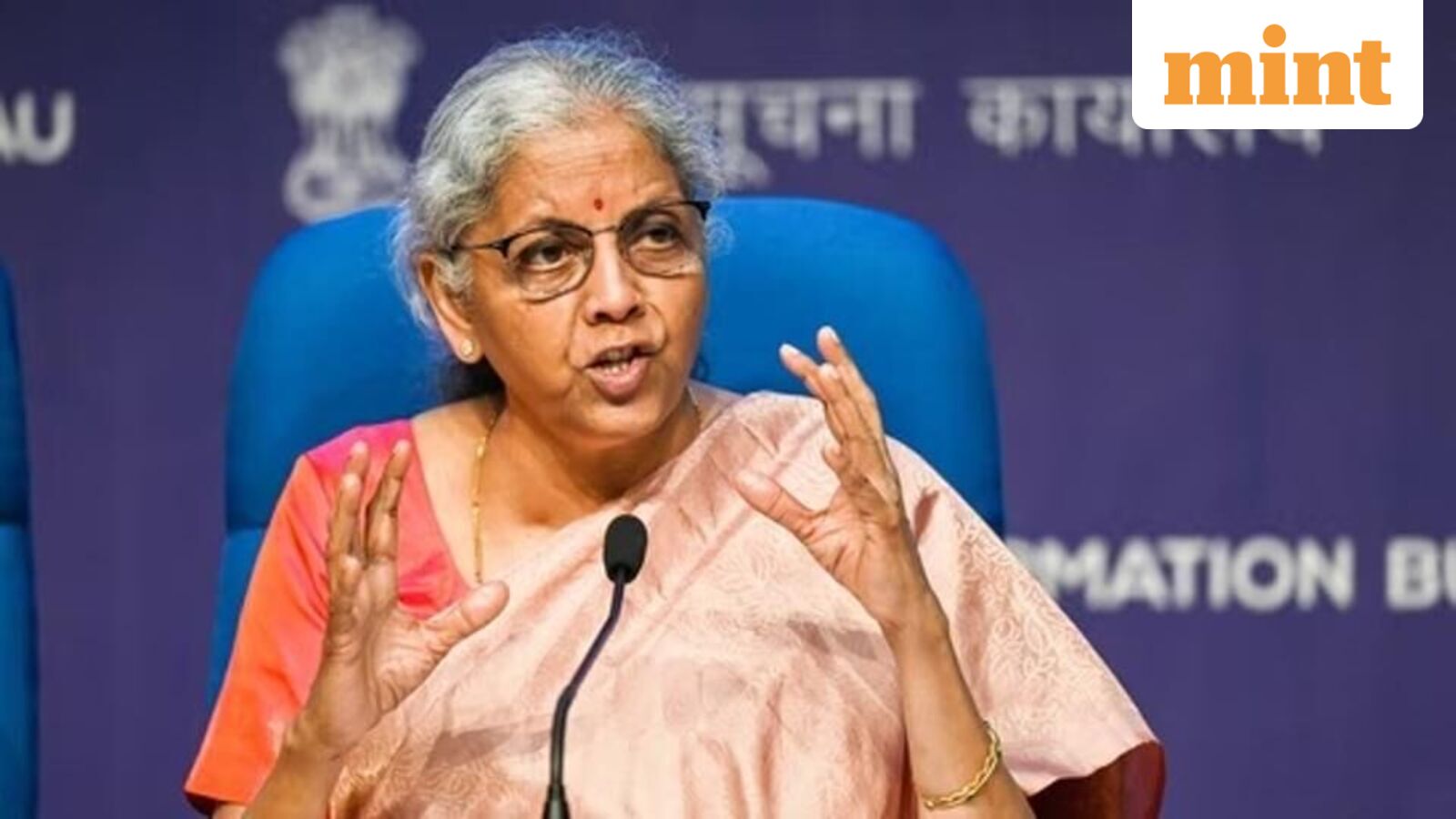
New Delhi: Trade fragmentation, along with the ongoing West Asia conflict, means that 2026 could prove more challenging, as the global economy moves from episodic “shocks” to a state of “permanent volatility,” finance minister Nirmala Sitharaman said on Monday.
However, India has sufficient fiscal space to sustain its asset-creating public expenditure, while the central bank has room to cut interest rates to support growth, aided by the government’s commitment to fiscal prudence, she said.
“The escalation of the Middle East conflict has evolved from a regional security concern into a systemic tremor, threatening the vital arteries of global energy and hardening the lines of a new multipolar world order,” Sitharaman said at an event organized by the National Institute of Public Finance and Policy (NIPFP), New Delhi.
The US and Israel launched coordinated strikes on Iran on 28 February, triggering retaliation that escalated into a wider regional conflict, with Tehran blocking access to the strategic Strait of Hormuz through which about a fifth of global oil trade passes.
Sitharaman said 2025 was monumental in more ways than initially expected. Trade fragmentation has introduced severe uncertainty into global supply chains. “This led to sharp downward revisions in global growth forecasts, but the year ended more optimistically than previously perceived, particularly for India,” she added.
The finance minister noted that global public debt has surged to approximately $106 trillion, exceeding 95% of global gross domestic product (GDP). According to the International Monetary Fund (IMF), the US has a debt-to-GDP ratio of 125% in 2025, and Japan at a staggering 235%. Many advanced economies that spent decades running expansionary fiscal policies now find themselves with severely constrained policy space precisely when they need it the most.
“Against this backdrop, India continues to stand out. Our general government debt to GDP ratio (which includes states’ debt), at approximately 81%, is the lowest among major economies after Germany,” she said.
“More importantly, India is the only major economy where the IMF projects this ratio to fall significantly—to 75.8% by 2030—while the debt outlook for the advanced economies such as US, China, Germany and others is projected to worsen,” Sitharaman added.
She also emphasized that a good public finance policy improves the countercyclical capacity of fiscal policy, especially the ability to “lean against the wind” in an economic downturn.
“Today, many countries with high debt and large deficits have no room to manoeuvre and they face a grim choice between austerity and instability. On the contrary, India has fiscal space to maintain our capex (capital expenditure) programme, room for the Reserve Bank of India (RBI) to cut rates, room to offer targeted support to affected sectors. This is the dividend of a decade of fiscal discipline,” she said while talking about in context of steps taken in the last decade towards fiscal prudence.
India has budgeted ₹12.22 trillion for capex in the ongoing financial year, up from nearly ₹11 trillion in FY26 that ended on 31 March.
“This is the strategic value of fiscal prudence that pays dividends across decades. Therefore, we have been able to reduce the excise duty on diesel and petrol, specific exemptions were given on critical petrochemical products and SEZs (special economic zones) to operate in DTA (domestic tariff area),” Sitharaman added.
She also said that India’s external debt-to-GDP ratio stands at just 19.1% (as of September 2025), one of the lowest in the emerging market world. India’s foreign exchange reserves, at over $688 billion (as of 31 March 2026), provide import cover of approximately 11 months, which is a substantial buffer.
While talking about the states and their fiscal health, Sitharaman said that states need to be full partners in the fiscal compact. “A Viksit Bharat requires Viksit States and Viksit Districts with healthy fiscal positions, effective revenue administrations, capable expenditure management systems, and accountability frameworks that translate public spending into measurable outcomes,” she said.
“When a state’s balance sheet is healthy, it has the capacity to co-invest in infrastructure with private partners, and to absorb economic shocks without cutting essential services,” Sitharaman said.
Speaking on expenditure and budgetary-side reforms for sound public finance, she said that the government has prioritized transparency in budgeting practices and numbers.
“The distinction between ‘Plan’ and ‘Non-Plan’ expenditure created a distortion in the perception of the two types of allocations. Therefore, it was done away with. From FY 2017-18, the budget cycle was shifted to 1st February instead of the last working day in February. This has improved administrative efficiency and delivery of schemes as ministries have the full budget available from the beginning of the financial year—1 April,” she said.








Leave a comment