
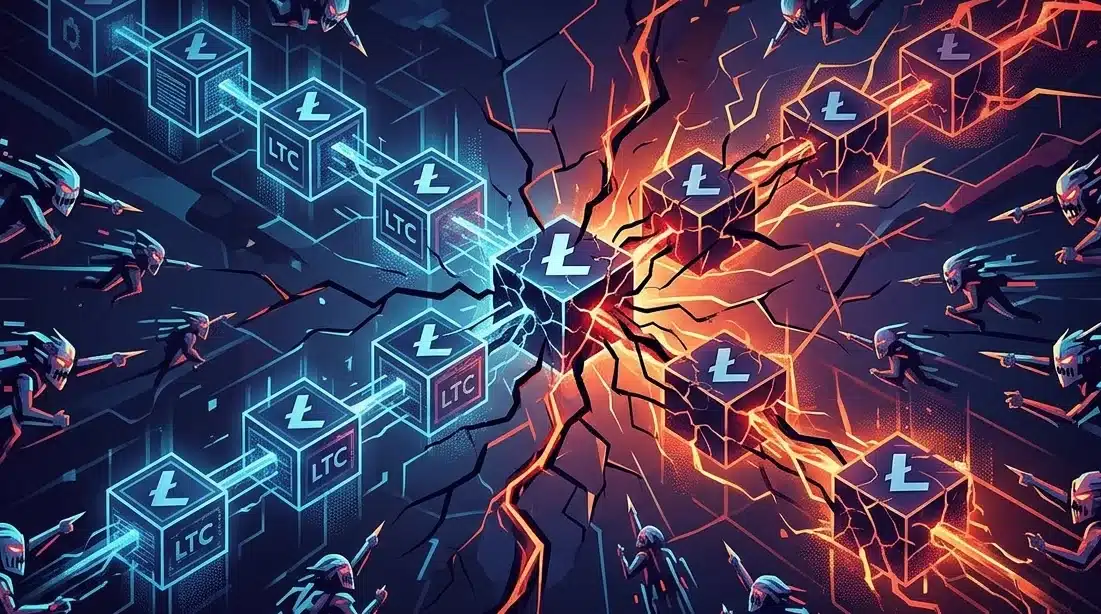
The Litecoin network faced a security breach when a zero-day vulnerability triggered a 13-block reorganization, impacting several major mining pools. This disruption led to a temporary halt in transaction finality, drawing attention to the potential risks within the Litecoin ecosystem.
The Litecoin team quickly confirmed the bug on their official X account and assured the community that a patch had been fully deployed to resolve the issue.
The Zero-Day Bug and Its Impact on the Litecoin Network
A zero-day vulnerability refers to a flaw that is unknown to the developers at the time of its exploitation. In this case, the bug targeted the handling of MimbleWimble Extension Block (MWEB) transactions, a privacy feature on the Litecoin network. The vulnerability allowed an attacker to exploit the network by triggering a Denial-of-Service (DoS) attack, flooding the network with invalid MWEB transactions.
MWEB transactions are designed to offer enhanced privacy for Litecoin users by obscuring transaction details. However, due to the zero-day bug, some Litecoin nodes that had not updated their software accepted invalid MWEB transactions, violating the network’s consensus rules.
As a result, a block reorganization (or “reorg”) took place when a competing chain of blocks replaced the existing chain, causing 13 blocks to be reorganized. A block reorg of this magnitude is a rare event and presents significant challenges, including the potential for double-spending and undermined user confidence.
Understanding the Denial-of-Service Attack and Its Impact on Miners
The core target of the attack was the mining pools, which play a critical role in securing the Litecoin network. Mining pools are groups of miners who pool their computational power to increase their chances of successfully finding a block. By launching a DoS attack, the attacker aimed to disrupt the mining process by overwhelming the network with invalid transactions.

The impact on miners was particularly severe. Mining pools that failed to update their nodes were unable to process valid blocks during the attack. This resulted in temporary downtime for these pools, contributing to a short-term drop in the network’s hashrate. While the Litecoin network quickly recovered, the event highlighted the vulnerability of mining operations when software updates are delayed or ignored.
Quick Response and Deployment of the Patch
Despite the severity of the incident, the Litecoin team responded promptly. Within hours, the development team confirmed the bug and rolled out a patch that effectively closed the attack vector. The patch prevented nodes from accepting invalid MWEB transactions, thus stabilizing the network and mitigating further risks. The team urged all node operators to update their software immediately to ensure the security of their operations.
Importantly, the Litecoin team confirmed that no funds were lost as a result of the reorganization. While users’ transactions that were part of the reorganized blocks were reversed, the overall integrity of the network remained intact. The incident, although disruptive, demonstrated the resilience and quick action of the Litecoin team.
The Role of MWEB and Zero-Day Bugs
Launched in 2011, Litecoin has earned a reputation as one of the oldest and most stable cryptocurrencies. As a fork of Bitcoin, it relies on a proof-of-work consensus mechanism to validate transactions. Over the years, Litecoin has faced relatively few security incidents, but the April 25 event serves as a stark reminder that even established networks are susceptible to vulnerabilities.
The introduction of MWEB in 2022 marked a significant upgrade for Litecoin, providing users with enhanced privacy features. However, as seen with this recent zero-day vulnerability, new features can also introduce unforeseen risks.













Leave a comment