
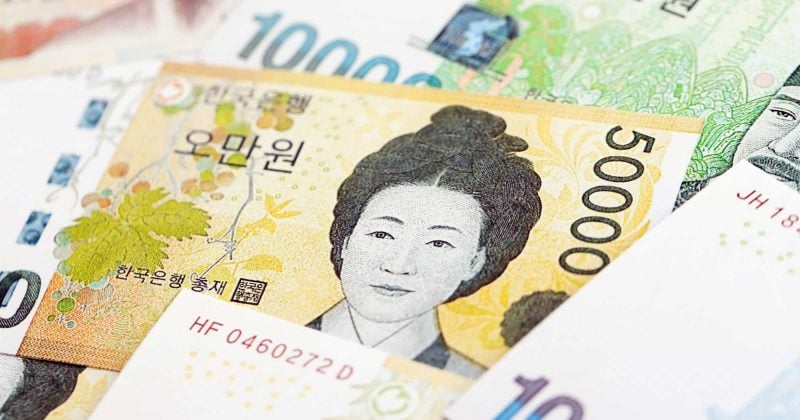
South Korea’s foreign exchange authorities are sending a clear message to currency speculators: the math isn’t mathing. The Korean won has been sliding against the US dollar in ways that officials say have nothing to do with the country’s actual economic health, and they’re not happy about it.
The won recently traded above 1,540 per USD, with intraday peaks hitting 1,555. Those are levels the currency hasn’t touched since the global financial crisis. For context, South Korea is the world’s 13th-largest economy, home to Samsung and Hyundai, and running what officials describe as stable economic indicators.
What’s actually happening with the won
South Korean officials are making a specific claim: the magnitude of the won’s depreciation is disproportionate to the country’s economic fundamentals. Second Vice Finance Minister Huh Chang raised this concern on May 20, calling the volatility excessive when measured against the underlying data.
Back in January, Bank of Korea Governor Rhee Chang-yong flagged that dollar-won levels in the high-1,400 range were misaligned with fundamentals. The won has only gotten weaker since then, which means the gap between what the currency “should” be doing and what it’s actually doing has widened considerably.
The culprit, according to authorities, is speculative activity. Officials have singled out non-deliverable forwards, or NDFs, as a key driver. NDFs are contracts that let traders bet on where a currency will go without actually exchanging the underlying currency.
Officials have also pointed to a structural problem: outflows for overseas investments have surpassed South Korea’s current account surplus. More money is leaving the country to chase foreign assets than the country is earning from its trade surplus.
The government’s playbook
South Korean authorities have pledged they will “not tolerate excessive volatility and one-way betting” in the forex market.
Officials have hinted at deploying various stabilization tools without targeting a specific exchange rate. This is a deliberate distinction. Defending a particular level would be expensive and potentially futile if market forces are strong enough. Instead, the strategy appears focused on smoothing out the extremes: dampening the speed of moves rather than reversing the direction entirely.
South Korea has also been exploring extending its FX trading hours, a reform designed to make the won market more liquid and less susceptible to speculative jolts.
What this means for investors
The coordinated messaging from the Ministry of Economy and Finance and the Bank of Korea is worth paying attention to. When multiple arms of government start using phrases like “excessive volatility” and “one-way bets,” it typically means intervention is moving from verbal to operational.
For crypto markets, the won’s instability adds another variable to an already complex picture. South Korea is one of the world’s most active crypto trading markets, and currency weakness can influence capital flows into digital assets.
The capital outflow dynamic is perhaps the most important signal to watch. If South Korean investors continue moving money overseas at rates that exceed the current account surplus, no amount of verbal intervention will arrest the won’s decline permanently.









Leave a comment