
291
Despite the rise of UPI and digital payments across India, people’s relationship with cash is still strong across the country. Smartphones are transforming transactions, but physical currency still plays a vital role in everyday commerce. Now, the Reserve Bank of India (RBI) is revisiting an idea that could fundamentally change the way Indians handle money, and that change is polymer banknotes.
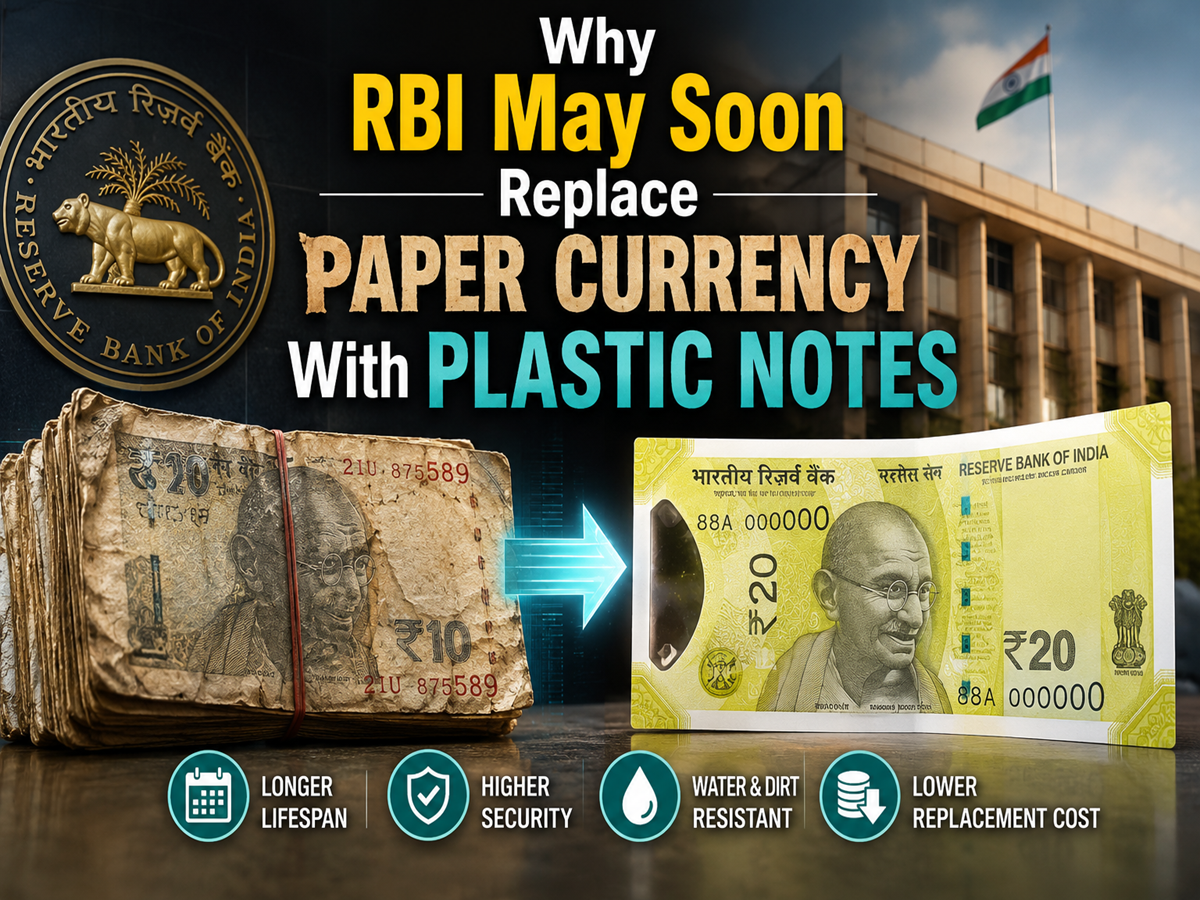
After multiple bank discussions and a failed experiment that was done over a decade ago, the central bank is reportedly preparing for the plastic-based currency notes. Initially, RBI will start this with lower denominations such as Rs 10 and Rs 20. This comes at a time when currency printing costs are climbing sharply, and billions of worn-out notes are being removed from circulation every year.
Why India’s Cash Economy Still Matters?
The digital payments revolution has undoubtedly reshaped India’s financial landscape, but cash remains deeply embedded in the economy. From local markets and small retailers to rural communities, physical currency continues to facilitate millions of transactions daily.
This sustained demand is reflected in the latest numbers. Currency in circulation has reached record levels, demonstrating that digital payments and cash are not competing alternatives but increasingly coexist within India’s financial ecosystem.
However, maintaining such a vast stock of currency comes at a high cost. The RBI faces the constant challenge of replacing notes that become dirty, torn, faded or otherwise unfit for circulation. As volumes rise, so does the financial burden of keeping cash in circulation.
The Growing Cost of Printing Money
One of the strongest arguments for polymer banknotes is economic efficiency. India’s currency printing expenditure has substantially grown in recent years, driven by growing demand for fresh banknotes. At the same time, the number of damaged notes being withdrawn from circulation continues to increase.
The problem is particularly severe for lower-denomination notes. A ₹10 or ₹20 note may pass through hundreds of hands within a short period, exposing it to moisture, dirt, folding and physical wear. By the time it is withdrawn, the RBI has already spent resources producing, transporting and managing its replacement.
Polymer notes offer a potential solution because they typically last much longer than conventional paper notes. Although they may cost more to manufacture initially, their extended lifespan can significantly reduce replacement expenses over time.
What Are Polymer Notes and What Makes Them Different?
Despite being commonly referred to as “plastic money”, polymer banknotes are nothing like rigid credit cards. They are produced using a flexible plastic substrate that feels lightweight and durable while retaining the foldability expected from traditional currency. To users, the experience remains largely familiar, but the material offers several advantages.
Polymer notes are highly resistant to water, dirt and tearing. They maintain their appearance for longer periods and remain cleaner throughout their life. This durability is especially valuable in a country with diverse climatic conditions ranging from humid coastal regions to dusty inland areas. Another major benefit lies in security.
Stronger Shield Against Counterfeiting
Counterfeit currency remains a concern for central banks worldwide. Polymer banknotes have emerged as one of the most effective tools for enhancing currency security. Unlike traditional paper notes, polymer currency can incorporate sophisticated anti-counterfeiting technologies such as transparent windows, micro-optic features, holographic elements and specialised inks.
These features are not only difficult to replicate but also easier for the public to identify, making counterfeit detection simpler for both consumers and businesses. For a country with a large cash ecosystem, enhanced security could provide an additional layer of confidence in the currency system.
India’s First Polymer Experiment: A Decade Ahead of Its Time?
Interestingly, India’s exploration of polymer currency is not new. Back in 2012, authorities approved a field trial involving one billion ₹10 polymer notes across cities representing different climatic conditions, including Kochi, Mysore, Jaipur, Bhubaneswar and Shimla.
The objective was to check whether polymer notes could survive longer than paper notes in real-world conditions. However, the initiative encountered practical obstacles. ATM systems at the time struggled to recognise and dispense the new notes consistently. Operational and technological limitations ultimately prevented the project from moving forward.
Today, the landscape looks very different. Banking infrastructure has become more advanced, ATM technology has evolved, and global experience with polymer currency has expanded significantly. It is believed that this will help to address most of the concerns which were previously hindered the adoption.
Lessons From Countries That Already Made the Switch
Indis is not the first country to try this; over 60 countries have already introduced polymer banknotes either partially or completely. Australia pioneered the technology in 1988 and remains one of its strongest advocates. Other nations, including Canada, the United Kingdom, Singapore, New Zealand, Malaysia, Thailand, Indonesia, Romania and Vietnam, have also embraced polymer currency.
The experience across these countries has been remarkably consistent. Central banks cite three recurring benefits: longer note lifespan, reduced replacement costs and stronger protection against counterfeiting. The success of these international examples offers India a valuable roadmap as it evaluates its own transition.
Will Indians Soon Be Using Plastic Currency?
The RBI is expected to proceed cautiously through a pilot programme before making any broader decisions. Lower denominations such as ₹10 and ₹20 are likely to serve as testing grounds because they experience the highest levels of circulation and wear.
Public acceptance will also play a crucial role. Indians are accustomed to the feel and handling characteristics of paper currency, and any transition must ensure that polymer notes are practical, accessible and user-friendly.
Yet the logic behind the proposal is becoming increasingly difficult to ignore. With printing costs rising, soiled notes accumulating and global adoption accelerating, polymer currency presents an opportunity to modernise India’s cash infrastructure.
The future of money in India may be digital, but for the foreseeable future, cash is here to stay. The question is whether that cash will continue to be printed on paper or arrive in a more durable, smarter and longer-lasting polymer form.








Leave a comment