

The Litecoin market looks very different in 2026 than it did just a few years ago. The launch of the Canary Litecoin ETF (LTCC) has opened the door to new institutional capital, while improving market sentiment has renewed interest among everyday investors. At the same time, Litecoin continues to build on its reputation as one of the longest-running cryptocurrencies with a proven track record. So, what is driving the latest price moves, and could these trends continue? In this guide, you’ll discover the key factors shaping the Litecoin ETF story, the biggest price catalysts, and what they could mean for Litecoin’s future. So, let’s get started!
What Is Litecoin? A Brief Overview
If you’re wondering what Litecoin is, think of it as a faster and more affordable version of Bitcoin that was built for everyday payments.
Created in 2011, Litecoin uses the Scrypt mining algorithm instead of Bitcoin’s SHA-256. This approach helps secure the network while keeping mining independent from Bitcoin.
One of Litecoin’s biggest advantages is speed. New blocks are confirmed every 2.5 minutes, making the network four times faster than Bitcoin, which produces a new block every 10 minutes. As a result, users usually receive transaction confirmations much sooner.
Litecoin also has a fixed maximum supply of 84 million coins, while Bitcoin is capped at 21 million. Despite these differences, Litecoin has maintained 100% network uptime for more than 14 years, making it one of the most reliable blockchain networks ever created.
Thanks to low transaction fees, fast settlements, and growing institutional interest, Litecoin remains one of the leading cryptocurrencies for everyday payments.
Litecoin vs. Bitcoin at a Glance
| Metric Component | Litecoin (LTC) Value | Bitcoin (BTC) Value | Strategic Crypto Portfolio Impact |
| Blockchain Block Time | 2.5 Minutes | 10 Minutes | Faster clearing for merchant micro-transactions |
| Max Circulating Supply | 84,000,000 LTC | 21,000,000 BTC | Four times the supply cap, designed as digital cash |
| Network Uptime History | 100% (Since 2011) | 100% (With minor early bugs) | Flawless institutional track record for custody |
| Major US Investment Vehicle | Canary Spot ETF (LTCC) | BlackRock iShares (IBIT) | Wall Street validation via retail brokerage access |
| Primary Real-World Use Case | BitPay Leader (Micro-payments) | Store of Value (Digital Gold) | LTC acts as the active spending layer of the market |
Litecoin Valuation Drivers in 2026: Beyond the Speculation
Litecoin’s valuation in 2026 depends on much more than market sentiment. Investors now watch institutional demand, on-chain activity, and Bitcoin’s performance alongside traditional price metrics.
As of late June 2026, Litecoin trades around $42, giving the network a market capitalization of roughly $3.2 billion. Despite losing about 45% year-to-date, LTC remains one of the largest and most liquid cryptocurrencies, supported by strong exchange availability and more than a decade of uninterrupted operation.
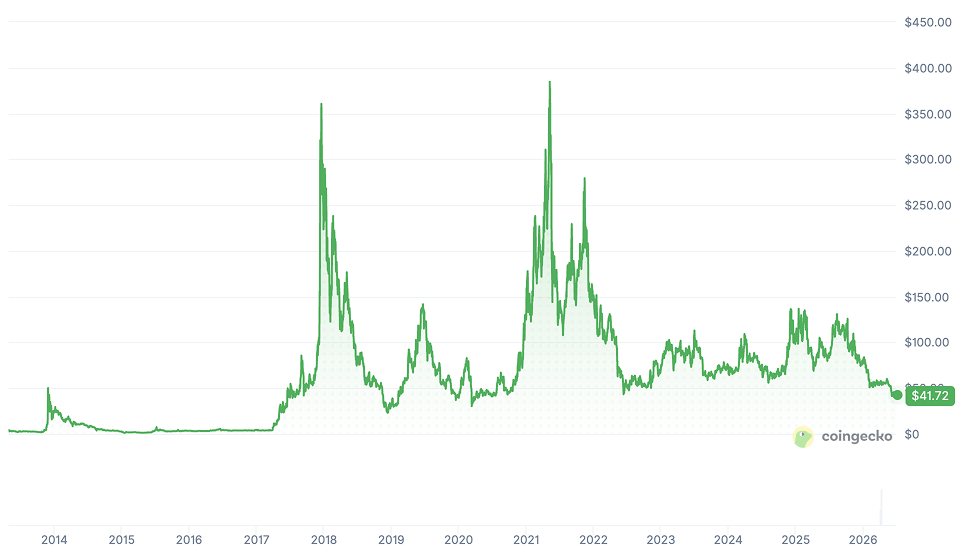
LTC Price Chart, CoinGecko, June 30, 2026
The biggest change this cycle is the launch of the Canary Litecoin ETF (LTCC). Although assets under management remain modest at around $5.5 million, the ETF gives institutions and retail brokerage clients regulated exposure to Litecoin for the first time.
Bitcoin still has the strongest influence on LTC, but that relationship is slowly evolving. ETF inflows create an additional source of demand that is independent of crypto exchanges, reducing Litecoin’s reliance on retail traders alone. As a result, any Litecoin price prediction for 2026 should consider both Bitcoin’s market cycle and the pace of institutional adoption, rather than focusing only on speculative momentum.
Technical Analysis: Support, Resistance, and On-Chain Metrics
Investing.com’s monthly technical data shows a weak short-term setup for Litecoin. The summary reads Strong Sell, with 12 moving averages and 8 technical indicators giving sell signals. RSI stands at 35.01, which shows weak momentum, while Stochastic, StochRSI, and Williams %R all sit in oversold territory. This means sellers still control the trend, yet a relief bounce can appear if buyers defend key levels.
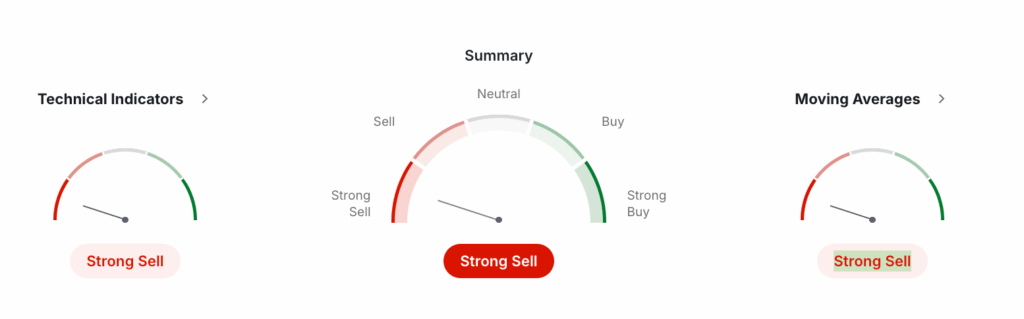
Investing, June 30, 2026
The main support zone sits near $48.07, followed by $44.1 and $37.85. If LTC loses these levels, the chart may stay under pressure. On the upside, resistance appears near $58.3, then $64.54 and $68.52. A clean move above these areas would improve the structure and make future Litecoin price predictions more constructive.
On-chain data gives a more balanced picture. BitInfoCharts shows 254,932 active Litecoin addresses in the last 24 hours, compared with 237,064 active addresses reported in February 2026, which suggests roughly 7.5% growth in active wallet activity despite weak price action.
Network usage also remains solid. BitInfoCharts reports 180,915 transactions in the last 24 hours, an average fee of only $0.0023, a median fee of $0.00038, and an average block time of 2 minutes 32 seconds. These figures support Litecoin’s payment-focused use case because users can still move value quickly and cheaply.
Security metrics are strong, but they need monitoring. BitInfoCharts places Litecoin hashrate near 2.53 PH/s, while CoinWarz shows the hashrate down 10.65% over 7 days and 14.22% over 30 days. That does not break the network thesis, but it shows that miner participation has cooled with the price.
The Post-ETF Reality: Wall Street’s Impact on LTC
The launch of the Canary Litecoin ETF (LTCC) marked a major turning point for Litecoin. LTCC began trading on Nasdaq in late October 2025 and became the first U.S. spot Litecoin ETF, giving investors exposure to LTC through a familiar brokerage product instead of a crypto exchange or private wallet. Canary’s own fund page lists Nasdaq as the exchange, an inception date of October 27, 2025, a 0.95% sponsor fee, and about $5.49 million in net assets as of June 29, 2026.
The approval path matters because LTCC did not appear in isolation. In September 2025, the SEC approved generic listing standards for commodity-based trust shares, including products that hold crypto asset commodities. Reuters reported that this change removed much of the old case-by-case review process and helped Canary launch Litecoin and Hedera products despite the SEC shutdown.
This gave the LTC ETF story more credibility. It also encouraged competition. Grayscale filed to convert its Grayscale Litecoin Trust into the Grayscale Litecoin Trust ETF, with NYSE Arca submitting a 19b-4 application in January 2025. That filing showed that major asset managers saw regulated Litecoin exposure as a serious product category, not just a short-term trade.
How Institutional Inflows Create a Supply Shock
A Litecoin spot ETF can create supply pressure because it must hold real LTC, not a paper claim. Canary’s holdings table showed 126,837.52 LTC held by LTCC on June 29, 2026. Compared with Litecoin’s circulating supply of about 77.33 million LTC, that equals roughly 0.16% of the market, so the current supply shock remains small.
The mechanism still matters. When ETF demand grows, authorized participants create new shares, the fund buys more LTC, and those coins move into custody. That can reduce liquid supply on exchanges and make price moves sharper during strong demand periods.
However, Litecoin is still far behind Bitcoin. U.S. spot Bitcoin ETFs recorded about $1.5 billion in net inflows in January 2024 alone, while LTCC sits near $5.49 million in net assets. This means Litecoin has the ETF structure, but not yet the Bitcoin-level flow engine.
Is Litecoin a Good Investment in 2026? Risk vs. Reward
So, is LTC a good investment in 2026? The answer depends on what you expect from it. Litecoin is not a high-growth smart contract platform like Solana, Ethereum, or newer Layer-1 networks. Instead, it is a liquid, battle-tested payment coin with deep exchange support, low fees, and a simple value proposition.
The bullish case is clear. Litecoin still has strong liquidity – LTC is near $3.2 billion in market cap and over $200 million in volume. BitPay’s 2025 report also shows LTC among the top five coins by payment volume and Litecoin as the fourth-largest payment network on its platform, which supports its real-world use case.
The risk is also real. Motley Fool argues that Litecoin faces pressure from Bitcoin’s Lightning Network and faster Layer-1 blockchains, while Cryptomus takes a more optimistic view and points to user growth, regular updates, and clearer regulation as potential support for LTC.
For beginners, Litecoin may work best as a smaller portfolio position, not a core holding. It offers stability and payment utility, but it needs stronger demand to outperform newer crypto networks.
Long-Term Network Outlook: The Scalability Roadmap
For investors asking whether Litecoin will go up, the stronger question is whether the network can stay useful. Litecoin’s roadmap focuses on practical payments, low fees, and optional privacy, not complex app ecosystems.
The key upgrade is MWEB, or MimbleWimble Extension Blocks. Litecoin activated MWEB in May 2022, and it lets users move LTC into a separate transaction layer where amounts can stay confidential. This gives Litecoin a privacy feature while keeping it optional for users and exchanges.
SegWit also matters. Litecoin activated SegWit in May 2017, which improved transaction efficiency and helped the network handle payments more smoothly.
Most importantly, Litecoin still keeps costs extremely low. BitInfoCharts recently showed an average Litecoin transaction fee near $0.0021–$0.0024, which supports its role as a fast payment network rather than a high-fee settlement chain.
The Role of Halving Cycles in Future Scarcity
Litecoin has a fixed supply cap of 84 million LTC, so its monetary policy becomes tighter over time. The block reward fell from 50 LTC to 25 LTC in 2015, then to 12.5 LTC in 2019, and to 6.25 LTC in 2023. The next halving should cut it to 3.125 LTC around 2027.
This scarcity does not guarantee instant gains. After past halvings, LTC often entered accumulation phases before stronger rallies appeared. That is why any Litecoin 2030 price prediction should focus on supply, demand, payments, and ETF adoption together, not on the halving alone.
How to Buy Litecoin on StealthEX
Buying Litecoin on StealthEX is straightforward because the platform works as a non-custodial crypto swap service. You do not need to create an account, complete registration, or leave funds on the platform. Instead, LTC goes directly to your personal wallet after the exchange.
- Select the trading pair you want to use, such as USDT to LTC, BTC to LTC, or ETH to LTC. Then enter the amount you want to exchange and review the estimated rate before continuing.
- Paste your personal Litecoin wallet address. This step matters because StealthEX does not hold your LTC in a user account. You keep control through self-custody and private key ownership.
- Confirm the transaction and send the deposit from your own wallet. StealthEX shows the exchange details before you start, so there are no hidden fund management fees or ongoing custody charges after the swap.
Litecoin Investment Access Methods
| Investment Vehicle Type | Management Fees (AUM) | Trading Structure | Custody Verification Method |
| US Spot Litecoin ETF (LTCC) | 0.95% Annual Sponsor Fee | Trades on Nasdaq (Intraday Liquidity) | Regulated Third-Party (Coinbase Custody / BitGo) |
| Legacy Over-The-Counter Trusts | Variable (Often 2.0%+) | Trades OTC (Risk of NAV Premium/Discount) | Internal Trust Vaults |
| Direct LTC Holdings via StealthEX | 0% Management Fees | Instant Non-Custodial Swap | True Self-Custody (Private Key Ownership) |
Litecoin enters 2026 with a rare mix of history, liquidity, and new institutional access. Its network remains stable, its fees stay low, and the LTCC ETF gives traditional investors a regulated path to LTC exposure. Payment adoption also supports its real-world use case, especially for fast and low-cost transfers. Still, Litecoin faces strong competition from newer blockchains, so the question of whether I should invest in Litecoin depends on risk tolerance. For most beginners, LTC may fit best as a smaller, diversified crypto position rather than an all-in bet.
Frequently Asked Questions About Litecoin Investment and ETFs
What Is a US Spot Litecoin ETF and How Does It Differ From Existing Crypto Trusts?
A spot ETF holds actual LTC and trades intraday on a regular exchange. Grayscale’s Litecoin Trust gives LTC exposure too, but OTC trusts can trade with premiums or discounts. Spot ETFs usually track LTC more cleanly.
Will Litecoin Reach $1000?
At $1,000, Litecoin would need a market cap near $77 billion based on its current circulating supply. That would likely require major ETF inflows, a broad crypto bull market, and stronger payment adoption. Probability before 2030: low.
Does Litecoin Have a Future Beyond 2026?
Yes, Litecoin has a future if users keep valuing fast, cheap payments. Its strengths are uptime, liquidity, and near-zero-cost transfers, but it must compete with newer Layer-1s and Bitcoin payment rails.
Why Is Litecoin Going Up in 2026?
When Litecoin rises, key drivers include ETF demand, Bitcoin rally spillover, adoption news, and technical breakouts from oversold levels. LTC still follows Bitcoin often, but ETF access can add independent demand.
How Can I Use Dollar-Cost Averaging to Invest in Litecoin?
Dollar-cost averaging means buying a fixed amount on a schedule, such as $50 weekly. If LTC trades near $50, four weekly buys equal about 4 LTC monthly. This reduces timing risk and emotional decisions.
Make sure to follow StealthEX on Medium, X, Telegram, YouTube, and Publish0x to stay updated about the latest news on StealthEX and the rest of the crypto world.
Don’t forget to do your own research before buying any crypto. The views and opinions expressed in this article are solely those of the author.
crypto price prediction cryptocurrency Litecoin LTC price analysis












Leave a comment