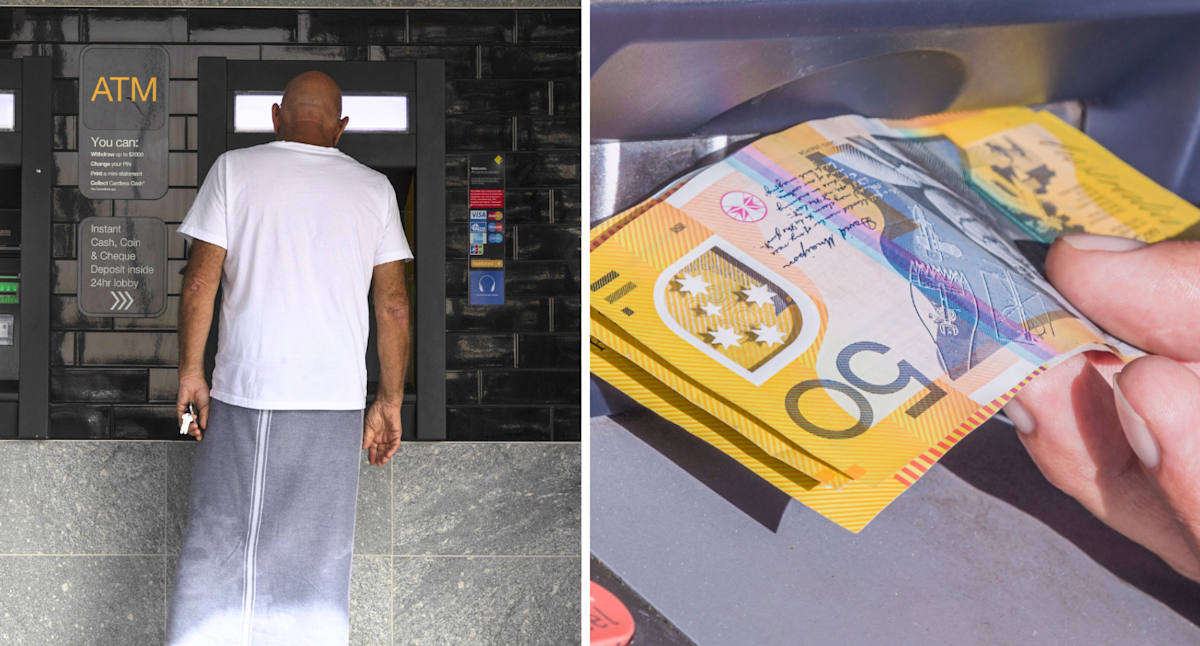
A poll of more than 25,000 Yahoo Finance readers found that 93 per cent were against the idea of a cashless Australia. But Finder’s Graham Cooke told Yahoo Finance that Australia has already largely become a cashless society.
Merchant Machine found that there has been a more than 15 per cent decline in the number of cash machines in Australia per 100,000 people from 2012 to 2021.
If that rate continues at its current rate, it would take 30 years before Australia has no ATMs left.
Australia came in joint 12th with Estonia on Merchant Machine’s list for the countries hurtling towards a ATMless future.
Norway and Ireland topped the data with just 11 years left, followed by Lithuania (14 years), the Netherlands and Cyprus (16 years), and Denmark (23 years).
Norway, which is one of the most cashless countries on the planet, has seen a 44.52 per cent decline in ATMs available between 2012 to 2021.
Ireland wasn’t far behind, with a 41.92 per cent drop.
Do you have a story? Email stew.perrie@yahooinc.com
Commonwealth Bank operates the largest network of cash machines, with nearly 2,000, while ANZ, which has the second-largest, only has 866.
Canstar found that there have been more than 6,000 ATMs removed from Australia in just a five-year period. (Source: Canstar)
Money.com.au also found recently that while digital payments are the overwhelming favourite these days, cash is still beloved by many.
A recent survey found 68 per cent of Aussies, roughly 14.8 million people, back the idea of all businesses being required to accept cash as payment.
Only 5 per cent supported the idea of a no-cash policy.
Cash remains the most reliable payment method — when the internet is down, the power is out, or there’s a tech glitch, it’s often the only way to pay,” Money.com.au’s finance expert Sean Callery said.
“It’s also the only way to dodge debit and credit card surcharges — the most hated fee among Aussies, with 39 per cent ranking it above even ATM withdrawal charges (14 per cent).”
How cash is slowly fading in Australia
Australian Banking Association CEO Anna Bligh said cash payments are expected to drop to just 4 per cent of all transactions by 2030.
That’s a massive drop from the 70 per cent that was recorded in 2007, according to Reserve Bank data.
Yahoo Finance contributor Graham Cooke said ATM withdrawals have been following a general downward trend, which could speak to why cash machines are being removed.
“Overall ATM withdrawals have been declining significantly since 2009, dropping from around 75 million monthly withdrawals to roughly 28 million today,” the Finder expert said.
“Despite a slight uptick after COVID lockdowns, ATM usage has hovered at under 30 million withdrawals per month.
“Even during the past year… ATM withdrawal numbers have remained below the equivalent year-on-year figure for 10 of the past 12 months.”
He suggested that because nearly nine in 10 transactions are digital, “a cashless society isn’t a future possibility — it’s already here”.
Cashless ·Finder
Armaguard, the beleaguered company tasked with transporting cash across Australia, pointed to 2017, when banks ditched the fee attached to withdrawals, as another possible reason why so many have been removed.
Privately-owned ATMs have tried to fill that void, however users can be charged $3 or more to take out their money that way than with a traditional bank’s cash machine.
Cash advocate Jason Bryce has been calling on the banks to keep ATMs alive to ensure physical money keeps flowing through our communities.
“They have more than a social responsibility to deliver cash,” he said.
“They have an economic responsibility to maintain this national economic infrastructure. Banks must ensure that we can have easy, local, cheap, or preferably fee-free access to our cash.”
Editorial Note: While we adhere to strict Editorial Integrity, this post may contain references to products from our partners. Here's an explanation for...
Severstal’s Cherepovets metallurgical plant. Stock image. Russian steelmaker Severstal may cut its investment program by another 24% to around 85 billion roubles ($1.1...








Leave a comment