
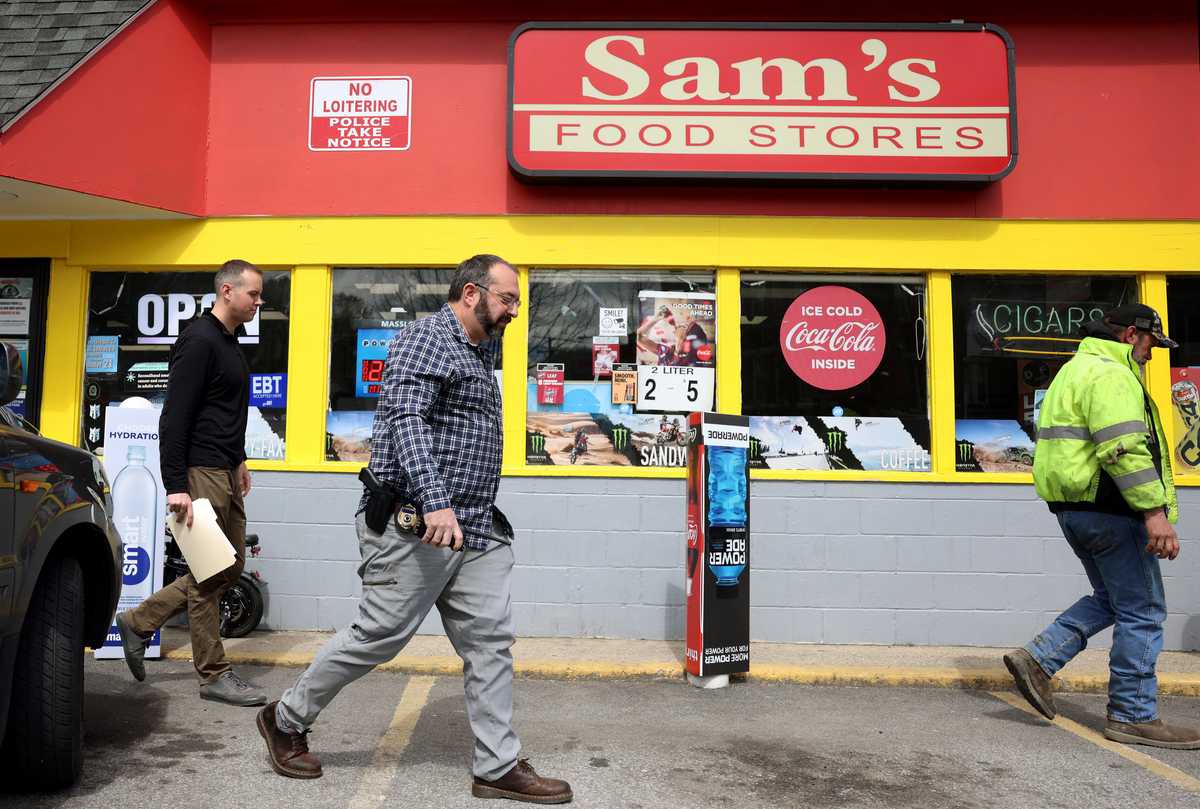
Unlike 32 other states, Massachusetts doesn’t regulate the kiosks.
As a result, each machine can be a digital black hole.
The men stood in the back of Sam’s, a convenience store in Haverhill, with a question hanging between them: Who got to keep the $21,790 in cash?
On the morning of June 7, 2023, they filed into the shop, just a few minutes’ drive from the New Hampshire border. It was an unusual group: Three cops, two officials from the county prosecutor’s office, and a businessman from Las Vegas.
They walked past rows of candy and snacks to gather around an orange crypto kiosk, where customers can convert their cash into Bitcoin or other cryptocurrencies.
The crypto machine looked a lot like an ATM — it had a digital screen, a slot to put in money, and a lockbox inside to hold it. But there was one key difference: Cash only ever went in, never came out. For at least five customers, it was a digital black hole.
A woman had lost $21,790 in the machine back in April, after online scammers persuaded her that buying cryptocurrency was the only way to protect her money from hackers. Once the scammers vanished, she called the police.
Stephen Beaulieu, a police detective in neighboring Merrimac where the woman lived, responded. He’d never seen a crypto scam before, so he did the only thing he could think of: Got a warrant and wrapped the machine in black plastic and evidence tape.
Now, weeks later, Beaulieu and two other police officers were gathered around the kiosk to take the money into evidence, joined by a prosecutor and an investigator from the Essex district attorney’s office. A driver from an armored truck company had pulled up with a key to unlock the machine.
The businessman in the group, Christopher Short, had come on behalf of his 25-year-old son, who was CEO of Coinhub, the company that owned the kiosk. Wearing shorts and a Coinhub T-shirt, Short had flown in overnight from Las Vegas.
A television overhead in Sam’s was tuned to a true-crime show, which could be heard on an officer’s body cam video recording. “Power, greed and jealousy — it can be a toxic combination,” the narrator said.
Short watched as the driver struggled to unlock the machine, then finally stepped forward and typed in a special code. The door clicked open to reveal a container full of $100 bills.
Haverhill police Lieutenant Michael Shinners (left) and Detective Blake Harris after disconnecting a crypto ATM, which had still continued to run inside a convenience store on April 6.
(Jessica Rinaldi/Globe Staff)
As Beaulieu saw it, the cash belonged to the woman who was ripped off by scammers, who were likely based overseas. “What I wanted to do was take the money out and give it back to the victim,” he recalled later.
Short saw things differently. Coinhub had already wired the money to the Bitcoin account the customer specified during her transaction, and the company now needed the cash to make them whole. It wasn’t their fault if the woman transferred the Bitcoin to a scammer trying to steal her money.
“We are very disappointed that we are becoming the victim.” Short said later that day. “We viewed that as our money.”
The encounter is just one in a series of clashes that have been playing out across the nation. Crypto machines have become one of the favorite tools used by scammers to move cash into the often-untraceable digital realm, beyond the reach of law enforcement. The FBI reported $389 million in losses tied to such scams last year, including nearly $7 million deposited at kiosks in Massachusetts. But local investigators believe the real toll is much higher.
In Haverhill, for example, police traced around $500,000 in losses to just seven machines. And there are around 500 in use across the state, according to estimates in March from Coin ATM Radar, an industry site. (State officials can’t offer an official count, because no one is tasked with tracking them.)
A sign from Haverhill police taped to a Coinhub kiosk for buying Bitcoin inside Sam’s Food Store in Haverhill.
(Jessica Rinaldi/Globe Staff)
Coinhub, with roughly 2,000 machines in the US, qualifies as a mid-size operator. The industry’s largest, until recently, was Georgia-based Bitcoin Depot, with more than 8,000. Massachusetts Attorney General Andrea Joy Campbell sued the company this year, alleging that most customers using the kiosks for big transactions were fraud victims and the kiosk operators weren’t putting enough safeguards in place to protect the public.
Bitcoin Depot declared bankruptcy in May, explaining in court filings that their quarterly revenue was cut in half after they imposed strict ID verification measures to try to curb fraud carried out by scammers.
Amid the spike in fraud, at least 32 states have now imposed restrictions on the machines, according to a report by AARP, which has been calling for a nationwide ban. But the industry remains almost entirely unregulated in Massachusetts.
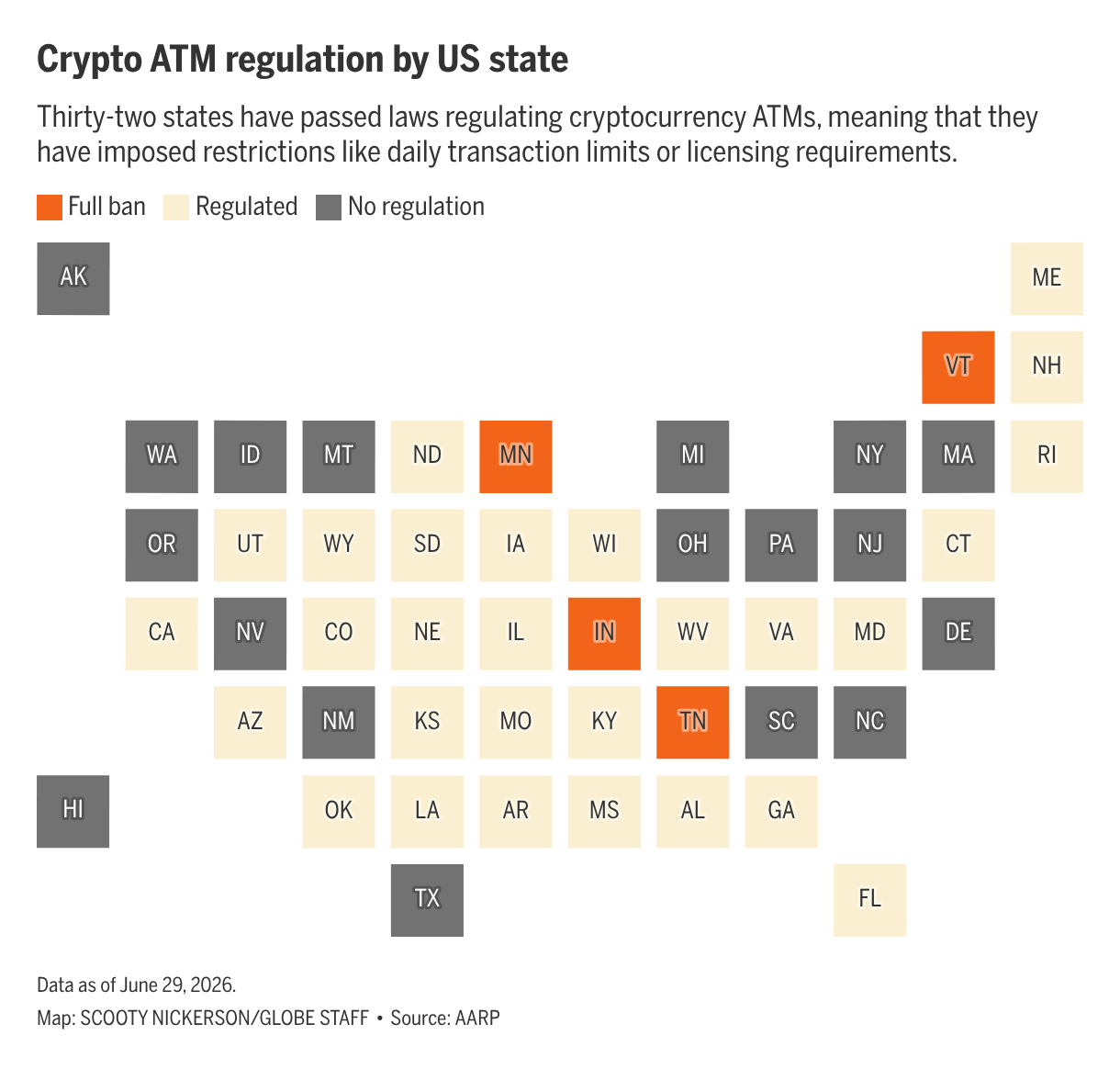
Four states have outlawed crypto kiosks altogether, including Vermont, which recently passed its ban. Other states have instituted such protections as daily deposit maximums, which are meant to at least limit the financial harm to victims.
In Massachusetts, which has yet to pass a single law reining in crypto kiosks, companies make their own rules. The maximum Coinhub’s website says a person can deposit in a single day is $50,000.
A legislative effort to ban the machines, championed by AARP, has been lingering on Beacon Hill, with little sign it will be acted on this year.
Faced with tighter restrictions elsewhere, crypto scammers have increasingly turned their attention to machines based here. They’ve been funneling their marks from other states into this one, said Matthew Patalano, an Essex County assistant district attorney. And that phenomenon has earned this state a dubious honor.
“Right now,” Patalano said. “Massachusetts is the scam capital of New England.”
If you run a small liquor or convenience store, the places where many crypto machines have popped up in recent years, renting space to a kiosk operator can make a lot of sense. According to the Coinhub website, store owners get $900 upfront to cover the first three months of hosting a machine, then $300 a month afterwards. That’s $3,600 a year for a kiosk that takes up about two square feet of floor space.
The kiosks, however, aren’t such good deals for customers looking to get into crypto.
An online broker, such as Fidelity or Robinhood, might charge transaction fees of 1 percent of the total purchase, or even offer it without a fee. But fees at crypto kiosks, which are often hidden in fine print, can stretch to 30 percent, or $6,000 out of a $20,000 purchase. (Fees vary by company and location, but Short told Merrimac investigators that the standard Coinhub fee at the Sam’s machine was 24.99 percent before any discounts.)
Prosecutors say that inflated fees at crypto kiosks scare away many potential customers, leaving primarily scam victims and criminals looking to hide their money.
“Who goes into a bodega with a stack of bills to buy Bitcoin at a [high] markup for an already risky investment?” asked Dave O’Sullivan, deputy chief of appeals for the Essex district attorney’s office.
In a report, Campbell’s office estimated that some 80 percent of the biggest depositors at crypto kiosks were scam victims, and most were 67 years or older. A separate investigation in Iowa found that over 98 percent of the money residents reported depositing at Bitcoin Depot machines was tied to fraud.
The scammers themselves are often based oversees, in places like India, Nigeria, and Southeast Asia, according to federal and local law enforcement officials.
The Merrimac woman whose case led to the unusual meeting at Sam’s was shopping for shoes on her iPad in April 2023 when a window popped up warning her of a computer virus, police records show. The scammers, posing as Apple tech support and representatives of her bank, persuaded her to withdraw $21,800 from her bank account, saying moving it into crypto was the only way to protect it. They coached her along — if the bank teller asked questions, she should say she was buying a car with cash.
Scammers also instruct their marks how to operate the kiosks and connect them to specific crypto accounts. In Sam’s, the clerk tried to warn the woman that Bitcoin was used to rip off people, but she kept feeding money into the machine, according to police reports. She was able to put in $21,790 — it wouldn’t accept her last $10 bill.
After Detective Beaulieu and the others retrieved the cash from the Coinhub machine in June 2023, the group reconvened in an interview room at the Merrimac police station.
Detective Stephen Beaulieu, shown inside his office at the Merrimac Police Department, was intent on returning the $21,000 to the woman who was scammed in a cryptocurrency deposit. (Jessica Rinaldi/Globe Staff)
Beaulieu turned on the room’s video camera, and the recording shows Short counting out the woman’s $21,790, stacking $100 bills into neat piles on the evidence table.
Prosecutors then began to ask Short about the victim. At first, he seemed skeptical that she even was one. He said he didn’t know if she was making the whole thing up to defraud Coinhub.
“Unfortunately, we are now dragged into a situation where we don’t believe that we belong,” Short said.
At one point, he offered an analogy: Think of a Coinhub crypto kiosk like a Coca-Cola vending machine. Crypto kiosk operators were just providing a legitimate service, like the vending machine company. They couldn’t control what customers did. “If you … put a dollar in and press Coke, and give the Coke to someone else,” he said, “does the vendor owe you money back?”
Still, since the kiosk was the scene of a fraud investigation, Coinhub would need to be involved in future discussions. A prosecutor asked Short whom they should direct subpoenas to at Coinhub.
“It would be the compliance officer,” Short replied. “But I am asking if you could kindly send them to me, because I don’t like things falling through the cracks.”
A prosecutor asked what role Short served at Coinhub.
“I’m just dad,” Short said. “My son owns it and I just help him in any way I can. I’ve been retired for a long time.”
“Oh, so you have no formal role in the company?”
“No.”
“And so you are not employed or paid by the company?”
“I am not.”
The prosecutor paused. “That’s a good dad.”
Beaulieu sat quietly throughout the exchange, listening. If you have nothing to do with the company, he recalled thinking, why are you here?
Traditional banks, and the ATMs they operate, are governed by a dizzying array of regulations. But in Massachusetts, crypto kiosks are almost entirely ungoverned by banking rules, even though they let customers wire tens of thousands of dollars a day to anonymous, online accounts.
It’s a fact that perplexes veteran investigators in the state, including Matthew Riportella, who oversees white collar crime investigations in the FBI’s Boston office.
“There’s so much regulation at your brick-and-mortar banks, like wire transfers are reviewed,” he said. “That doesn’t happen at crypto ATMs. Almost anyone can set one up without oversight.”
A cryptocurrency ATM setup in a convenience store on May 12, 2022 in Miami, Fla. (Photo by Joe Raedle/Getty Images)
The Bitcoin logo appears on the display screen of a crypto currency ATM at the Smoker’s Choice store, Tuesday, Feb. 9, 2021, in Salem, N.H. (AP Photo/Charles Krupa)
Some crypto kiosk entrepreneurs, seeing how their machines have been misused, have decided to quit the business. Marc Grens built his Chicago-based company DigitalMint into one of the country’s largest kiosk operators, with roughly 1,400 machines. Then he shut the business down, convinced it had become inseparable from fraud.
“We communicated with the industry our concerns on how bad the scams and fraud were, and nobody cared, because the reality was they were making too much money,” Grens said.
The Short family has stayed in the business. Besides operating in an industry that has been criticized for not doing enough to protect customers, Coinhub has run into trouble because of its high fees. In 2025, the company agreed to pay $105,000 in restitution to California consumers who were charged more than the maximum fees allowed in that state, as well as a $675,000 penalty to the state for violating its consumer financial protection law.
Christopher Short has a work history with checkered companies that suggests he’s no stranger to controversy. And it goes beyond a $140,000 tax lien on him that still hasn’t been cleared, according to the IRS and records from Clark County in Nevada.
Short, his son Logan, and Coinhub did not respond to interview requests for this story, or to a detailed list of questions sent by the Globe. Reached briefly by phone, Christopher Short said, “I don’t comment to media — ever,” and hung up.
Earlier in his career, Short worked in the timeshare industry, at one point as director of sales and marketing at an Illinois company, Vacation Resort Management Inc. Indiana’s attorney general sued the firm, one of several in a network they alleged lured customers with promises of free TVs and other prizes and sold packages that couldn’t be used or canceled. A $248,125 default judgment was levied against the company in 2009, after it didn’t respond in the case. Short moved on.
By 2010, corporate records listed him as the chief operating officer of Heart Check America, a chain of body-scanning clinics that charged patients high fees for medical scans pitched aggressively by staff who lacked medical training, according to a complaint filed by the Illinois attorney general. The company denied wrongdoing in court, but closed down within a year.
Short was not named in either case filed against his former employers.
In 2019, Short’s son Logan, then 21, founded Coinhub, which has apparently turned into a profitable operation. Records show Logan purchased two Las Vegas-area mansions in 2024, worth a combined $13 million. One had an eight-car garage; the other a sauna and movie theater. According to one of the home sellers, Christopher Short was involved in the purchase.
He has also been involved in the workings of Coinhub, though he claims no formal role at the company. Corporate filings in Florida list him as the primary contact. And in Massachusetts, on at least three occasions in the last few years, Christopher Short or his brother Dennis arrived to deal with the investigations of third-party scams, according to police reports. One report described Christopher as the company’s owner.
In November 2023, a woman was tricked into depositing around $15,000 into a Coinhub kiosk in Middleton and a police officer bagged the machine to prevent the cash from being collected. Christopher Short dispatched Dennis to help release it, according to police records and an officer involved in the case. Dennis Short didn’t respond to a Globe request for comment.
The victim, who asked to remain anonymous to protect her privacy, still hasn’t recovered the money, which represented the bulk of her savings. She’s furious at the scammers who swindled her. But she also blames the Short family, whose machines she believes make it too easy for scammers to steal from people.
If she could speak to the Shorts, she would tell them to “stop hurting people,” she said. “Stop taking advantage of people, because a lot of people are worse off than I am. You should be ashamed of yourselves.”
After Christopher Short and the others left Sam’s convenience store in June 2023, heading to the Merrimac police station, the Coinhub kiosk was back open for business.
Over the next two years, at least four more fraud victims sank their money into the machine, according to a Globe analysis of police reports, for a combined total of some $128,000 in losses.
At some point, the local police hung up a large red sign near the machine. “STOP. READ BEFORE YOU DEPOSIT MONEY,” it said, explaining how the kiosk could be misused. It didn’t seem to help much.
In July 2024, a man was duped into depositing $42,000 into the machine by scammers impersonating agents from the Texas attorney general’s office, who claimed it would clear a warrant for his arrest that didn’t exist.
That November, a woman in Salem, N.H., was tricked by scammers pretending to be local cops into traveling over the border to Sam’s and depositing $9,901 into the machine.
Two months later, in January 2025, a Globe reporter witnessed a woman putting money into the machine, after being told her accounts at Fidelity had been compromised. She was instructed to deposit $20,000 for “safekeeping,” according to a later police report.
Though two store workers and the journalist warned the woman she was likely being scammed, she continued to feed $100 bills into the kiosk. “I know what I’m doing,” she said.
Last October, a man deposited $35,000 after being convinced by scammers it would keep him safe from Chinese hackers. If he didn’t, he was told, they would falsely frame him for having child pornography.
Haverhill police Lieutenant Michael Shinners, reflected in a crypto kiosk. (Jessica Rinaldi/Globe Staff)
Meanwhile, the original victim at Sam’s, whose contested $21,790 summoned Christopher Short to Haverhill, negotiated a private settlement with Coinhub, according to her attorney Keith Sachs. “The case has been settled, and the terms of the settlement are confidential,” he said.
Many crypto scam victims don’t want to talk about how they were tricked, and the Globe isn’t identifying the victims who requested anonymity. But Don Deprez, who lives near Worcester, wants others to know how crypto scams can hurt people’s lives.
In late 2020, according to notes Deprez made during his review of banking records, his wife started depositing money at crypto kiosks around greater Worcester. First, $6,900 on Oct. 16, then another $700, then $1,500. By mid-December, the total was up to $76,100. When Deprez spotted the unusual bank withdrawals a few days before Christmas, he asked his wife what was happening.

Don Deprez’s records tracing 2020 transactions (Courtesy of Don Deprez)
She told him about a man she’d met while teaching water aerobics classes at a YMCA. She said he was a structural engineer with projects in Turkey and needed short-term loans to help fund them. She thought she was helping the man she knew as “Will Turner.”
Deprez was skeptical. “What, you believe this line of BS?” he recalled asking her.
Deprez said his wife (who didn’t respond to Globe interview requests) continued to withdraw money from the bank and liquidate investments, until police and federal agents got involved and told her she was being victimized. Still, Deprez said, the deposits continued.
By June 2021, he had a shocking tally: $269,100. The vast majority was deposited at crypto kiosks around Worcester, but some was also sent to a post-office box in Georgia.
Eventually, Deprez said, the situation got so difficult that his wife of 54 years told him she wanted a divorce.
Even five years later, he still finds it all hard to imagine. “If a novelist wrote a story about this and took it to the publisher, a publisher would say, ‘who can believe this?’”
In Haverhill, the frustration about crypto kiosks, the one at Sam’s and elsewhere in the city, boiled over at a City Council meeting in March. A police officer outlined how scammers were using the kiosks, and a victim explained how she was conned into putting her money into a machine owned by the company Bitstop.
Mary Mbugua was undergoing radiation treatment for breast cancer in July 2024 when a scammer, posing as a law enforcement official, accused her of trafficking drugs from Kenya. “I don’t even know what drugs look like,” she said. They didn’t care, and told her she’d be arrested unless she moved her money.
Mary Mbugua, a breast cancer patient, was targeted in a crypto scam. (Jessica Rinaldi/Globe Staff)
He kept her on the phone for nearly two hours, forbade her from calling her son, and directed her to a convenience store in Haverhill.
There, hands shaking, she fed $5,500 into the crypto kiosk — much of it given to her by friends when they came to her apartment to pray for her recovery. The machine took a 20.5 percent cut, roughly $1,130, according to the receipt.
When it was over, Mbugua had only $35 left in her bank account. “Just 35 dollars, between me and poverty,” she told the Globe. “I cried.”
Local police managed to get back all the money before the scammers took control of it — a rarity in these cases. After she shared her story with the Haverhill City Council, several councilors weighed in.
“Boy, this topic runs up my backside like 8 inches of barbed wire,” said City Councilor Ralph Basiliere. “I’m quite chagrined to hear that local businesses are allowing these machines that are ripping off old ladies in my neighborhood.”
The business owners hosting the machines weren’t happy either, the police officer said. “A lot of them say that honestly the juice isn’t worth the squeeze, and they are trying to get them out,” he explained. “But the companies just won’t come and pick them up at this point.”
In the end, the council voted 10-0 to ban crypto kiosks in Haverhill, and would fine stores $300 a day for having them. A handful of other municipalities have passed similar bans, including Gloucester, Peabody, and Waltham.
On a Monday afternoon in April, a few weeks before the Haverhill ban took effect, two police officers rolled through the city in a black SUV, stopping at one convenience store after another to hand out informational notices. None of the store owners balked. Most walked straight to the back of their shops and unplugged the machines.
An employee disconnected the Coinhub kiosk inside Sam’s on April 6, shortly before a city-wide ban on the machines went into effect. (Jessica Rinaldi/Globe Staff)
At two of the six stops, store managers said kiosk companies had stopped paying the promised rent, but did not come and collect the machines.
At Sam’s, Peter Basnet, a longtime manager, told the officers that just days earlier, yet another woman had walked into the store, phone pressed to her ear, heading straight for the crypto kiosk. Basnet stepped in and talked her out of it, he said, and she left without depositing anything.
Basnet welcomed the ban, because exposing his customers to the machine “doesn’t make me feel good.” He said he tried to get Coinhub to remove its kiosk, but no one from the company had responded in months.
Detective Blake Harris said that silence is part of a pattern, even when police reach out. “We just don’t even get responses from a lot of companies when we try to get the fee back to the victim,” he said.
Beaulieu, the Merrimac detective, was glad to hear Haverhill had finally done something. He’s made it his personal mission to keep them out of his own town, too.
But that’s just two places in Massachusetts. In communities elsewhere across the state, some just a short drive away, hundreds of crypto kiosks are still online, screens glowing, ready for the next customer.

About this story
Reporting by Scooty Nickerson. Editing by Yoohyun Jung and Francis Storrs. Photography by Jessica Rinaldi. Photo editing by Leanne Burden Seidel. Video editing by Julianne Varacchi and Raphael Chinca. Design and development by Agnes Lee. Design editing by Ryan Huddle. Audience engagement by Kelly Broder and Cecilia Mazanec. SEO editing by Ronke Idowu Reeves. Copy editing by Michael Bailey. Technical editing by Nalini Dokula.
© 2026 Boston Globe Media Partners, LLC












Leave a comment