
…Naira stock hits N5.73 trn, but real value falls 14%
Nigeria’s currency in circulation rose 72.4% in five years to N5.73 trillion in 2025, but the increase in the volume of naira notes has been accompanied by a significant erosion in their real purchasing power amid persistent inflation.
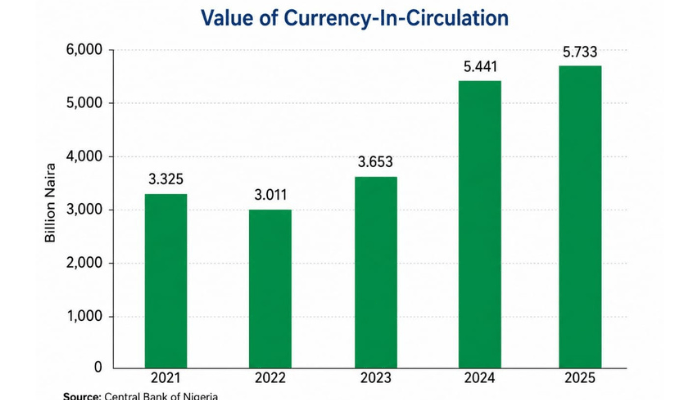
Currency in circulation rose from N3.325 trillion in 2021 to N5.733 trillion in 2025, according to Central Bank of Nigeria (CBN) data. It declined to N3.011 trillion in 2022 before rising to N3.653 trillion in 2023, jumping 49% to N5.441 trillion in 2024 and reaching N5.733 trillion in 2025.
The CBN, in its 2025 Annual Report, attributed the increase to the increased pace of economic activity and rising demand for cash. The bank approved a currency indent of 5,706.8 million pieces across various denominations for 2025, up 20.5% from the 4,737.5 million pieces approved in 2024.
However, economic analysts say the rise cannot be viewed solely as evidence of stronger economic activity, arguing that inflation and the rapid expansion of electronic payments are also important factors shaping demand for physical cash.
Dele Kelvin Oye, Chairman of Alliance for Economic Research and Ethics Ltd/Gte, said a review of CBN data from 2021 to 2025 showed that the headline increase in currency in circulation masked a decline in the real value of cash held by Nigerians.
Oye estimated that purchasing power declined by about 14.3% in real terms in 2025, noting that Nigeria’s annual average inflation rate stood at 23.01%, compared with a 5.37% increase in nominal currency in circulation.
“The CBN printed more paper. Nigerians got poorer,” Oye said, challenging the central bank’s characterisation of the increase as evidence of rising demand for cash.
He said the growth in physical cash should be assessed alongside price movements and the changing structure of payments in the economy.
Between 2021 and 2025, Oye estimated that cumulative consumer price inflation had significantly outpaced the growth in nominal currency in circulation, leaving the real value of currency in circulation substantially lower than its 2021 level.
His analysis showed that currency in circulation as a proportion of nominal gross domestic product stood at about 1.30% in 2025, compared with 1.46% in 2024 and 1.37% in 2021.
The figures point to a disconnect between the nominal quantity of naira in circulation and its purchasing power, according to Oye, who argued that the increase in physical currency should not automatically be interpreted as stronger underlying demand for cash.
Read also: Tinubu charges MDAs to prioritise service delivery, tangible results
“When you adjust for inflation, the thing economists do before making claims about ‘real’ anything, the result is sobering,” Oye said.
He said inflation has forced Nigerians to use more naira notes to purchase goods and services whose prices have increased significantly, particularly in parts of the economy where cash remains dominant.
Oye also pointed to the sharp movements in currency in circulation following the naira redesign. Cash in circulation declined by 9.4% in 2022 following the policy announced by former CBN Governor Godwin Emefiele. It subsequently recovered by 21.3% in 2023 before recording a 49% increase in 2024.
He said the unusually strong 2024 increase should not be interpreted as normal underlying demand for cash, given the disruptions to cash supply during and after the naira redesign. The 5.4% growth recorded in 2025 therefore represented a significant moderation.
Oye argued that the persistence of cash demand should not necessarily be interpreted as resistance to digital payments. Instead, inflation has increased the amount of physical currency Nigerians need to complete transactions as the prices of goods and services rise.
The figures also highlight a growing paradox for the CBN’s cashless policy. While electronic payments are expanding rapidly, physical cash remains deeply embedded in Nigeria’s economy, particularly among informal businesses and consumers who continue to conduct transactions in cash.
Oye argued that inflation has forced Nigerians to use more naira notes to purchase goods and services whose prices have increased significantly. Yusuf similarly pointed to the simultaneous effects of inflation and digitalisation, saying the two trends are shaping cash demand in opposite directions.
Digital payments reduce the need for physical cash for some transactions, while inflation increases the nominal amount of money required for transactions that are still conducted in cash.
The implication is that the N5.73 trillion figure reflects a combination of economic expansion, higher prices and continued reliance on physical currency, even as digital payment systems gain ground.
Muda Yusuf, Chief Executive Officer of the Centre for the Promotion of Private Enterprise, however, said it would be misleading to attribute the increase in currency in circulation entirely to inflation.
He said stronger economic activity was also contributing to higher demand for cash, particularly as economic transactions expanded.
“Certainly the growth in the absolute figures is a reflection of the growth in the economy,” Yusuf said, pointing to the improvement in Nigeria’s economic growth between 2024 and 2025.
Nigeria’s real GDP growth accelerated to 3.87% in 2025 from 3.38% in 2024, according to the figures cited in the analysis.
“As the economy grows, the demand for cash will also grow, so there’s a correlation between economic growth and demand for cash,” Yusuf said.
Yusuf, however, said the slower pace of growth in currency in circulation between 2024 and 2025 could also reflect the rapid adoption of electronic payments.
“If you look at the numbers in terms of electronic payments, the growth is staggering in the growth of electronic payments over this period,” he said.
He noted that the migration to electronic payments was becoming particularly pronounced among informal-sector operators, small businesses and micro-enterprises, adding that this could have reduced the momentum of growth in physical currency.
Electronic payment transactions have expanded significantly as banks, fintech companies and payment platforms have widened access to digital financial services. The development means the relationship between economic activity and physical cash demand is becoming more complex, as a growing volume of transactions can take place without physical naira.
Yusuf also acknowledged that inflation remains an important driver of the increase in the absolute value of currency in circulation. Higher prices mean consumers require more naira to purchase the same quantity of goods and services, particularly in segments of the economy where cash remains dominant.
“Inflation is also a factor in the absolute growth in numbers because if you are buying something for maybe N1,000 before and you are using cash, these days you need close to N1,500,” Yusuf said.
He said the increase in demand for cash reflected a combination of economic expansion and higher prices, while digital payments were simultaneously reducing the need for physical currency in some transactions.













Leave a comment