

Bitcoin (BTC) slips below $64,000 at the time of writing on Thursday after failing to close above the 50-day Exponential Moving Average (EMA) near $65,120 the previous day. Institutional demand shows mild improvement, with spot Exchange Traded Funds (ETFs) recording a second consecutive day of inflows this week. However, rising US-Iran tensions have renewed inflation concerns, offsetting the positive impact of softer-than-expected US inflation data on the Crypto King.
US-Iran tensions revive inflation concerns
Bitcoin stalls trading below $64,200 on Thursday as escalating skirmishes between the US and Iran renew inflation concerns. The continued military tensions between both countries in the Middle East have raised concerns over potential disruptions to global energy supplies, pushing crude oil prices higher.
Earlier this week, softer-than-expected US Consumer Price Index (CPI) and Producer Price Index (PPI) data for June initially supported BTC’s recovery by reinforcing expectations that the Federal Reserve (Fed) will keep interest rates on hold, with BTC reclaiming $65,600 on Wednesday.
However, the renewed rise in oil prices has revived fears of energy-driven inflation. This has strengthened the safe-haven US Dollar (USD) and capped the Crypto King’s upside.
Mild signs of improvement
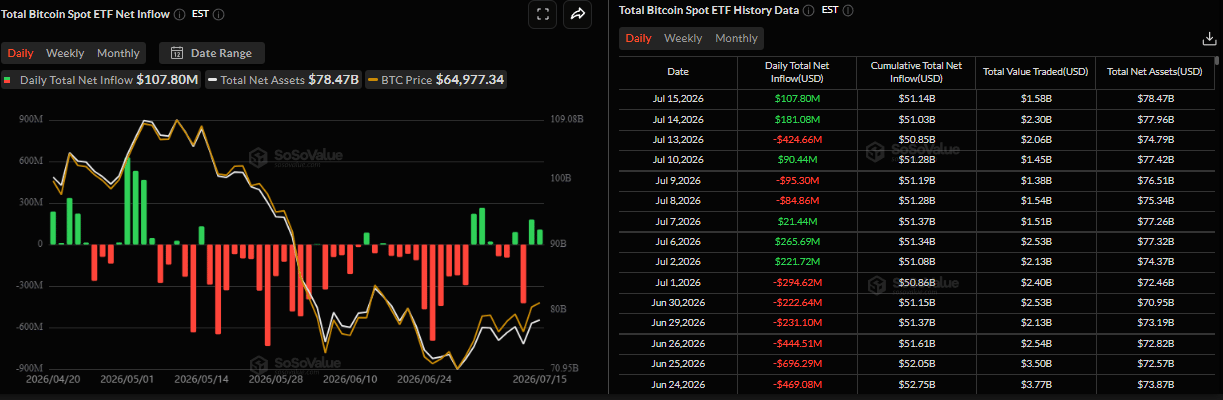
Institutional demand signal slight improvement so far this week. SoSoValue data shows that spot ETFs recorded an inflow of $107.80 million on Wednesday following a positive flow of $181.08 million the previous day. However, these inflows were insufficient to offset Monday’s sharp $424.66 million outflow, suggesting that institutional sentiment remains cautious despite the recent recovery in Bitcoin.
Bitcoin Price Forecast: BTC faces rejection around 50-day EMA
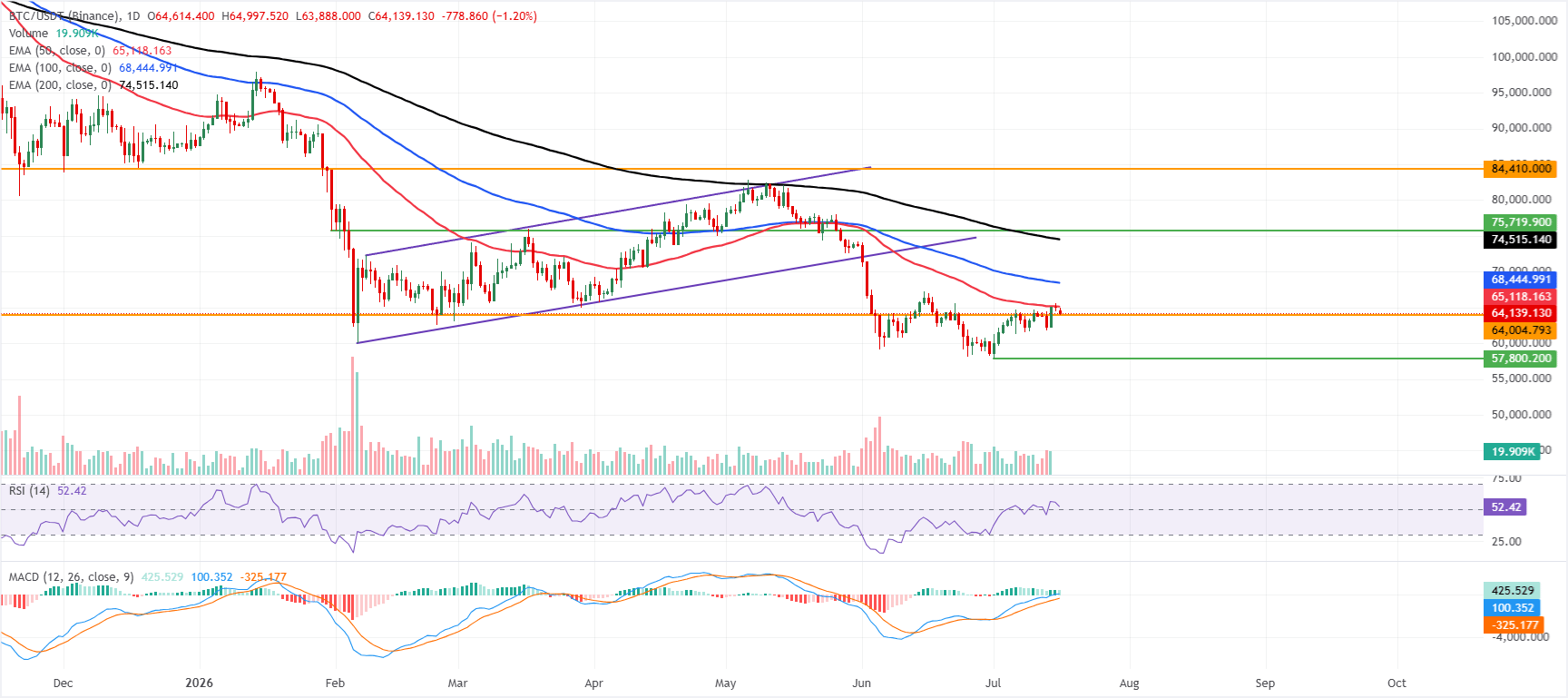
Bitcoin price trades at $64,138 on Thursday after fading rejection from the 50-day EMA at $65,118. Moreover, BTC also remains below the 100-day and 200-day EMAs at $68,444 and $74,515, respectively.
This alignment of short- and long-term EMAs above spot suggests the broader trend remains under pressure, even as the Relative Strength Index (RSI) holds around 52 on the daily chart and the Moving Average Convergence Divergence (MACD) stays in positive territory, hinting at modest underlying buying interest that has yet to overcome the prevailing overhead structure.
On the downside, immediate support is defined by the horizontal level at $64,004, which acts as the nearest demand zone just beneath the current price.
On the topside, initial resistance is seen at the 50-day EMA near $65,118, followed by the 100-day EMA at $68,444 and the 200-day EMA at $74,515, before a more distant barrier emerges at the prior horizontal resistance around $84,410; as long as BTC trades below this stacked cluster of moving averages, rallies are likely to struggle and the near-term bias would stay constrained.
(The technical analysis of this story was written with the help of an AI tool. Know more.)
Bitcoin, altcoins, stablecoins FAQs
Bitcoin is the largest cryptocurrency by market capitalization, a virtual currency designed to serve as money. This form of payment cannot be controlled by any one person, group, or entity, which eliminates the need for third-party participation during financial transactions.
Altcoins are any cryptocurrency apart from Bitcoin, but some also regard Ethereum as a non-altcoin because it is from these two cryptocurrencies that forking happens. If this is true, then Litecoin is the first altcoin, forked from the Bitcoin protocol and, therefore, an “improved” version of it.
Stablecoins are cryptocurrencies designed to have a stable price, with their value backed by a reserve of the asset it represents. To achieve this, the value of any one stablecoin is pegged to a commodity or financial instrument, such as the US Dollar (USD), with its supply regulated by an algorithm or demand. The main goal of stablecoins is to provide an on/off-ramp for investors willing to trade and invest in cryptocurrencies. Stablecoins also allow investors to store value since cryptocurrencies, in general, are subject to volatility.
Bitcoin dominance is the ratio of Bitcoin’s market capitalization to the total market capitalization of all cryptocurrencies combined. It provides a clear picture of Bitcoin’s interest among investors. A high BTC dominance typically happens before and during a bull run, in which investors resort to investing in relatively stable and high market capitalization cryptocurrency like Bitcoin. A drop in BTC dominance usually means that investors are moving their capital and/or profits to altcoins in a quest for higher returns, which usually triggers an explosion of altcoin rallies.













Leave a comment