
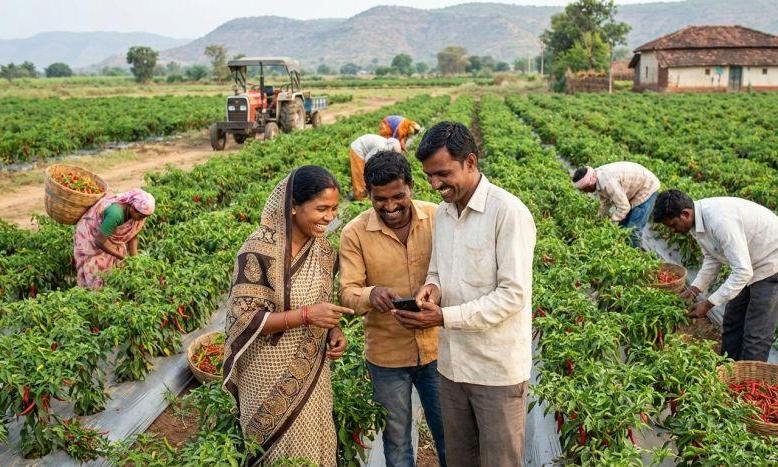
HYDERABAD: A World Bank study has mentioned an effort by the Telangana agriculture department in providing AI-based monsoon forecasts to small farmers, who then changed their cultivation and investment decisions. Some of them recorded net savings of up to $560 per farmer, according to the World Bank’s World Development Report 2026: The Promise of Artificial Intelligence.
The advance weather information holds particular significance this year, with the forecasts that the El Nino factor could negatively affect agriculture by impacting rainfall.
The farmers in Medak and Mahbubnagar districts were provided with weather information several weeks before the expected arrival of the monsoon, according to a senior official who was involved in the effort.
Some farmers reduced costs by as much as one-third when the forecast indicated favourable conditions, while others avoided risky investments and achieved substantial savings, the report said.
The research was conducted across nearly 250 villages. Researchers found during their preliminary visits to Medak and Mahbubnagar that farmers’ estimates of the monsoon’s arrival varied considerably, underlining the value of accurate advance information, the official told Deccan Chronicle on Sunday.
The World Bank report said: “In the Indian state of Telangana, for example, an AI weather forecasting system enabled smallholder farmers to alter their behaviour in response to specific risks, causing some to increase farm expenditures by as much as one-third and others to reap net savings of as much as USD 560 per farmer.”
The Telangana study showed that the forecasts were not treated merely as general weather updates. Farmers used the information to decide how much land to cultivate, which crops to grow and how much to spend on seeds, labour and other inputs, said the official.
Farmers who received indications of a shorter monsoon season increased the area under cultivation and invested more in pre-harvest activities, while those who anticipated a longer season adjusted their plans differently. The study recorded a rise of about 34 per cent in pre-harvest expenditure among a section of farmers who changed their plans in response to the forecast, The information was particularly useful for farmers who had limited access to government advisories and agricultural extension workers. The World Bank said AI-based weather forecasts made wider economic effects in farming households.
Some households used the information to adjust non-agricultural investments as well; four out of seven newly established non-farm businesses continued to operate, while households collectively reduced their debt by half, contributing to net savings of more than $560 per farmer and nearly doubling business profits.
The University of Chicago’s Climate and Energy Policy Institute said that providing a monsoon forecast about a month in advance resulted in substantial savings and losses averted for farmers who tailored their planting investments to the expected weather conditions.
The research formed part of a wider effort to take long-range weather information to millions of farmers. In 2025, AI-based monsoon-onset forecasts were disseminated to about 3.8 crore farmers in India through digital channels, according to the research material.
The World Bank used the Telangana findings to urge developing countries to accelerate the adoption of small, affordable and locally relevant AI tools.
It said the benefits of AI need not come only from expensive frontier models or large language systems concentrated in a few companies.
“Today’s developing economies missed the first Industrial Revolution and spent the next two centuries paying the price. They cannot afford to miss this one,” said Indermit Gill, World Bank senior vice-president and chief economist.
The farmers in Medak and Mahbubnagar districts were provided with weather information several weeks before the expected arrival of the monsoon, according to a senior official who was involved in the effort.
Some farmers reduced costs by as much as one-third when the forecast indicated favourable conditions, while others avoided risky investments and achieved substantial savings, the report said.
The research was conducted across nearly 250 villages. Researchers found during their preliminary visits to Medak and Mahbubnagar that farmers’ estimates of the monsoon’s arrival varied considerably, underlining the value of accurate advance information, the official told Deccan Chronicle on Sunday.
The World Bank report said: “In the Indian state of Telangana, for example, an AI weather forecasting system enabled smallholder farmers to alter their behaviour in response to specific risks, causing some to increase farm expenditures by as much as one-third and others to reap net savings of as much as USD 560 per farmer.”
The Telangana study showed that the forecasts were not treated merely as general weather updates. Farmers used the information to decide how much land to cultivate, which crops to grow and how much to spend on seeds, labour and other inputs, said the official.
Farmers who received indications of a shorter monsoon season increased the area under cultivation and invested more in pre-harvest activities, while those who anticipated a longer season adjusted their plans differently. The study recorded a rise of about 34 per cent in pre-harvest expenditure among a section of farmers who changed their plans in response to the forecast, The information was particularly useful for farmers who had limited access to government advisories and agricultural extension workers. The World Bank said AI-based weather forecasts made wider economic effects in farming households.
Some households used the information to adjust non-agricultural investments as well; four out of seven newly established non-farm businesses continued to operate, while households collectively reduced their debt by half, contributing to net savings of more than $560 per farmer and nearly doubling business profits.
The University of Chicago’s Climate and Energy Policy Institute said that providing a monsoon forecast about a month in advance resulted in substantial savings and losses averted for farmers who tailored their planting investments to the expected weather conditions.
The research formed part of a wider effort to take long-range weather information to millions of farmers. In 2025, AI-based monsoon-onset forecasts were disseminated to about 3.8 crore farmers in India through digital channels, according to the research material.
The World Bank used the Telangana findings to urge developing countries to accelerate the adoption of small, affordable and locally relevant AI tools.
It said the benefits of AI need not come only from expensive frontier models or large language systems concentrated in a few companies.
“Today’s developing economies missed the first Industrial Revolution and spent the next two centuries paying the price. They cannot afford to miss this one,” said Indermit Gill, World Bank senior vice-president and chief economist.





Leave a comment