
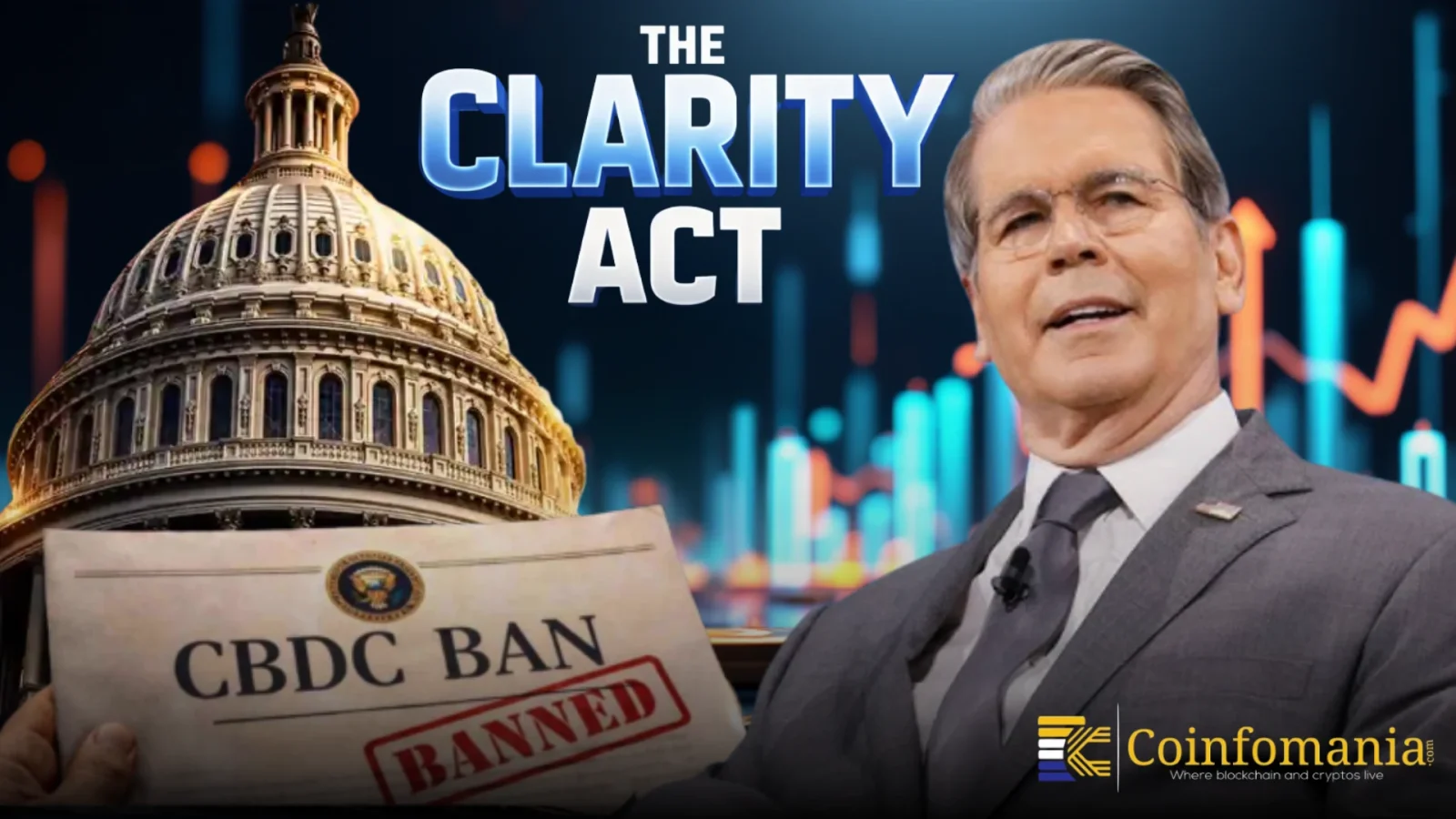
U.S. Treasury Secretary Scott Bessent has renewed calls for Congress to pass the CLARITY Act. He is arguing that the United States needs a clear regulatory framework to bring digital asset activity back onshore. Speaking amid ongoing debates over crypto oversight and central bank digital currencies.
Bessent said the country must avoid the “Wild Wild West offshore” environment that has developed due to regulatory uncertainty. His latest remarks come as the CLARITY Act continues advancing through Congress. As lawmakers debate whether a ban on a Federal Reserve-issued CBDC should become permanent.
Why Bessent Says Regulatory Clarity Matters
Bessent’s comments highlight growing momentum behind the Crypto Clarity Act. It seeks to establish clear rules for digital assets in the United States. The legislation would divide oversight responsibilities between the SEC and the CFTC. This helps companies understand which regulator governs specific assets.
Supporters argue that the lack of regulatory certainty has pushed innovation, capital and talent overseas. As a result, crypto firms have increasingly expanded operations into jurisdictions. Such as Singapore, Abu Dhabi, and other markets with clearer digital asset frameworks.
According to Bessent, bringing crypto businesses back to the United States would strengthen consumer protections. While allowing the country to maintain leadership in financial innovation. His remarks have become a major talking point in recent crypto regulation news as lawmakers weigh the future of digital asset legislation.
CLARITY Act Gains Support in Washington
The CLARITY Act was introduced in May 2025 and later passed the House with bipartisan support. More recently, the legislation advanced out of the Senate Banking Committee on May 14, 2026. This marks another important milestone.
The bill includes several key provisions:
- CFTC oversight for digital commodities such as Bitcoin
- SEC oversight for securities-like digital assets
- Consumer protection requirements
- Anti-money laundering safeguards
- Clear registration pathways for exchanges and platforms
Senator Cynthia Lummis also recently emphasized the need for action. She warned that customers of failed digital asset exchanges currently lack guaranteed ownership rights over their assets during bankruptcy proceedings.
Bessent Reaffirms Opposition to CBDCs
Alongside his push for regulatory clarity, Bessent reiterated that the Trump administration has no plans to launch a central bank digital currency. “There will be no Central Bank Digital Currency,” Bessent said. He added that the administration prefers encouraging private sector innovation. Rather than creating a government controlled digital dollar.
Treasury Secretary @SecScottBessent reiterated today that there will be no CBDC under the Trump administration.
However, it’s worth noting that the House-passed ROAD to Housing Act includes a temporary ban on a Fed-issued CBDC that expires in December 2030. That bill has yet to… https://t.co/PxAeiApjyK
— Eleanor Terrett (@EleanorTerrett) May 28, 2026
The current debate centers on a temporary CBDC ban included in the House-passed ROAD to Housing Act. But that provision expires in December 2030. It creates concerns among some lawmakers that a future administration could revisit the issue. Supporters of a permanent ban argue that CBDCs could increase government monitoring of financial activity. Critics of a permanent prohibition, meanwhile, believe the technology could improve payment efficiency and financial inclusion if proper safeguards exist.
What This Means for the Crypto Industry
The combination of regulatory clarity and opposition to a CBDC reflects a broader shift in U.S. crypto policy. Industry leaders have long argued that uncertainty surrounding digital assets has discouraged investment and innovation.
If Congress ultimately passes the CLARITY Act, the legislation could provide the legal certainty. That is needed for exchanges, developers, and institutional investors to expand operations in the United States. At the same time, a continued rejection of a CBDC would reinforce the administration’s preference for private-sector digital asset solutions over government-issued alternatives.
What Comes Next
The Senate Banking Committee has already advanced the CLARITY Act. But the legislation still requires approval from the full Senate before reaching President Trump‘s desk. With support from Treasury officials, crypto advocates and lawmakers such as Cynthia Lummis, pressure is building on Congress to act. As the digital asset industry grows into a multi-trillion-dollar market. The outcome of the CLARITY Act and the CBDC debate could help determine whether the United States remains a global leader in crypto innovation.












Leave a comment