
Cash circulating outside Bangladesh’s banking system has surged to a record high, despite a rapid expansion of digital payment systems across the country.
Central bank data show currency held outside banks exceeded BDT 3.49 trillion at the end of May before climbing further in June and July. A Bangladesh Bank official said the figure has now surpassed BDT 3.8 trillion.
The surge comes despite the steady modernisation of the country’s payment infrastructure allowing customers to transfer funds, settle utility bills and make retail purchases via banking applications or mobile financial services at any time.
Economists attribute the persistence of physical money to a large informal sector, cash-reliant businesses, high inflation, patchy financial inclusion and a crisis of confidence in the banking sector. Rather than replacing physical cash, digital transactions increasingly run alongside it. That dynamic reveals structural vulnerabilities in Bangladesh’s financial architecture.
Bankers and economists warn that holding vast volumes of cash outside the banking sector starves the formal financial system. Weak deposit mobilisation shrinks the pool of capital available for credit and investment, choking off funds to productive economic sectors. Large cash holdings outside the banking system also expand the shadow economy, subsequently accelerating tax evasion, undeclared income and illicit transactions that erode transparency and accountability.
Dr Fahmida Khatun, executive director of the Centre for Policy Dialogue, said the sharp rise warrants official scrutiny.
“Modernising the payment system should have contracted the informal economy,” Dr Khatun told Bonik Barta. “Instead, cash held outside banks is climbing alongside formal bank deposits. These competing trends are contradictory. Both the finance ministry and Bangladesh Bank must examine why this is occurring.”
Dr Khatun, who is now also a board member at the central bank, said the expanding shadow economy raises urgent questions. “Money is entering from somewhere. We must ask whether that money is legal and whether tax has been paid on it. When distrust in banks, bribery, corruption and black money rise in an economy, demand for cash tends to climb.”
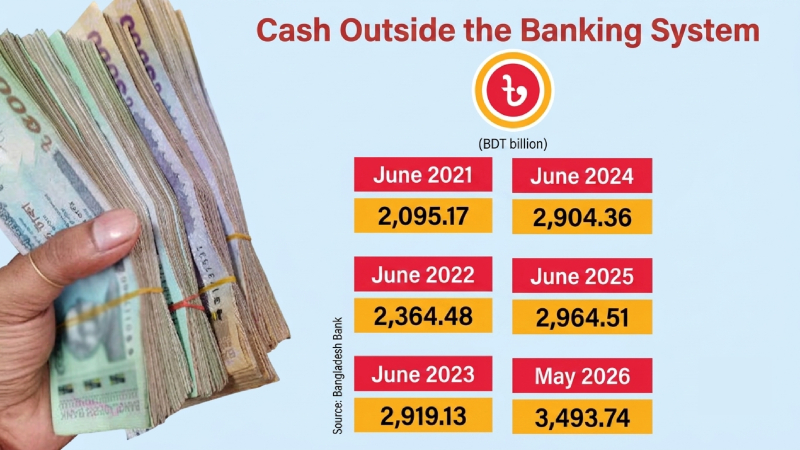
Central bank records chart this steady surge. Currency outside the banking system stood at BDT 584.17 billion in 2011 before expanding over the following decade to hit BDT 2.09 trillion in June 2021, BDT 2.36 trillion a year later and BDT 2.91 trillion by June 2023. Cash held outside the banking system fluctuated in 2024 and 2025 but did not increase significantly. The figure held near BDT 2.96 trillion in June 2025 before jumping to BDT 3.49 trillion in May 2026.
A governance crisis at Islami Bank Bangladesh, the country’s largest lender, drove the figure sharply higher. Its chairman resigned this June and the central bank appointed a successor, triggering turmoil. Depositors pulled nearly BDT 250 billion from the institution, forcing the regulator to extend BDT 130 billion in emergency liquidity support.
Bangladesh Bank currency management officials said the panic spread to other lenders, prompting broader withdrawals. They said cash outside banks surpassed BDT 3.7 trillion in June and touched BDT 3.8 trillion in July before physical currency demand stabilised. Officials expect a new board at the Islami Bank to restore calm.
Mohammad Zahir Hussain, an executive director at the central bank recently appointed as administrator to Islami Bank Bangladesh, said daily operations have returned to normal.
“We will repay the central bank loan in instalments. Many of the depositors who withdrew in panic have already come back,” Hussain told Bonik Barta.
Bangladesh Bank data show that deposit growth across the banking sector also accelerated this year. Commercial banks added BDT 1.63 trillion in deposits over the first 11 months (July–May) of the 2025–26 fiscal year, nearly double the BDT 897.74 billion increase recorded in the same period a year earlier. Total deposits reached BDT 20.41 trillion at the end of May 2026, reflecting an 11.41 percent expansion.
Mashrur Arefin, managing director and chief executive of City Bank, identified elevated inflation as the primary driver pushing cash outside the banking system.
“The main reason cash in circulation has risen so much is inflation,” Arefin, who also chairs the Association of Bankers, Bangladesh, told Bonik Barta. “Because goods and services cost more, people need more money for the same purchases. That money changes hands in retail markets and stays in cash. If inflation falls to 5 percent, the amount of cash outside banks will halve.”
Arefin added that digital payment infrastructure remains underdeveloped, with QR codes, point-of-sale terminals, cards and internet banking serving only a fraction of the nation’s retail outlets.
Compounding the issue, a crisis of confidence in commercial banking has deepened reliance on physical currency. Strong banks maintain a limited footprint in many regions, prompting depositors who withdraw funds from troubled lenders to keep cash at home rather than re-deposit it. Widespread reporting on financial irregularities and asset stripping has damaged even mid-tier banking brands, Arefin noted.
“In this situation, our good banks either have to expand like bKash, or this vast economy needs a few more bKashes,” he said.
Technology-driven payment systems have expanded rapidly across Bangladesh’s banking sector over the past few years. Mobile financial services now handle approximately BDT 2.5 trillion in monthly transactions, while digital banking applications and card networks process a similar volume. Meanwhile, the central bank has aggressively promoted its unified “Bangla QR” payment system.
Bangladesh Bank views the persistent accumulation of unbanked cash with growing concern.
Arif Hossain Khan, executive director and spokesperson for the central bank, told Bonik Barta: “We’ve brought merchants under Bangla QR. Digital channels such as RTGS, NPSB and MFS are now faster and more popular than ever. Yet the rise in cash outside banks remains worrying. The central question is whether the public is retreating from commercial banks. We’re taking every measure to restore governance, discipline and trust in the banking sector.”
Khan also attributed the trend in part to persistent inflation, which has squeezed consumer budgets and raised cash requirements since 2022. He said emergency liquidity injections by the central bank into troubled lenders over the past three years also backfired, as depositors withdrew much of the support, further expanding the volume of physical currency circulating outside the financial system.











Leave a comment