
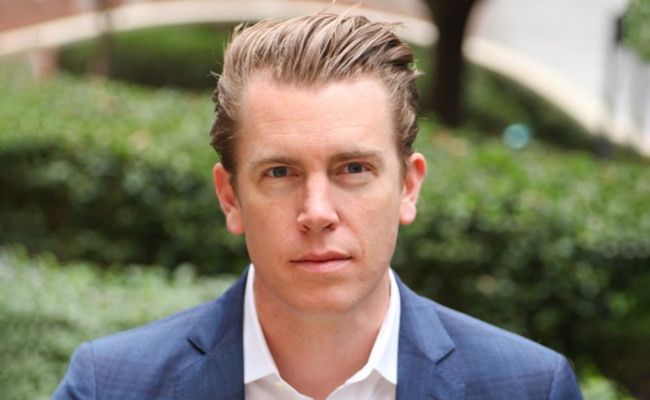
David McCloskey knows a thing or two about secrets. Before becoming a bestselling spy novelist, he spent nearly a decade as a CIA analyst, writing for the President’s Daily Brief, briefing senior White House officials, and working in field stations across the Middle East.
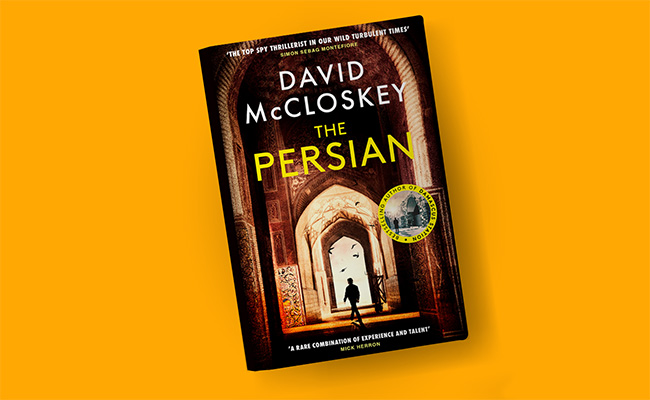
These days, he channels that experience into tightly plotted espionage thrillers, including Damascus Station, Moscow X, The Seventh Floor and his latest, The Persian (Jonathan Ball Publishers), which plunges readers into the shadow war between Israel and Iran through the story of an unlikely Mossad recruit. His new novel, London Station, is due out later this year.
McCloskey also co-hosts The Rest Is Classified alongside veteran security correspondent Gordon Corera, a smart, addictive podcast unpacking the murky worlds of intelligence, espionage and geopolitics for a wider audience.
He’s in South Africa as part of a book tour, so we naturally asked him about CIA life, spy fiction and whether South Africa might one day make it onto the podcast.
Before the books and the podcast, there was the CIA. How did you end up there, and what does an analyst actually do?
I was a CIA analyst for nearly a decade, and I got in the door as an undergraduate intern (seriously) after CIA recruiters paid a visit to my school. I heard the pitch while in an international relations 101 class and immediately thought the work sounded interesting.
And I was right! An analyst is basically doing classified journalism: reading through information from all manner of secret and open sources, and then making sense of that information for readers, which in the CIA’s case is often the president.
Your characters feel psychologically layered and morally messy in the best way. What does your writing process look like when creating them?
I start with a setting (in the case of The Persian, it was the shadow war between Israel and Iran). From that setting, characters emerge. This never happens all at once. I find developing complex characters is something like getting to know a real person: at first, you have only the vaguest sense of who they are, what they care about and what drives them. But the more time you spend with someone, the deeper your understanding of them, and the more complex they seem. It’s the same with characters in fiction, and the only way to get that depth is by writing them, scene by scene, for a very long time.
Your books feel incredibly authentic in terms of place and atmosphere. Have you worked in or travelled through all the locations you write about?
I try to, as a rule. But I sometimes need to break that rule. For example, I couldn’t travel to Iran when I worked for the CIA, and I can’t travel there now. One thing I’ve learnt as a writer, though, is that you don’t necessarily need to have lived something to write it well if you have friends in the right places who will talk to you. A lot of Iranians supplied cultural, linguistic and geographic details to make this book possible!
We’re big Rory Stewart fans at Currency, so his quote on The Persian caught our attention: “A fine, skilled intelligence officer with great powers of observation and deep knowledge, and a fine writer – the combination is miraculous.” Was writing always something you wanted to do?
Definitely not. I stumbled into it and discovered I loved it, mostly because I could figure out what I thought about the world by writing about it. But I did not grow up wanting to be a writer.
You’ve written extensively from a CIA perspective before, but The Persian shifts more towards Mossad and Iranian intelligence networks. What interested you about exploring that world, especially given how relevant the region feels right now?
I wanted to write a novel set in the middle of the intelligence war between Israel and Iran. It’s high stakes – existential for both sides – so you have characters willing to take great risks and finding themselves in great jeopardy. You also have next-generation technology deployed in this battle, particularly by the Israelis. Said differently, you’ve got a recipe for a great spy thriller.
Having worked so closely on conflict and geopolitical crises, has that changed your outlook on the world? Are you optimistic about humanity’s future?
I am, unfortunately, not an optimistic person by nature. My outlook on the world has probably become more negative in recent years, but maybe that’s just because I’m getting older and grumpier.
Can you tell us a little about your upcoming novel, London Station? Is it connected to your earlier book Damascus Station in any way?
London Station is a story about what it might look like if the CIA and its British counterpart, the Secret Intelligence Service, had a falling out. Could the US and UK actually start spying on each other? (I hoped the answer would be yes.) So, this story is about the nature of the US-UK special relationship, how it works, why it’s important, and how it might go wrong. It’s also a story about the future of the spy business and how new types of actors, particularly in the private sector, are redefining what it means to be an intelligence agency. It’s not a sequel to Damascus Station, but it does feature the colourful CIA case officer Artemis Aphrodite Procter, who was chief of station in Damascus, in a starring role.
You recently spoke to Patrick Radden Keefe on The Rest Is Classified about Ireland and Say Nothing, which sent me back to his Wind of Change podcast. How plausible do you think it is that intelligence agencies use culture, music and media as soft-power tools?
I think intelligence agencies try to do this, with mixed results. You can look at the CIA’s track record during the Cold War, supporting things like the Jazz Ambassadors programme, or the way Russian secret services have helped bankroll their own spy films. But are they effective? I suspect the real impact is often minimal.
Of all the books and films about espionage, which do you think comes closest to portraying the CIA realistically?
Nothing gets it exactly right, but you can get slices of authenticity from different books, films and series. For example, the Netflix series The Spy showed the psychological complexities of deep-cover operations, while the French series Le Bureau does a good job with the field-headquarters dynamic and many of the bureaucratic aspects. David Ignatius’s Agents of Innocence is also a great window into the slow-burn nature of a real human intelligence operation.
One of the things I love about The Rest Is Classified is how philosophical it can become, especially around ethics and unintended consequences. Have you ever looked into the alleged CIA links to apartheid South Africa, including the long-running rumours around Liliesleaf Farm and Nelson Mandela’s capture? And have you ever considered a South Africa-focused podcast series, or even a novel set here?
This is a terrific idea, and one I’m going to take back to Gordon and our production team. We are always looking for stories that will expand the cultural and geographic breadth on the pod!
Finally, what are you reading right now, or what’s the best book you’ve read in the past year that you’d recommend?
I’m rereading Ian Fleming’s Bond novel, From Russia with Love. I’d also heartily recommend the psychological thriller All the Colours of the Dark by Chris Whitaker. Quite literally unputdownable.
For more, check out www.davidmccloskeybooks.com.
ALSO READ:
Top image: supplied









Leave a comment