
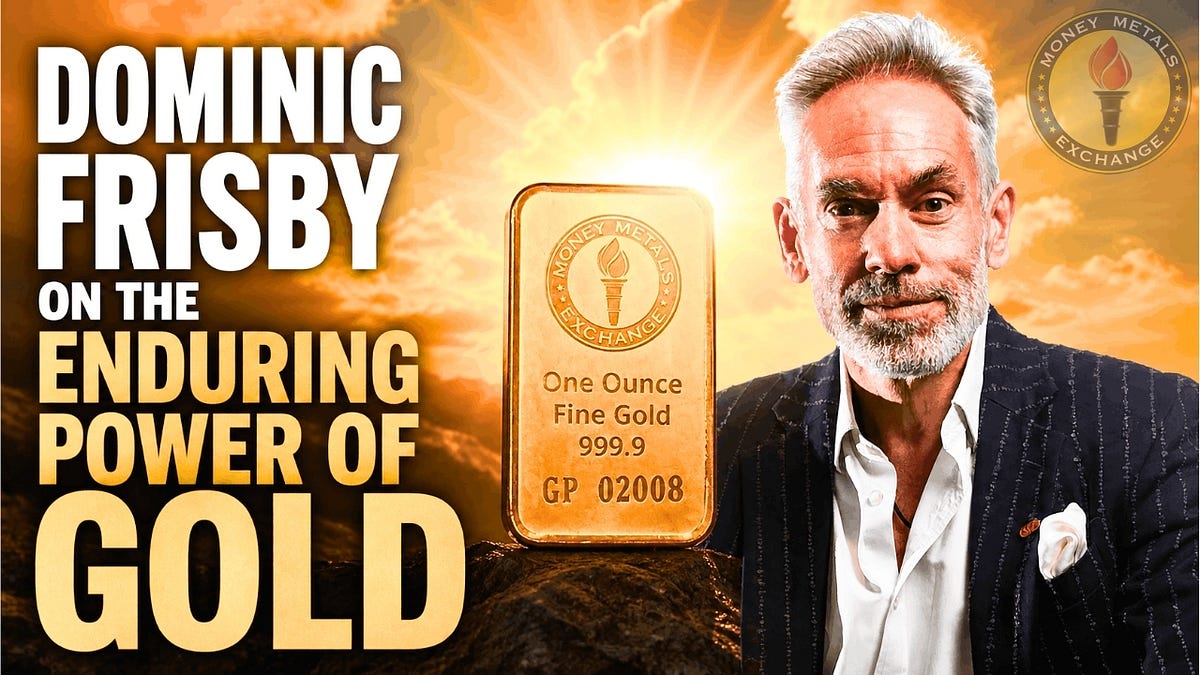


In a wide-ranging conversation on the Money Metals podcast, host Mike Maharrey sat down with British comedian, author, and financial commentator Dominic Frisby to explore the deep historical and modern significance of gold.
Frisby, author of The Secret History of Gold: Myth, Money, Politics and Power, brings more than 25 years of experience studying and investing in gold, offering insights that connect ancient human behavior to today’s global financial system.
Frisby’s journey into gold began in the early 1990s when he was trying to understand economic imbalances, particularly why housing prices in London seemed disconnected from incomes. His research into fiat money, debt, and manipulated interest rates led him to gold and to a broader philosophy centered on sound money.
Over time, this interest expanded into writing, filmmaking, and commentary, including his documentary Four Horsemen, which drew roughly 15 million views after the 2008 financial crisis.
(Interview Starts Around 7:55 Mark)
Gold as Humanity’s First Money
Frisby argues that gold’s role in human society stretches much further back than commonly believed. While many sources claim copper was the first metal used by humans, he points to evidence showing gold was used tens of thousands of years ago. Archaeological findings in Paleolithic caves in Spain suggest the use of gold dating back as far as 50,000 years.
In those early societies, gold served familiar purposes. It was used to store wealth, display status, and likely facilitate early forms of exchange. Frisby emphasizes that modern discussions of money often focus too heavily on its role as a medium of exchange while overlooking its function as a store of value and unit of account. In those areas, gold has proven far more stable than fiat currencies over long periods.
He argues that gold provides a consistent benchmark across time. Measuring value in dollars from different decades is misleading due to inflation and policy changes. Gold, by contrast, offers a stable reference point for comparing the real value of goods and services.
Fiat Money and the Growth of Government
Frisby draws a direct connection between fiat currency systems and the expansion of government. When governments can create money at no cost, while citizens must earn it through labor, an imbalance develops that encourages unchecked growth.
He points to the steady expansion of programs such as welfare, military spending, subsidies, and regulatory systems. Without the discipline imposed by sound money, governments can grow beyond sustainable limits. This dynamic, he argues, creates inefficiencies and distorts economic incentives across society.
Gold and the Arc of Human History
Gold has been one of the most powerful drivers of human behavior throughout history. Frisby suggests that after basic needs like food, shelter, and reproduction, the pursuit of wealth, often represented by gold, has motivated exploration, innovation, and conflict.
From ancient myths like Jason and the Argonauts to historical events such as the California Gold Rush, gold has shaped civilizations. The California discoveries helped fund the Union during the American Civil War, while massive finds in South Africa, which accounted for about 40 percent of all gold ever mined, played a major role in global wealth flows.
Frisby also argues that this abundance of gold may have contributed to Britain’s decline in the 20th century. The financial cushion it provided allowed for costly decisions, including the funding of two world wars.
Who Holds the Gold Today
In today’s world, gold ownership remains a key indicator of economic power. The United States officially holds around 8,100 tonnes of gold, but Frisby notes that these reserves have not been fully audited since the 1950s.
China presents a striking contrast. While its official holdings are reported at roughly 2,000 to 2,500 tonnes, Frisby estimates total Chinese gold could be between 30,000 and 40,000 tonnes when accounting for domestic mining and imports. China has mined about 8,000 tonnes this century and does not export its gold, meaning it continues to accumulate.
Even if only a portion of that gold is state-owned, it could rival or exceed U.S. holdings. This quiet accumulation, he argues, is one of the most important and underreported developments in global finance.
De-Dollarization and the Rise of Gold
Frisby sees de-dollarization as an ongoing and logical process. Central banks are gradually reducing reliance on the U.S. dollar and increasing their gold reserves. Events such as the freezing of Russian assets after the Ukraine invasion accelerated this trend.
Currently, gold accounts for about 30 percent of central bank reserves, while the U.S. dollar makes up roughly 50 percent. Frisby believes gold could surpass the dollar within the next decade, especially if prices continue to rise.
He frames this shift as a return to more balanced reserve holdings rather than a sudden collapse of the dollar. For many countries, holding gold is simply prudent diversification. Unlike fiat currencies, gold carries no counterparty risk and is not dependent on any government.
Gold, Bitcoin, and the Future of Money
Frisby takes a balanced view of the debate between gold and Bitcoin. Born in 1969, he sees himself at the intersection of generations. Older investors tend to prefer gold, while younger ones gravitate toward digital assets.
He argues that both have roles to play. Bitcoin offers advantages in speed and global transactions, while gold remains unmatched as a long-term store of value. The key principle for him is sound money, regardless of form.
Gold in the 21st Century
Despite claims that gold is outdated, its continued relevance is clear. Central banks are still accumulating it, investors continue to hold it, and its price rose by roughly 60 to 70 percent in the previous year.
Frisby argues that gold’s core function has not changed since prehistoric times. It remains a reliable way to store and display value. While it may not dominate everyday transactions, it continues to serve as a foundational asset in the global financial system.
A Timeless Asset in a Changing World
Frisby’s book The Secret History of Gold explores the many ways gold has influenced human civilization. Praised by Adam Fleming, nephew of Ian Fleming and former chairman of Harmony Gold, as one of the best books ever written on the subject, it aims to uncover insights that are often overlooked.
The conversation highlights a central idea. Gold is not just a relic of the past. It is a constant force that has shaped history and continues to play a critical role in an evolving financial world.
Stay connected with Dominic Frisby on his X (formerly Twitter) @DominicFrisby, his Instagram, and his Substack.
Stay connected with Money Metals here.
Originally Published on Money Metals.







Leave a comment