“We are, as Australians, using less and less and less cash,” Bligh said.
RELATED
“In 2007, about 70 per cent of everything we paid for was with real cash.
“These days, it’s about 10 per cent, and the Reserve Bank estimates it will fall to around 4 per cent by 2030.”
However, Cash Welcome disputes these figures.
They highlight that current Reserve Bank of Australia (RBA) data shows 16 per cent of in-person transactions still use cash, with no publicly available statistics backing the 10 per cent figure cited by Bligh.
To strengthen their argument, Cash Welcome make two points:
But is the push towards a cashless society genuinely stalling, or are these figures being selectively used?
Let’s unpack the data.
There has never been more cash circulating around Australia, despite its declining use in transactions. ·Cash Welcome
Firstly, Bligh is correct that the RBA’s projection is that cash transactions will fall to just 4 per cent by 2030.
Interestingly, both the ABA and Cash Welcome agree that despite fewer transactions, there has never been more cash physically circulating in Australia.
Why is there more cash around if Australians aren’t using it?
The RBA provided insight into the increase in physical currency in a 2021 paper.
“The increase in banknotes in circulation against the backdrop of declining transactional cash use can be attributed to the growing role of cash for precautionary and store-of-wealth purposes,” the RBA wrote.
In fact, nearly 73 per cent of current banknotes by number and a staggering 94 per cent by value are $50 and $100 denominations, indicating their use as a store of wealth rather than for everyday spending.
Australian Banking Association CEO Anna Bligh has warned that bank branches have to adapt to the changing nature of banking. (Source: Getty)
Yet, when adjusted for Australia’s growing population, the narrative shifts slightly.
Analysis and forecasting of recent RBA and Australian Bureau of Statistics (ABS) data revealed that cash in circulation per person has actually decreased—from a peak of $3,987 in 2021 to $3,750 in March 2025.
This means Cash Welcome’s claim about increasing physical cash doesn’t translate to daily usage.
What about ATM withdrawals?
Cash Welcome claimed that “[RBA data] shows the value of ATM cash withdrawals, over-the-counter cash withdrawals (in bank branches), and EFTPOS cash-outs is not falling.”
While technically accurate if you focus narrowly on this specific metric, it doesn’t reflect the broader reality.
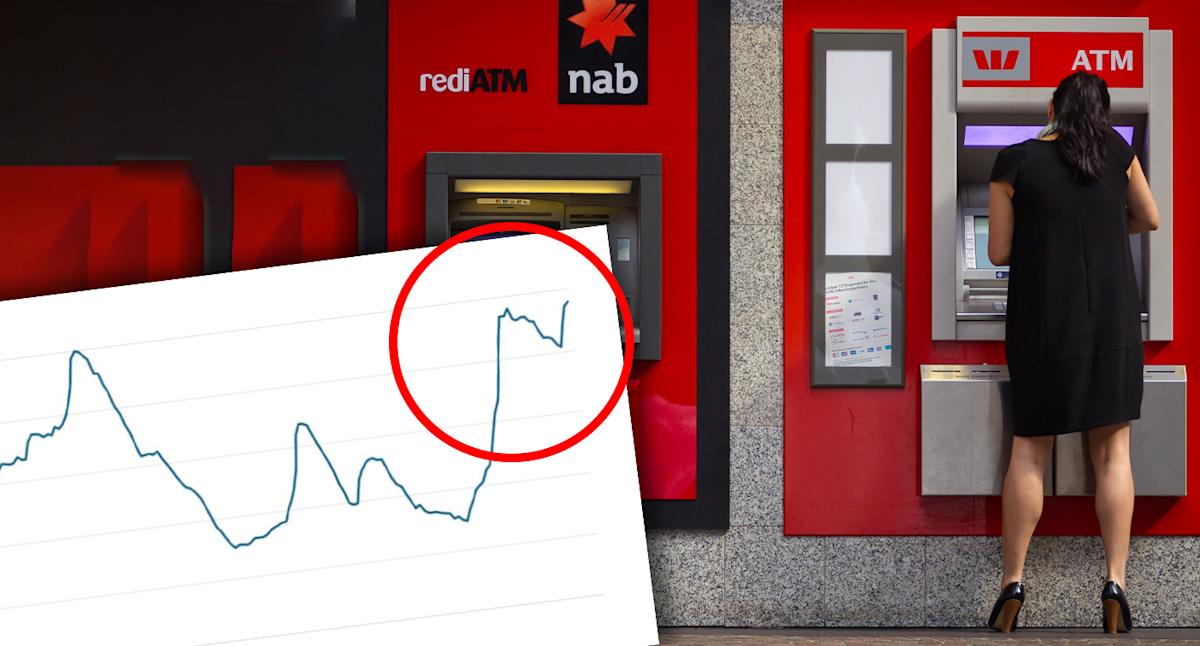
Overall ATM withdrawals have been declining significantly since 2009, dropping from around 75 million monthly withdrawals to roughly 28 million today.
Despite a slight uptick after COVID lockdowns, ATM usage has hovered at under 30 million withdrawals per month.
Even during the past year, which looks relatively flat on the chart below, ATM withdrawal numbers have remained below the equivalent year-on-year figure for 10 of the past 12 months.
ATM withdrawals have plummeted. ·Finder
I work for Finder, a financial comparison site that helps Australians compare products like home loans, mobile plans, super funds and payment methods including both debit and credit cards.
I also work with data everyday, and this data points to a clear trend away from cash.
Storing, counting and securing physical money is time-consuming and expensive, and these costs are only rising.
“As cash usage declines, the cost of transporting and distributing it escalates,” the ABA explained.
It’s also worth noting that cash-only businesses may find it easier to operate partially outside the tax system, reducing government revenue and ultimately impacting the funding of essential public services.
Tackling card surcharges, alongside managing the costs associated with cash, will be crucial as Australia continues to transition towards a predominantly digital economy.
Businesses should have the freedom to choose whether they accept cash, and consumers have the right to decide where they spend their money.
In the fast-moving world of cryptocurrency in 2026, many American investors, especially beginners, are searching for the best new cryptocurrencies to invest in...













Leave a comment