

“The Japanese yen has surpassed the Turkish lira to become the world’s weakest currency,” a post on X by Robin Brooks, a researcher at the Brookings Institution in the United States, has sparked heated discussions in the market…
Japan’s external purchasing power continues to decline. The index showing the comprehensive strength of the yen has hit a new low since the shift to the floating exchange rate system. The structural pressure to sell the yen, against the backdrop of Japan’s trade deficit and other factors, has been further exacerbated by the rising crude oil prices.
Two currencies show contrasting trends
On May 24th, “The Japanese yen has surpassed the Turkish lira to become the world’s weakest currency,” a post on X (formerly Twitter) by Robin Brooks, a researcher at the Brookings Institution in the United States, has sparked heated discussions in the market.
Brooks is referring to the “real effective exchange rate.” This index is used to show the comprehensive strength of the yen relative to multiple currencies and is calculated by comprehensively considering factors such as the relative values of different currencies, price changes, and trade volumes. Its characteristic is that if a country’s inflation rate is higher than that of other countries, the index will rise; if the inflation rate is lower than that of other countries, the index will fall.
Brooks pointed out that the real effective exchange rate values of the Japanese yen and the Turkish lira have now reversed. Against the backdrop of persistent high inflation, Turkey has long adopted a loose monetary policy, resulting in a long – term depreciation of its domestic currency. Now, the yen is even “weaker than the Turkish lira.”
The real effective exchange rate is an indicator to measure the change in the purchasing power of a country or region’s currency compared to the base year. Since there are various calculation methods, there has always been a debate about whether the absolute values of different currencies can be directly compared.
However, it is quite obvious that the real effective exchange rate of the yen has been continuously declining, while the Turkish lira has shown an upward trend.
The real effective exchange rate estimated by the Bank for International Settlements (BIS) (with 2020 as 100) shows that the yen has hit a new low since the shift to the floating exchange rate system in 1973. On the other hand, the Turkish lira has turned to appreciation, with a 7% appreciation since the beginning of the year.
Expansionary fiscal policy leads to a decline in creditworthiness
There are still no signs of a recovery in the “strength” of the yen. First of all, in terms of trade balance, the yen continues to face headwinds. Japan’s trade deficit expanded to about 20 trillion yen in 2022. Although the deficit has narrowed in recent years, it was still close to 3 trillion yen in 2025.
Rising oil prices are weakening the yen’s strength from multiple directions (Reuters)
That is to say, Japan’s payments for goods and services to overseas have long been higher than its income from overseas. This structural situation has continuously put pressure on the yen exchange rate. Koya Miyamae, a senior economist at SMBC Nikko Securities, analyzed that against the backdrop of rising crude oil prices: “The trade deficit, which has been narrowing in recent years, is likely to widen again to about 5 trillion yen per year.”
Japan’s fiscal situation has also become a burden on the yen. Rising crude oil prices are prompting Sanae Takaichi to adopt a more expansionary fiscal policy. Takaichi said on May 25th that a supplementary budget for fiscal year 2026 will be compiled, with fiscal expenditures exceeding 3 trillion yen.
Atsushi Takeda, the chief economist at Itochu Research Institute, pointed out: “Implementing an expansionary fiscal policy while maintaining a loose monetary environment will lead to a decline in the market’s trust in the currency’s credit and gradually evolve into a trend of’selling Japanese assets’, including driving up interest rates.” Regarding the Bank of Japan (the central bank), there has also been a persistent concern in the market that the Bank of Japan is slow to act on interest rate hikes and is in a situation of “behind the curve.”
Theoretically, currency depreciation may be beneficial to enhancing a country’s export competitiveness. This is because the prices of domestic products in overseas markets will relatively decline, which will drive up exports and boost the Japanese economy.
However, Japan has now shifted a large number of production bases overseas, so the promotional effect brought about by the depreciation of the yen is no longer as obvious as in the past.
The yen exchange rate is barely supported by intervention
It has been about three months since the United States and Israel launched an attack on Iran. Looking at the fluctuations in the exchange rates of major currencies against the US dollar during this period, the currencies of South American countries that can ensure their own energy supply independently or have a weak geographical connection with the Middle East situation have generally maintained an upward trend. On the contrary, the Indonesian rupiah, the South Korean won, and the Turkish lira have continued to be sluggish, with a depreciation rate of 4% to 5%.
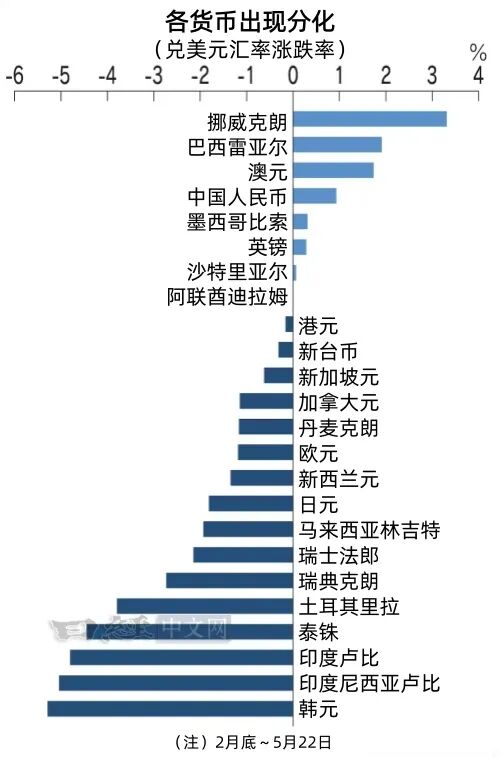
The exchange rate of the yen against the US dollar has depreciated by less than 2%. On the surface, the decline is limited. But in fact, since the end of April, the Japanese government and the Bank of Japan have carried out a total of about 10 trillion yen in foreign exchange interventions to buy the yen. In other words, the current yen exchange rate is, to some extent, like a level “wearing height – increasing clogs.” Without government intervention, the yen is likely to fall further.
So, is there a way to stop the decline in the yen’s strength? Takeshi Higashifukazawa, the chief economist at Mizuho Research and Technologies, believes that the key lies in the market’s expectation of the future inflation level, that is, the “expected inflation rate.” Currently, Japan’s expected inflation rate has exceeded 2%, and whether this level can be stabilized in the long term will be an important factor determining the trend of the yen.
If the expected inflation rate of 2% can be stabilized, it will be easier for enterprises to promote salary increases based on future inflation expectations. As salary increases are further reflected in the rising prices of services, which are greatly affected by labor costs, and form a cycle that spreads to the real economy, the yen’s strength may stop falling.
However, Takeshi Higashifukazawa pointed out that “it often takes years for the rise in expected inflation to be transmitted to actual inflation, so it is difficult to expect a recovery in the yen’s strength in the short term,” which means that Japan still needs structural reforms.
Atsushi Takeda said: “The key lies in whether the growth – strategy investment promoted by the Takaichi government can drive the growth of domestic industries and attract the inflow of overseas investment.”
The improvement of the yen’s strength cannot be achieved overnight. But if the Japanese government cannot even send a policy signal to maintain the market’s trust in the yen, Japan may not even be able to stand on the starting line to restore the yen’s credibility.
This article is from the WeChat official account Nikkei Chinese Net” (ID: rijingzhongwenwang), author: Nikkei Chinese Net, published by 36Kr with authorization.













Leave a comment