
This article was published in August 2022 and updated in October 2022.
- Australia’s central bank is trialling a digital currency to explore “innovative ways” for homes and businesses to make payments and transfer funds.
- More than 100 countries, including 19 G20 nations, are now exploring central bank digital currencies (CBDCs).
- CBDCs could improve financial inclusion, say experts, but cybersecurity threats and theft are potential pitfalls.
Money isn’t paper and coins any more.
It’s increasingly digital – and a growing number of central banks are considering issuing their own digital currencies.
Australia is the latest country to trial a central bank digital currency (CBDC).
Its central bank, the Reserve Bank of Australia, said the project would explore the potential economic benefits of introducing a CBDC.
What is a central bank digital currency?
Digital currency is simply electronic, rather than physical, money.
Central bank digital currencies are digital versions of a country’s physical currency – for example, a digital dollar, euro, pound or yuan.
This means “£10 of a UK digital currency would always be worth the same as a £10 note,” explains the Bank of England in the United Kingdom.
The central banks issuing and managing these digital currencies are national financial authorities that oversee a country’s currency, supply of money and monetary policy – like setting interest rates, which change the cost of borrowing.
How safe are central bank digital currencies?
The Bank of England explains that CBDCs – because they’re pegged to a country’s national currency – don’t have the volatility of privately issued digital currencies like Bitcoin, Ether (Ethereum) and XRP.

How do central bank digital currencies work?
People are using cash less, and could use a CBDC to pay for things digitally, the Bank of England says.
They can hold the digital currency either in an account with the central bank, or as electronic tokens, the World Economic Forum explains in its Central Bank Digital Currency Policy‐Maker Toolkit. The electronic tokens could be held on mobile devices, prepaid cards or other forms of digital wallets.
Businesses and other financial institutions, like high-street banks, could also use CBDC.
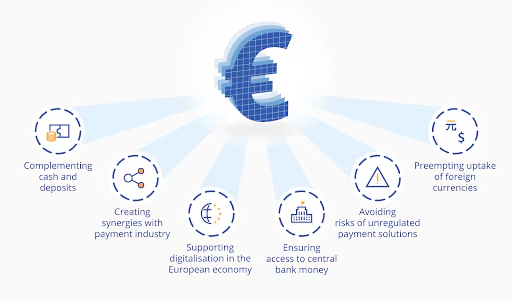
A digital currency would complement, rather than replace, physical cash, according to the ECB.
Would society benefit from CBDCs?
The digital euro would be a “fast, easy and secure” way for people to make daily payments, the ECB says. It would give people more “choice about how to pay” and also increase financial inclusion.
The resilience of financial systems could also be boosted. If a natural disaster or the failure of a payments company made cash unavailable, a CBDC could provide a back-up, the International Monetary Fund says.
Reducing financial crime is another motivator. Cash is essentially untraceable and this helps to facilitate crime. Central bank digital currencies, on the other hand, can improve the transparency of money flows, says the Atlantic Council.
How many countries are considering central bank digital currencies?
Ten countries have already launched their own digital currency, including Nigeria in Africa and Jamaica in the Caribbean. The Bahamas in the West Indies was the first country in the world to roll out a national central bank digital currency, called the Sand Dollar, in October 2020. China is due to launch a CBDC in 2023. Nineteen countries in the G20 – which represents the world’s largest economies – are exploring central bank digital currencies, including Japan, India, Russia and South Korea.
As mentioned above, the US and UK are researching CBDCs, but have not yet committed to introducing them.
What successes have CBDCs had?
In the Bahamas, introducing the Sand Dollar has made it easier for people to transact money across “an otherwise vast archipelago,” says Deloitte.
The island of Jamaica, which started rolling out its JAM-DEX digital currency earlier this year, expects savings of about $7 million a year on replacing, storing and handling cash, according to the Atlantic Council’s CBDC tracker tool.
And what are the challenges of central bank digital currencies?
For Ecuador in South America, low levels of trust in the central bank led to its digital currency being cancelled three years after launch in 2017.
Challenges for central banks exploring digital currencies include potential cybersecurity threats.
Another challenge is how to make central bank digital currencies widely available enough in a country to ensure they improve – rather than worsen – financial inclusion, the Forum adds.
Countries also need to have suitable technical and legal frameworks in place before they can issue digital currencies.










Leave a comment