
The Monetary System Nobody Explained to You
Most people assume that financial stress is a personal problem, a matter of discipline, effort, or intelligence. They blame themselves for not saving enough, not diversifying correctly, or not picking the right assets. But there is a more precise explanation, one that begins not with individual behaviour but with the architecture of the monetary system itself.
Understanding why your savings lose value and how gold fixes the leak is not a matter of learning better investment tactics. It requires stepping back and examining the foundational rules of the financial environment every saver operates within, rules that were quietly rewritten decades ago with lasting consequences for anyone who simply tries to hold onto what they earn.
When big ASX news breaks, our subscribers know first
The Gap Between Your Balance and Your Buying Power
Nominal Value vs. Real Value: The Distinction That Changes Everything
A savings account statement shows a number. What it does not show is how much that number can actually purchase in the real world. These two things, the nominal balance and its real purchasing power, are not the same, and the gap between them is where savings quietly disappear.
Consider a straightforward example: $10,000 held in a standard savings account in the year 2000 would need to be worth approximately $18,000 or more today just to maintain the same purchasing power, based on cumulative U.S. CPI data tracked over that period. If the account earned modest interest but never approached that threshold, the saver lost real wealth even as their balance grew.
This outcome has a name in economics: a negative real return. It occurs whenever the interest rate paid on savings falls below the prevailing rate of inflation, a condition that has been common across most developed economies for extended periods during the past two decades.
The Mathematics of Monetary Decay
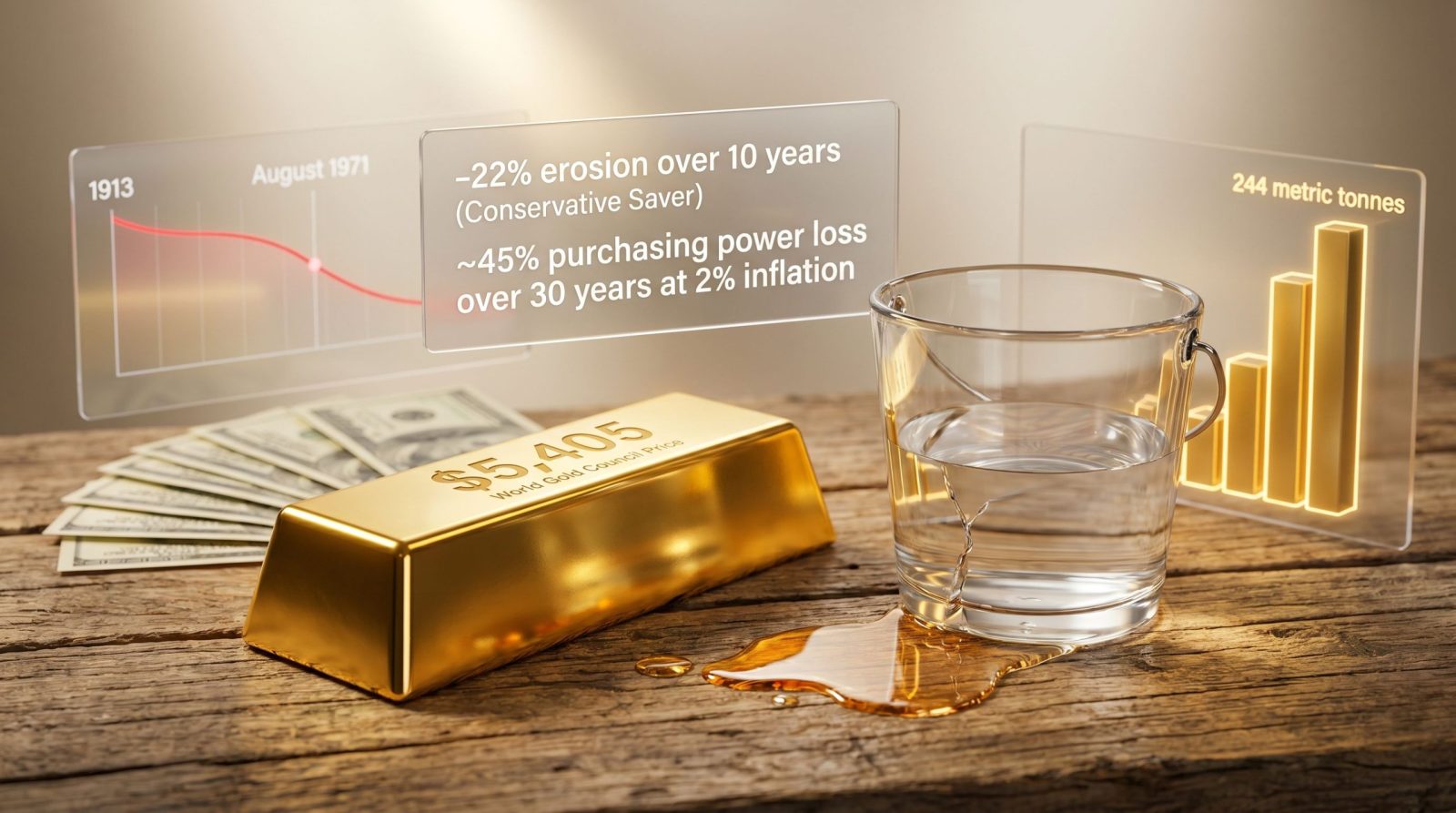
The compounding effect of negative real returns is easy to underestimate in a single year but becomes significant over a decade. The table below illustrates three savings scenarios over a ten-year period at a constant inflation rate of 3.5%:
| Scenario | Savings Rate | Inflation Rate | Real Annual Return | 10-Year Purchasing Power Erosion |
|---|---|---|---|---|
| Standard Savings Account | 1.0% | 3.5% | -2.5% | ~22% loss |
| Moderate Savings Account | 2.0% | 3.5% | -1.5% | ~14% loss |
| High-Yield Account | 4.5% | 3.5% | +1.0% | Modest preservation |
Most retail savings accounts have historically offered rates well below inflation thresholds, particularly during periods of accommodative monetary policy. The result is that the majority of everyday savers have experienced meaningful erosion in real wealth even while their account balances appear to be growing.
What Behavioural Research Reveals About Investor Underperformance
The natural response to this erosion is to move savings into higher-returning assets. Yet the evidence consistently shows that this transition introduces a different category of risk, one that is behavioural rather than structural.
DALBAR’s Quantitative Analysis of Investor Behavior, which has tracked U.S. investor returns since 1994, identifies a persistent performance gap between average investors and benchmark indices:
- In 2023, the average equity fund investor earned 20.79%, while the S&P 500 returned 26.29%, a gap of 5.5 percentage points
- In 2024, that gap widened to 8.48 percentage points, representing the second-largest investor underperformance recorded in a decade
Critically, DALBAR’s research does not attribute this gap to poor fund selection. The primary driver is emotionally reactive behaviour: selling during downturns, chasing recent performance narratives, and reallocating capital at precisely the wrong moments. These behaviours are not random personal failures. They are predictable responses to the anxiety that a structurally flawed monetary environment creates in ordinary savers.
The problem is not that most people make poor investment decisions. The problem is that the monetary system places savers in a position where doing nothing guarantees a loss, and doing something introduces behavioural risk. Both paths lead to erosion, just through different mechanisms.
A Monetary History That Most Savers Have Never Been Told
What Pre-1913 Price Behaviour Reveals About Monetary Architecture
The persistent upward drift of prices that modern savers accept as normal is not an economic law. It is a relatively recent policy outcome, and the historical record makes this clear.
Research published by the Federal Reserve Bank of St. Louis documents that the period preceding the Federal Reserve’s establishment in 1913 was characterised by a fundamentally different price dynamic. Inflation spikes occurred during wartime periods, but these were typically followed by prolonged deflationary corrections that largely reversed the earlier price increases.
Measured across generational timescales, prices trended downward rather than upward. This was not a malfunction. It was the natural consequence of a commodity-backed monetary system operating alongside rising industrial productivity. As manufacturing and distribution became more efficient, those productivity gains passed through to consumers as lower prices, not simply higher corporate profit margins. The purchasing power of a worker’s savings would increase over time simply by holding it.
The 1971 Turning Point: When Structural Deflation Was Eliminated
The most consequential shift in modern monetary history occurred in August 1971, when President Richard Nixon formally ended the convertibility of the U.S. dollar into gold. This decision severed the last formal link between the world’s reserve currency and a tangible commodity constraint. Furthermore, understanding the 1971 Nixon shock helps clarify why savers today face a fundamentally different financial landscape than previous generations.
The measurable consequence was structural: post-crisis deflation ceased. Before 1971, price spikes during economic disruptions were followed by corrective periods. After 1971, price spikes were followed by further price increases. The correction mechanism had been removed from the system.
This is not a political argument. It is a monetary architecture observation. The rules governing how currency retained or lost value changed fundamentally, and the implications for anyone holding that currency as savings changed with them.
The 2% Inflation Target: A Policy Choice That Guarantees Savings Erosion
Modern central banking frameworks, including those operated by the U.S. Federal Reserve and the Reserve Bank of Australia, explicitly target 2% annual inflation as a policy objective. Presented as a neutral stability measure, this target carries a consequence that is rarely stated plainly:
A 2% annual inflation target is a structural guarantee that the purchasing power of cash savings will decline every single year by design.
The compounding effect over longer time horizons is significant:
| Time Horizon | Cumulative Purchasing Power Loss at 2% Annual Inflation |
|---|---|
| 10 Years | ~18% |
| 20 Years | ~33% |
| 30 Years | ~45% |
A saver who holds cash over a 30-year period under a consistent 2% inflation target loses nearly half their purchasing power, not through any decision they made, but through the intended operation of the monetary system they operate within.
The Leaky Bucket: Why More Strategies Don’t Solve the Problem
The Structural Trap That Forces Savers Into Speculation
In a monetary environment where holding cash preserves or grows purchasing power, the decision to save is rational and low-risk. In a fiat monetary environment built around a positive inflation target, holding cash is a guaranteed slow loss. Savers are not choosing to take on investment risk out of greed. They are being structurally compelled to assume risk simply to avoid a predetermined erosion.
This is the core dynamic that understanding why your savings lose value and how gold fixes the leak requires: the system is not neutral toward savers. It imposes a cost on inaction and forces a choice between certain gradual loss and uncertain but potentially larger loss.
The Leaky Bucket Framework: Diagnosing the Real Problem
A useful way to understand this dynamic is through what can be called the leaky bucket framework. Imagine carrying water from a well to your home in a bucket with a hole in the bottom. No matter how many trips you make, how efficiently you walk, or how many extra buckets you carry, the leak continues.
The apparent rational response is to optimise the carrying system: more trips, better routes, additional buckets, hired help. However, every one of these solutions addresses the carrying problem rather than the leak itself.
Applied to personal finance, this framework reveals something important: index funds, dividend strategies, real estate, cryptocurrency, and side income streams are all variations of carrying more buckets. They can work, and they can partially compensate for the erosion. But none of them address the source of the problem, which is a monetary system structurally designed to erode the value of savings over time.
The leaky bucket framework reframes financial anxiety not as a personal competence problem but as a structural design problem. The leak originates in the architecture of the monetary system, not in the decisions of individual savers.
The Hidden Cost: Time as the Non-Renewable Resource
The optimisation loop that fiat-induced financial stress creates follows a recognisable pattern:
- Awareness that savings are losing real value
- Compulsion to seek additional returns through active engagement
- Time and cognitive resources diverted from other life priorities
- Behavioural errors driven by anxiety, consistent with DALBAR’s documented findings
- Underperformance relative to passive benchmarks
- Renewed anxiety, restarting the cycle
The cost that never appears in return calculations is time. The hours spent monitoring portfolios, reading financial news, evaluating strategies, and managing anxiety are not free. They represent the very resource that financial security is supposed to liberate. A strategy that generates modestly higher nominal returns at the cost of perpetual active management may deliver a worse real-world outcome than one that preserves purchasing power without requiring constant attention.
Gold as a Monetary Anchor: What the Evidence Actually Shows
How Gold Preserves Purchasing Power Across Monetary Regimes
Gold’s role in a wealth preservation strategy is frequently mischaracterised as a speculative investment. A more precise framing is that gold functions as a monetary anchor, a store of value whose purchasing power is determined by its physical and economic properties rather than by government policy decisions. Consequently, understanding gold’s role in the global monetary system provides essential context for evaluating its long-term relevance to savers.
When goods and services are measured in gold terms rather than fiat currency terms, a consistent long-run pattern emerges across categories including energy, agricultural commodities, and real estate: real goods become progressively cheaper in gold terms over time. This is the inverse of what fiat currency does to purchasing power, and it reflects gold’s historical property of retaining real-world value across monetary regime changes.
What Goldman Sachs Research Identifies About Gold’s Inflation-Hedging Properties
Goldman Sachs research identifies gold’s inflation-hedging effectiveness as context-dependent rather than universally reliable in all conditions. The analysis points to three specific environments where gold performs most effectively as an inflation hedge:
- Very high inflation environments, generally above 5-6% annually
- Periods where inflation is accompanied by central bank credibility shocks, where markets lose confidence in monetary institutions’ ability to control prices
- Geopolitical stress periods where capital seeks safe-haven assets outside the conventional financial system
An important caveat: in moderate inflation environments where real interest rates are rising, gold can underperform over shorter periods. Gold exhibits significant short-term price volatility and is best understood as a long-duration preservation tool rather than a short-term inflation trade. For a deeper look at these dynamics, gold as a safe haven offers further analysis on how it behaves during periods of financial stress.
Central Bank Accumulation as a Confidence Signal
Perhaps the most revealing data point in the current gold market involves institutional behaviour rather than retail sentiment. According to the World Gold Council, central banks globally purchased a net 244 metric tons of gold in Q1 2026, the fastest accumulation pace in over a year, and did so at a record gold price of $5,405 per ounce.
The analytical implication of this behaviour is significant. Institutions that purchase an asset at all-time high prices are not making speculative trades. Speculative buyers seek undervalued entry points. In addition, central bank demand in 2025 highlights how this pattern has been building consistently over recent years.
When the institutions responsible for managing national monetary reserves allocate aggressively to gold at record price levels, the behaviour is inconsistent with treating gold as a speculative position. It is consistent with treating it as structural protection against long-term fiat currency erosion.
Gold vs. Other Inflation Hedges: A Comparative Framework
Positioning Gold Within a Broader Wealth Preservation Toolkit
Gold is not the only available response to monetary erosion, but it possesses a distinct profile that separates it from most alternatives. The table below compares the primary inflation-hedging assets across several relevant dimensions:
| Asset Class | Inflation Hedge Mechanism | Key Risk | Liquidity | Requires Active Management? |
|---|---|---|---|---|
| Gold | Monetary scarcity, zero counterparty risk | Short-term price volatility | High (global market) | No |
| Real Estate | Rental income growth, asset appreciation | Illiquidity, leverage risk | Low | Yes |
| Equities (S&P 500) | Earnings growth can outpace inflation | Behavioural underperformance risk | High | Moderate |
| TIPS (Inflation-Linked Bonds) | CPI-linked principal adjustment | Rate sensitivity, tax drag | Moderate | Low |
| Cryptocurrency | Scarcity model (Bitcoin) | Extreme volatility, regulatory risk | High | Moderate |
| Cash (Savings Account) | None, loses real value at inflation rate | Guaranteed purchasing power erosion | Highest | None |
What Distinguishes Gold From Other Inflation-Protection Strategies
Gold’s value preservation mechanism does not depend on external conditions remaining favourable. Unlike equities, gold does not require monitoring of quarterly earnings reports, anticipation of central bank rate cycles, or evaluation of geopolitical developments. Unlike real estate, it requires no active management, carries no leverage risk, and imposes no transaction costs for ongoing ownership.
Its properties are intrinsic: physical scarcity that cannot be expanded by policy decision, durability across indefinite time horizons, universal global recognition and liquidity, and zero counterparty risk, meaning its value does not depend on any institution’s ability or willingness to honour an obligation. For instance, how gold and silver protect portfolios from inflation provides further evidence of these protective characteristics in practice.
Practical Allocation Considerations
Most institutional and academic frameworks treat gold as a partial portfolio allocation rather than a complete wealth strategy. Common guidance suggests a range of 5-15% of a diversified portfolio, with the primary rationale being gold’s historical non-correlation with equities and bonds during stress periods. This non-correlation provides portfolio-level risk reduction even when gold’s standalone return profile is variable.
Savers whose primary objective is purchasing power preservation over long time horizons, rather than return maximisation, may find a case for allocations toward the higher end of that range. However, appropriate allocation levels depend heavily on individual time horizons, existing portfolio composition, and personal risk tolerance. Those weighing up their options can explore gold investment options in 2025 to compare physical gold against ETFs and other accessible formats. Consultation with a qualified financial adviser is strongly recommended before making material allocation changes.
The next major ASX story will hit our subscribers first
Redefining What Wealth Actually Means
The Measurement Problem at the Heart of Modern Financial Planning
Conventional financial planning measures success in nominal terms: portfolio size, annual returns, percentage gains. These metrics are products of the fiat monetary environment and measure the wrong variable. The question that actually matters for a saver’s real-world wellbeing is not how large is the portfolio but how much can the portfolio purchase.
A portfolio that grows from $100,000 to $150,000 over ten years appears to have succeeded. If purchasing power increased by 40% over that same period due to cumulative inflation, the portfolio’s real gain is negligible. The number grew; the wealth did not.
Reframing the objective changes the strategy. A purchasing-power-first approach treats the preservation of real-world value as the baseline requirement, then pursues returns above that baseline through conventional investment assets. Gold occupies the baseline function: the portion of a portfolio insulated from fiat currency erosion.
The True Cost of Financial Anxiety: Beyond Portfolio Returns
Financial stress does not exist in a contained compartment. Research consistently links monetary anxiety to reduced cognitive bandwidth for non-financial decisions, measurable impacts on physical and mental health outcomes, strained personal relationships, and diminished professional performance. These are real costs, but they rarely appear in any return calculation.
Furthermore, protecting wealth during inflation illustrates precisely how this erosion plays out across different asset classes and why passive preservation strategies matter. The optimisation loop consumes the very resource that financial security is supposed to create.
A strategy that preserves purchasing power passively, without requiring constant attention, monitoring, or emotional management, delivers something that high-nominal-return strategies with high anxiety costs cannot: mental bandwidth and time.
Genuine financial security is not measured by portfolio size. It is measured by the degree to which a financial structure operates without requiring constant attention. A strategy that preserves purchasing power passively is worth more in real terms than one that generates higher nominal returns at the cost of perpetual anxiety.
Frequently Asked Questions
Why does a savings account lose value even when the balance is growing?
A growing nominal balance and a growing real value are not the same thing. When the interest earned on savings falls below the prevailing inflation rate, the real return is negative. At a 1% savings rate against 3.5% inflation, the account loses approximately 2.5% of its purchasing power annually, eroding roughly 22% of its real value over a decade despite the balance increasing in numerical terms.
Is gold a reliable inflation hedge?
Gold’s effectiveness as an inflation hedge is context-dependent. Over very long time horizons, its purchasing power preservation record is strong. Over shorter periods, particularly when inflation is moderate and real interest rates are rising, gold can underperform. Goldman Sachs research identifies gold as most effective during high-inflation environments, central bank credibility crises, and geopolitical stress periods. It is a long-duration preservation tool, not a short-term inflation trade.
How did prices behave before the Federal Reserve existed?
According to research published by the Federal Reserve Bank of St. Louis, the pre-1913 era was characterised by inflation spikes during wartime followed by prolonged deflationary corrections that largely reversed those increases. Across generational timescales, prices trended downward. Productivity improvements under commodity-backed money passed through to consumers as lower prices rather than being absorbed by monetary expansion.
Why do most investors underperform the stock market index?
DALBAR’s Quantitative Analysis of Investor Behavior identifies behavioural factors, not asset selection, as the primary driver of the performance gap. In 2024, average equity investors underperformed the S&P 500 by 8.48 percentage points. The main causes are panic selling during downturns, chasing recent performance narratives, and reallocating capital at precisely the wrong moments, all behaviours that intensify under financial anxiety.
What portfolio allocation to gold is appropriate?
There is no universally correct answer. Most institutional frameworks suggest 5-15% as a starting range, with the rationale being gold’s non-correlation with equities and bonds during stress periods. Investors whose primary concern is purchasing power preservation may consider allocations toward the higher end. A qualified financial adviser should be consulted before making significant allocation changes, as appropriate levels depend on individual circumstances.
What changed after the U.S. ended dollar-gold convertibility in 1971?
Before August 1971, price spikes during economic disruptions were followed by deflationary corrections that partially reversed them. After gold convertibility was ended, that correction mechanism was removed. Post-crisis deflation effectively ceased, and prices continued rising after disruptions with the only variable being the pace of increase. Inflation transformed from a cyclical phenomenon into a permanent directional force within the fiat monetary system.
Key Statistics Reference
| Data Point | Figure | Source |
|---|---|---|
| Average investor underperformance vs. S&P 500 (2023) | 5.5 percentage points | DALBAR QAIB |
| Average investor underperformance vs. S&P 500 (2024) | 8.48 percentage points | DALBAR QAIB |
| Central bank gold purchases, Q1 2026 | 244 metric tons (net) | World Gold Council |
| Record gold price at time of Q1 2026 purchases | $5,405 per ounce | World Gold Council |
| Federal Reserve established | 1913 | Federal Reserve Bank of St. Louis |
| Dollar-gold convertibility ended | August 1971 | Historical record |
| Cumulative purchasing power loss at 2% inflation over 30 years | ~45% | Compound inflation calculation |
Disclaimer: This article is for informational and educational purposes only and does not constitute financial or investment advice. Past performance is not indicative of future results. All investments, including precious metals, involve risk and may result in partial or total loss. Readers should consult a qualified financial adviser before making any investment decisions.
Want to Know Which ASX Mineral Discoveries Could Offer Real Purchasing Power Growth?
While gold provides a structural defence against fiat currency erosion, Discovery Alert’s proprietary Discovery IQ model scans daily ASX announcements in real time, instantly identifying significant mineral discoveries — including gold — and delivering actionable alerts before the broader market reacts. Explore historic discovery returns on Discovery Alert’s dedicated discoveries page and begin your 14-day free trial to position yourself ahead of the next major find.












Leave a comment