
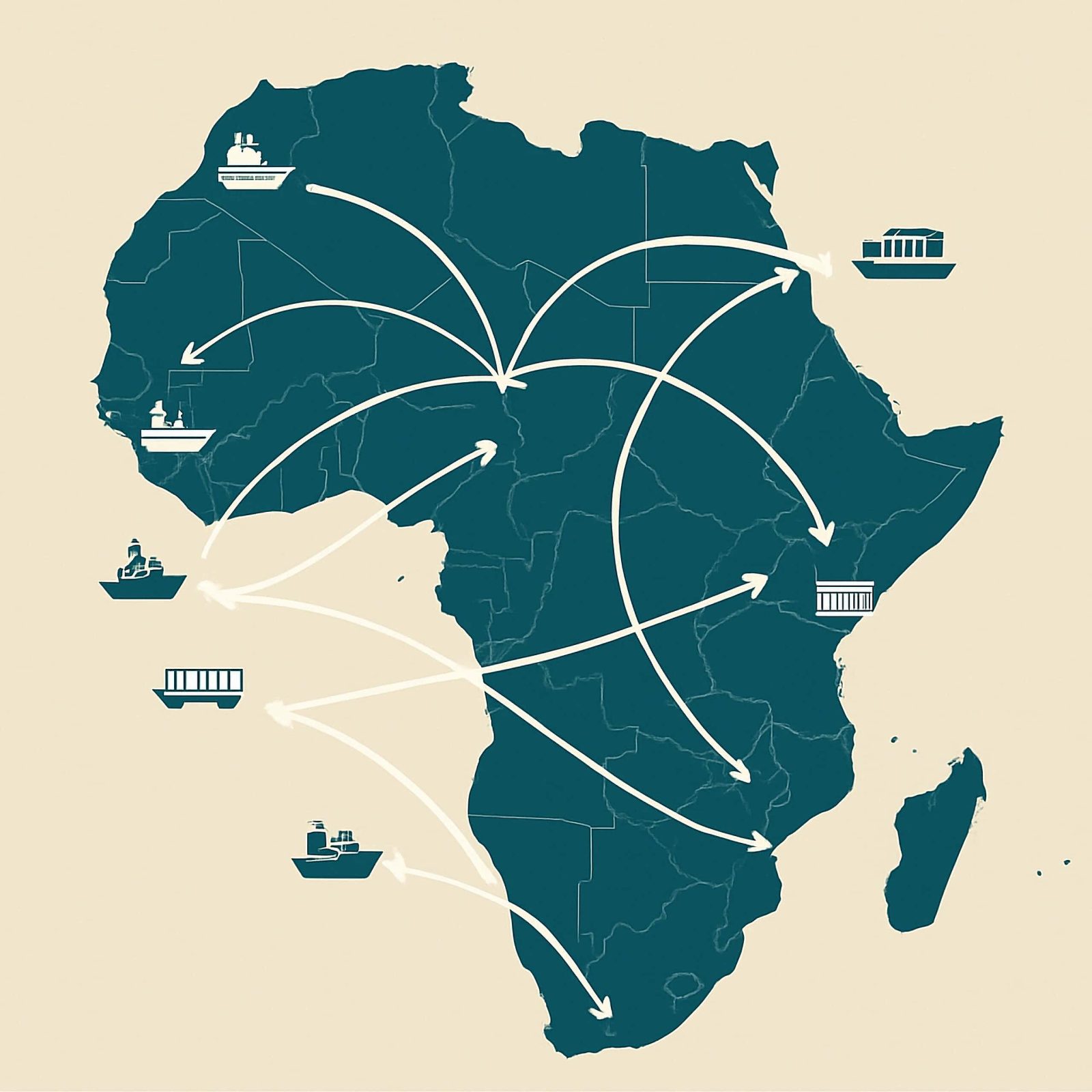
A customs revamp is a welcome change, but logistics and transit bottlenecks still stifle African trade.
To curb revenue and income losses and accelerate trade across 50 member states, the African Continental Free Trade Area (AfCFTA) Secretariat partnered with Nigeria’s Bergmans Security Consultants and Supplies Ltd. in a $3.1 billion deal to roll out a unified continent-wide customs system.
The project aims to digitize customs processes, streamline cross-border procedures, and provide real-time cargo tracking, with the goal of reducing corruption, revenue leakage, and trade misinvoicing.
The initiative could be “potentially very significant,” Phyllis Wakiaga, a Kenyan lawyer and former Kenya Association of Manufacturers CEO, told Global Finance in an email. “One of the biggest barriers to intra-African trade is the friction businesses face at borders through slow clearance, duplicated documentation, and inconsistent customs procedures.”
Bergmans, based in Abuja, Nigeria, intends to help AfCFTA achieve its goal of doubling intra-African trade by 2035. However, fundamental trading challenges, such as payments, persist across the continent.
AfCFTA did not respond to requests for comment.
Currently, companies often have to route transactions through hard currencies and third-party intermediaries. As a result, high costs will remain even if customs procedures improve, Wakiaga said.
The 2022 launch of the Pan-African Payments and Settlement System (PAPSS) could potentially unlock the anticipated benefits of AfCFTA, she added. However, rollout is slow. As of 2025, the network only connects 19 countries so far (the African Union has 55 member states).
Logistics Creates Another Headache
Jacqueléne Coetzer, founder and CEO of a pan-African business advisory and trade firm, described to Global Finance just how convoluted transporting cargo across the continent by land, sea, and air can be. Goods, she said, are frequently routed through South Africa, Europe, or the Middle East—adding significant transit time and cost.
Furthermore, political will remains inconsistent, as individual governments often resort to protectionist measures and informal barriers to shield domestic industries.
Ultimately, while modernizing customs creates an essential foundation, Coetzer said that it’s not a complete solution. Without parallel investments in logistics, payment systems, standardized regulations, and physical infrastructure, a streamlined customs framework will fall short.
“A perfectly digitized customs declaration does not help much if the truck cannot cross the border efficiently because the road is inadequate, or if the cargo then spends days waiting for space at a congested port,” she said.
AfCFTA took effect in January 2021, aiming to counter global isolationism through cross-border cooperation. Since then, the picture has shifted somewhat. Africa’s population has grown to roughly 1.6 billion people as of 2026. That’s up from 1.2 billion when the agreement was first signed.
On intra-African trade, the AfCFTA-era numbers show real but modest progress. Intra-African trade hit about $220.3 billion in 2024 and roughly $213.8 billion in 2025. African Export–Import Bank, or Afreximbank, projects it will reach $230 billion in 2026.
But, as Coetzer explained, getting customs right is only part of the challenge. If logistics, payments, infrastructure, standards, production capacity, and political implementation remain unresolved, it will simply create a faster system for moving goods through borders that still cannot move enough goods efficiently.
“The real objective should therefore be much more ambitious,” she added. “AfCFTA needs to build an integrated continental trading system, not simply a continental customs system.”
Anthony Noto covers corporate finance and private credit. Contact him at anoto@gfmag.com
John Njiraini and Charles Wachira contributed to this report.











Leave a comment