
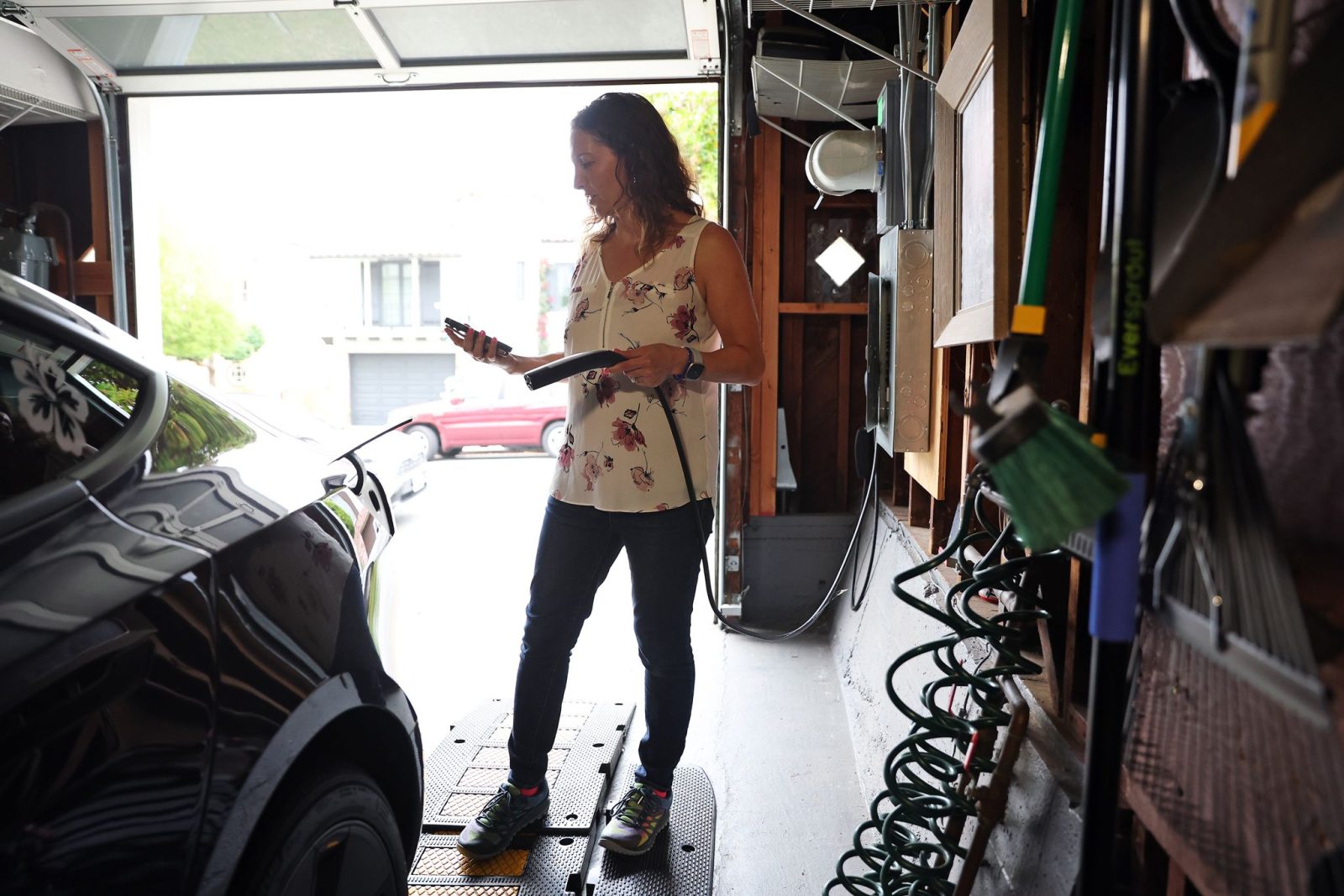

Debbie Mansfield plugs in her Tesla at her San Francisco home in August 2024. On the advice of energy consultant James Tuleya, she started charging the car after midnight, when electricity rates are lower — one strategy households can use to trim energy costs.
This weekend, temperatures are expected to hit as high as 110 degrees in California’s Central Valley, and in the 90s to low 100s across the interior Bay Area.
The world is on course for what could be the hottest year on record due to human-caused climate change and a strenthening El Niño, scientists say — and despite the Bay Area’s relatively moderate climate, summer temperature extremes can have a sudden, outsized impact on household budgets.
California has the second-highest electricity costs of any state in the U.S. Mark Toney, the executive director of nonprofit consumer advocacy group The Utility Reform Network, said high rates and fluctuating weather patterns can make monthly bills unpredictable.
Article continues below this ad
Electricity bills “have high volatility,” he said. “They can go up very quickly, before you know it, based on the weather that you really have very little control over.”
“It’s not like you did something wrong,” he added. “The unpredictability of the electricity bill, where it can be $75 one month and $400 the next, that’s what makes it so difficult for a lot of people to keep up. And why it’s so easy to fall behind.”
The most recent report from the California Public Utilities Commission’s Public Advocates Office indicated 24% of PG&E customers, or about 1.3 million people, are behind on their bills, by an average of $572. The report notes PG&E costs are up 69% in the past decade, primarily due to wildfire mitigation and liability costs, infrastructure investments, and costs related to the rooftop solar net energy metering program.
PG&E has touted three rate cuts since the start of 2024, due to completing some of its wildfire and energy projects. And there is some relief on the horizon: The utility’s annual state-mandated electricity climate credit — $36.18 this year — will appear on August and September bills, totaling $72.36 in savings.
Article continues below this ad
The utility provider also has a program called HomeIntel that helps people find ways to reduce their electricity usage. James Tuleya is a senior energy coach for HomeIntel, based in Los Altos. He’s helped close to 1,000 people figure out how to plug energy leaks in their homes, including a San Francisco family that started saving $1,400 on PG&E bills annually with his tips.
Tuleya offered several recommendations to help trim your summer energy bills.
Ways to save money while staying cool
Get your system serviced.
He said the industry standard is to have it done every year; he recommends aiming for at least once every two to three years. HVAC technicians are probably pretty booked up right now handling emergencies, he said, so if you can’t find someone to come out in the immediate future, set a calendar reminder for November.
Article continues below this ad
Make sure you’re using your appliances the right way.
That’s a fundamental misunderstanding of how fans keep us cool, Tuleya said.
Air conditioners and heat pumps work by cooling the air with refrigerants. Fans just move air around. It makes us feel cooler because the moving air evaporates moisture on our skin — the same reason a breeze feels good on a hot day. But without a person to cool, a fan isn’t serving any purpose.
“A fan only has value if there’s somebody in the room,” Tuleya said. “Running fans to ‘cool down the room’ doesn’t do anybody any good, it doesn’t save you any money.”
There is a different strategy that leverages your fans for cooling power: In the evening, after the temperature outside drops below the temperature in your house, open a window, position a box fan or table fan in front of it, and blow the cooler air inside. For extra cooling power, position another fan at the bedroom door to blow the hot air out. That would have made a difference for the San Jose homeowner, who was turning on the fans but leaving windows closed, Tuleya said.
Article continues below this ad
Turn up the thermostat — just a bit.
“You should be comfortable but not overly comfortable,” he said. “You shouldn’t be walking around with a sweatshirt and long pants on.”
“Precool” before peak times.

Debbie Mansfield uses an app to control the temperature in her San Francisco home in August 2024. Mansfield cut her family’s PG&E bill by more than a third after working with energy consultant James Tuleya.
Close your drapes when the sun is out.
Article continues below this ad
Check that you’re on the optimal rate plan.
“You wouldn’t believe how many people are on the wrong rate plan or not optimized for it,” Tuleya said. “Particularly people with EVs, they’re charging their car at the wrong time.”
What’s so special about 4 to 9 p.m., anyway? Michael Stadler is a former energy research scientist who worked at the Lawrence Berkeley National Laboratory before co-founding Xendee, a company that helps people generate electricity at building sites with things like rooftop solar and battery systems. He said the late afternoon and early evening is when demand on the grid is highest as people arrive home from work and school. At the same time, renewable power such as solar is winding down. Many utilities in California and other states have established these time-of-use rate plans to address the imbalance, he said.
PG&E also lists some tips on its website, including replacing and cleaning air filters regularly, using major appliances during off-peak hours, charging electric vehicles overnight, sealing gaps around doors and windows, and unplugging devices when not in use.
Money-saving programs for PG&E customers
Especially in the wake of all the Bay Area tech layoffs in recent years, people should take a closer look at PG&E’s income-based savings programs to see whether they qualify, Toney said.
For PG&E customers, the California Alternate Rates for Energy program, or CARE, offers a 30% to 35% discount on electric bills and a 20% discount on natural gas bills. People are eligible based on their household income or if they’re enrolled in certain public assistance programs such as WIC, CalFresh/SNAP, Medicaid/Medi-Cal and Supplemental Security Income.
The Family Electric Rate Assistance Program, or FERA, gives income-qualified customers an 18% discount on their electric bills. Eligibility is based on gross annual household income and household size. For CARE, the income limit for a family of four is $66,000; for FERA, it’s $82,500.
FERA and CARE share one application; if you apply, PG&E will check whether you qualify for either program. Learn more about income-based eligibility guidelines and find out if you qualify at this link.
If you or another full-time resident in your home relies on energy for a medical need — for instance, if you use a respirator, oxygen generator, powered wheelchair, dialysis machine or apnea monitor, or if you need a refrigerator to keep medicine such as insulin cold, or depend on heating or cooling for conditions like multiple sclerosis or scleroderma — you are eligible to receive an extra monthly allotment of energy at the lower baseline price. Eligibility is based on medical need, not income.
“I call it one of the best-kept secrets because people always assume, ‘Well, I have to be low-income to qualify for assistance,’” Toney said. “And this is one program where you don’t.”
Your doctor must complete a form for your application. See more qualifying devices and conditions and learn how to apply at this link.
And in the long term, if you’re unhappy about your electricity bills, Toney said, your local representatives should be hearing about it.
“I’m a ‘call to action’ kind of person,” he said. “You’ve got to let your elected officials know on a regular basis, got to let the California Public Utilities Commission know on a regular basis, that you’re at a breaking point.”










Leave a comment