
Professor Stuart Cole, CBE. Emeritus Professor of Transport Economics and Policy, Prifysgol de Cymru / University of South Wales
In any business, financial success depends in part on the stability of the supply chain. One of its most efficient forms is ‘just in time’ procurement, widely used in the retail sector to minimise stock levels while ensuring availability, keeping prices competitive and maximising profits.
The same principle applies to the railway industry. This month, the UK government responded to a House of Commons Transport Select Committee report on rail procurement, which criticised uncertainty in the rail supply chain.
‘Boom and bust’ funding and planning
The Transport Committee’s report, published in February, concluded that rail investment was carried out in a ‘boom and bust’ fashion, leading to uncertainty in the supply chain.
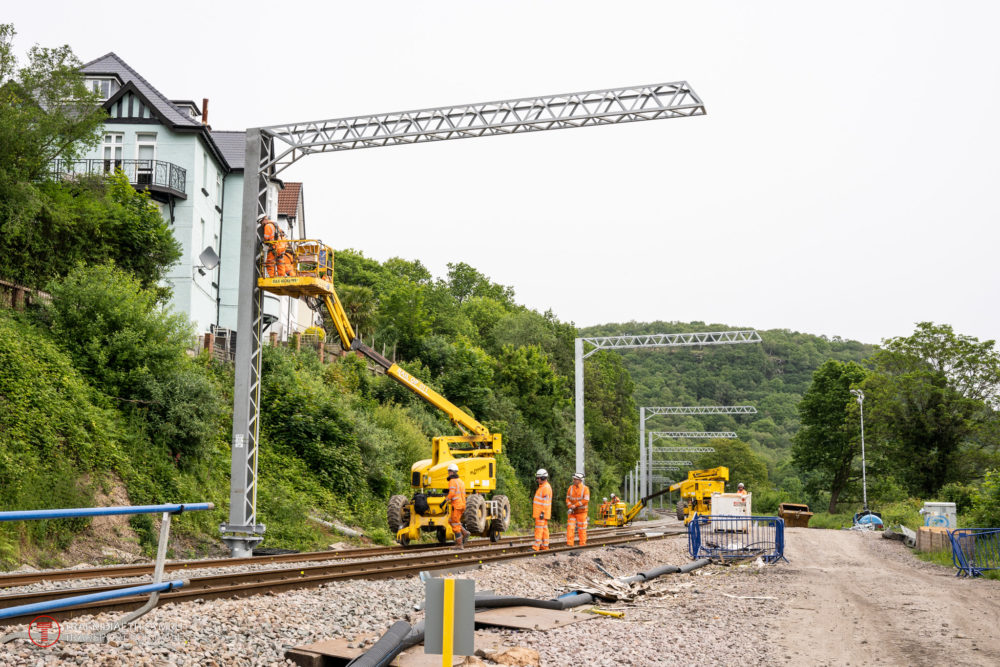
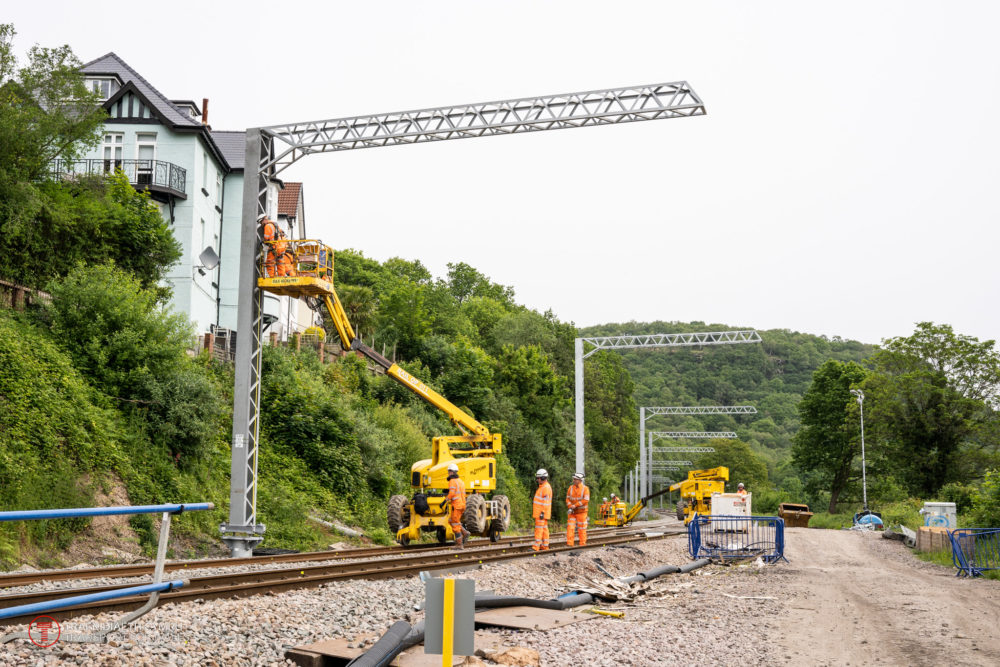
The Rail Industry Association (RIA), representing rail supply contractors, argued in its evidence that the lack of stability in long-term projects had increased the cost of schemes such as electrification. The original Swansea to London main line electrification plan was curtailed at Cardiff.
The RIA’s evidence implied that the UK government’s decision to terminate electrification at Cardiff increased the costs of any future extension to west Wales.
This column previously estimated that restarting the programme could add around 30 per cent to costs. The UK government agreed that stop-start electrification and high-speed rail projects may have contributed to higher costs.
Similarly, electrification of the North Wales Main Line will now cost more in real terms than during its original planning period in the mid-1970s, when construction should have continued westwards from Crewe.
That suggests that with a clearer, steady and systematic funding approach, electrification could have continued to Swansea, and even Carmarthen, as originally designed by Network Rail. However, there was no coordination between track electrification and train procurement.
Consequently, TfW had little choice but to procure diesel trains with a 30-year lifespan, despite their environmental drawbacks compared with electric trains, because new rolling stock was urgently needed. This arose from uncertainty over future rail electrification in Wales, which would have been funded by Westminster.
Electrification comparisons
Germany’s long-running railway programme had, by 2025, electrified 62 per cent of its network compared with England’s 41 per cent. In Wales, the figure is just 8.8 per cent, with 6.6 per cent accounted for by the Core Valley Lines network north of Cardiff, funded mainly by the Welsh Government.
The UK government has contributed only 2.2 per cent of Network Rail track electrification costs in Wales.
UK government view
The UK Department for Transport (DfT) remains the funding department for railways in Wales, excluding the Core Valley Lines. More’s the pity. This column, and many others, has argued that those responsibilities should be transferred to Senedd Cymru. The UK Labour government refused to amend recent railways legislation passing through Westminster to allow this.
The DfT suggested in its response to the Committee that Germany’s steady programme could help reduce the cost of long-term projects. It emphasises its ‘whole-system’ approach, through Great British Railways, to infrastructure, rolling stock and emerging traction technologies, arguing that this will provide greater flexibility in responding to changing technological, financial and economic conditions.
There is a system of five-year ‘control periods’ – currently CP7 (2024–2029) – for infrastructure expenditure agreed with HM Treasury and the Office of Rail and Road. They are designed to prevent boom-and-bust cycles and provide stability for the supply chain, but are limited to maintenance and renewals and do not cover enhancements.
The House of Commons committee maintained that uneven investment remains a feature of the funding process and therefore of the supply chain. Such variability leads to wider consequences, including cost inefficiency and reduced service reliability.
The DfT agreed that factors such as scheme maturity, policy changes, inflation and demand shifts from commuting to leisure mean that some parts of the supply chain do not experience continuous demand.
Forecasting
As an economist whose role included forecasting cost changes, one has some sympathy for those attempting the same task in a more volatile inflationary world. A process called the Rail Network Enhancements Pipeline was intended to provide a clear and consistent view of projects and funding but was last published in 2019.
The UK government suggested in its response that a separate pipeline of potential schemes could be published, identifying projects that are strategically valuable but not yet funded. It argued that publishing unfunded schemes could “create unrealistic expectations and undermine fiscal discipline”.
This appears to contradict the 2026 changes to HM Treasury’s Green Book, which made the strategic case more important than the economic and financial cases that rely heavily on a single benefit-cost ratio metric. It is also inconsistent with the UK government maintaining fiscal distinctions between renewals, funded from current expenditure, and enhancements, funded mainly through borrowing, which limits flexibility between funding mechanisms.
Rolling stock and infrastructure
The Committee also identified a highly cyclical pattern in rolling stock procurement, a point with which the UK government agreed. It also accepted the need for closer alignment between rolling stock and infrastructure planning.
Great British Railways is expected to achieve this as part of its Long-Term Rail Strategy. However, that strategy will provide only a framework of objectives and principles. It will not include actual schemes or expenditure commitments.
This presents a further challenge to the Welsh Government’s ambition of delivering a 21st-century transformational railway for Wales through taking responsibility for both infrastructure and trains. Under such a model, Welsh Government and TfW could determine which routes require increased line speeds through track realignment and which should be prioritised for electrification.
The benefits of having track and rolling stock under the same strategic control can be seen in Scotland, where 25 per cent of the network had been electrified by 2025, supported by Barnett formula funding and borrowing powers.
Long-term railway planning in Wales
Research has shown that improvements in railway service quality, including greater frequency, reliability and lower fares, encourage more people to leave their cars at home and travel by rail.
Most rail services in Wales now use trains less than five years old, whether on TfW domestic routes or on services operated by Great Western Railway and Lumo between Carmarthen and London. Lumo’s new fleet, due to enter service in December 2026, is expected to attract even more passengers.
However, uncertainty over future traction power has resulted in the purchase of more expensive bi-modal trains and forced TfW to introduce diesel trains through no fault of its own.
The boom-and-bust approach identified by the Transport Committee can be addressed through greater openness and cooperation between the Welsh and UK governments.
This would help avoid the increased costs associated with supplying bi-modal rolling stock today, or the future expense of retrofitting relatively new diesel trains should further electrification eventually take place.
Support our Nation today
For the price of a cup of coffee a month you can help us create an
independent, not-for-profit, national news service for the people of Wales, by
the people of Wales.










Leave a comment