
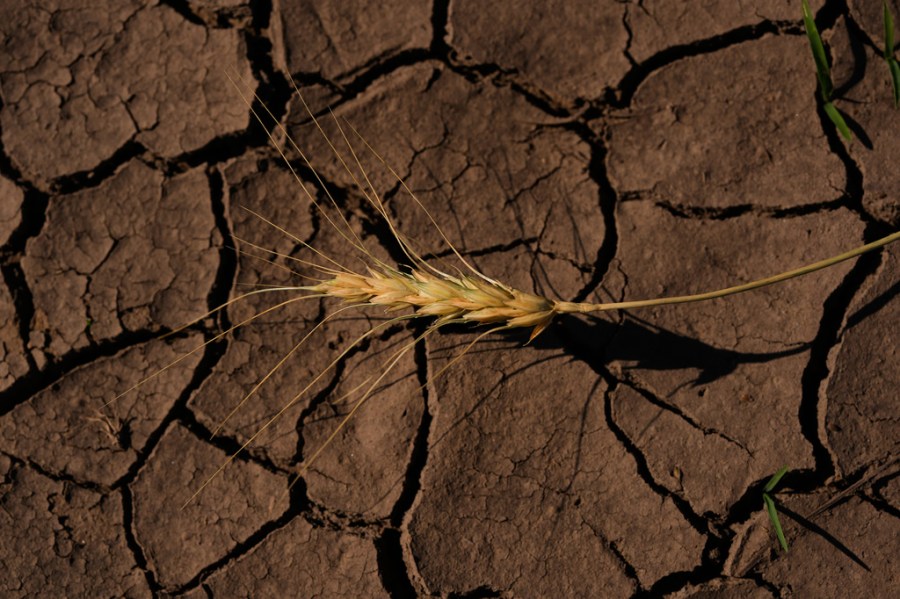
(NEXSTAR) – It’s a perfect storm of terrible conditions for wheat farmers this year. Drought, dramatic swings in temperature, the skyrocketing price of fertilizer and diesel, plus multiple viruses affecting wheat have all led to one of the most challenging years for farmers in decades.
There are different classes of winter wheat, but they’re all down when compared to last year’s crop, explained Todd Hubbs, a crop marketing specialist at Oklahoma State University Extension.
The most widely produced class of wheat in the U.S., Hard Red Winter wheat, has a current production forecast of 515 million bushels. That may sound like a lot, but it would end up being the lowest since 1957, Hubbs said.
Soft red winter and white wheat varieties are also having tough years, with the lowest production volume in 6 to 10 years.
Groceries just had the biggest price hike in years. It’s about to get even worse, experts warn
In all, growers will see their smallest wheat crop in terms of production since 1972, according to the U.S. Department of Agriculture; 1.56 billion bushels this year, down 21% from 2025.
How will this year’s dismal wheat crop affect food, grocery prices?
For an idea of how a terrible wheat crop may impact the food and grocery supply chains, we can turn to recent history. In 2023, a severe drought led to dramatically higher grain prices, “and these elevated prices rippled through the economy and raised Americans’ grocery bills,” Teresa Kroeger, an economist at the Bureau of Labor Statistics, wrote at the time.
Hobbs doesn’t believe we’ll see a sudden and major price shock at the grocery store. Rather, rising wheat prices will work their way through the supply chain, joining in with all the other higher costs of producing and distributing food, from more expensive packaging to the cost of gas for truckers.
A few cents here and a few dollars there add up to ultimately mean higher grocery prices for consumers.
“A price shock to grains can ripple through the stages of goods production. When a food producer pays more for their inputs to production, such as when prices for grains rise, these producers typically pass on some or all the price increases to their buyers,” Kroeger explained.
With wheat, the most direct impacts are on flour, bread, pasta, cereals and baked goods, Hobbs said.
These are America’s most ‘overpriced’ housing markets
But it doesn’t end there. Grains are sometimes used as part of animal feed, so pricier wheat can make it pricier to raise animals. “This has downstream impacts on the supply and prices of beef, pork, poultry, eggs, and dairy products,” Kroeger wrote.













Leave a comment