

By Larry and Adam Mogelonsky – 7.19.2026
There’s a famous quote often attributed to Henry Ford: “If I had asked people what they wanted, they would have said faster horses.” Whether he actually said it is almost beside the point. Customers are remarkably good at identifying today’s pain points and wanting tweaked upgrades, but far less adept at imagining tomorrow’s 10x opportunities. Hotel technology vendors and IT directors can easily get caught in this type of feedback loop.
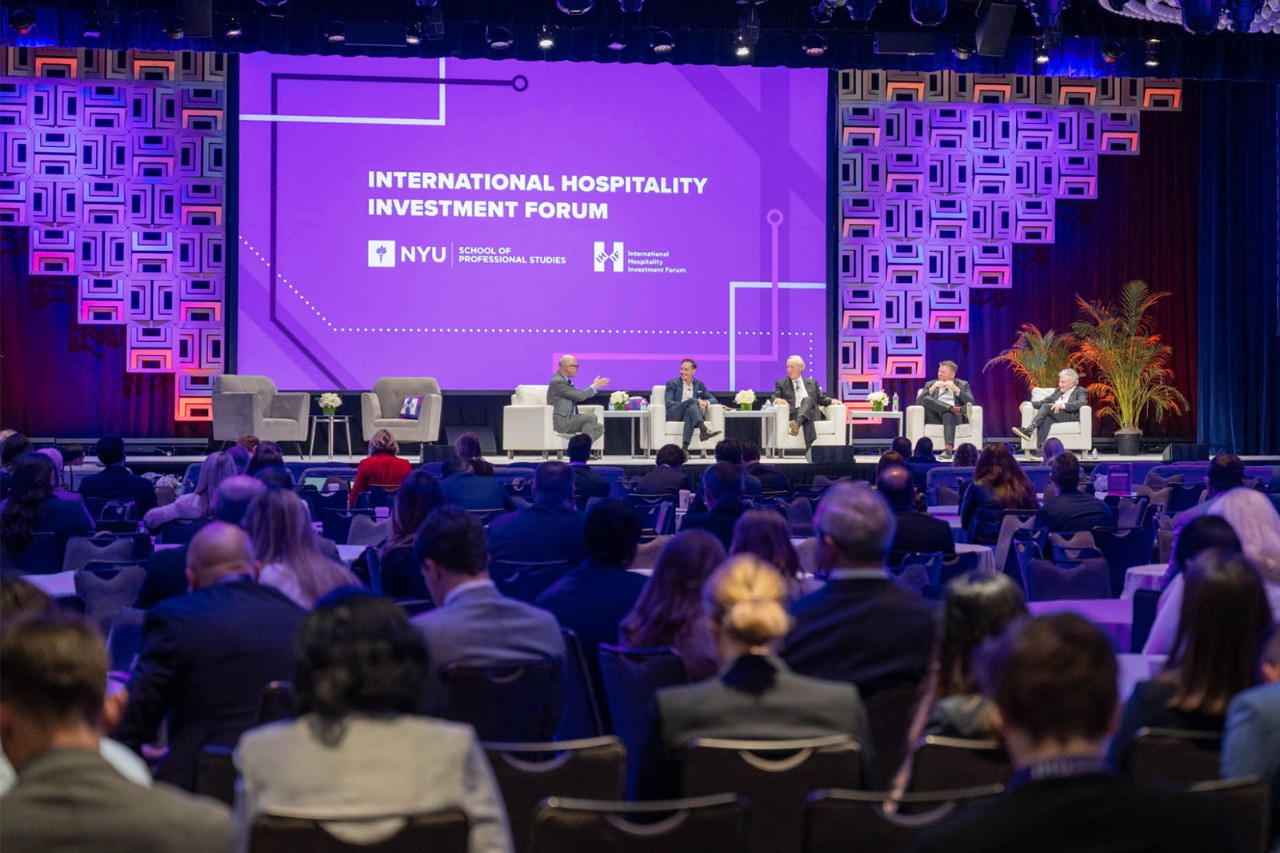
We couldn’t help but think about this after attending the 2026 NYU International Hospitality Investment Forum (IHIF) in New York and comparing it to HITEC 2026 in San Antonio two weeks later.
Widely regarded as the industry’s premier investment conference, IHIF brings together hotel owners, institutional investors, lenders, developers, asset managers and the CEOs of the world’s largest hotel brands to discuss where hospitality capital is flowing next. More than 700 investors representing over $700 billion in hotel assets attended this year’s event, making it one of the industry’s most influential gatherings for capital allocation.
Yes, AI and BI are mentioned, but only as petit fours, hardly a main course. Ironically, though, it would benefit more hotel technology companies to attend these types of events as a complement to traditional hotel technology conferences. Indeed, we saw some there, and likely these are the vendors who will benefit from having the highest-quality feedback in terms of what motivates CEOs and institutional owners, not just CIOs, CTOs, DOSMs and other distinguished ranks.
That may sound counterintuitive. After all, hotel tech conferences are where vendors meet buyers, and also where the learning as to what’s coming next is put on clear display. But they also tend to become echo chambers. Conversations revolve around incremental improvements to existing workflows: a better PMS, another entrant to AI voice (yes, this is a very hard technology to master), a craftier upsell engine, smoother integrations or a more flexible reporting dashboard.
Useful? Absolutely. Transformational for 10x your investment in a short time horizon? Hardly. At IHIF, the conversation operates several levels higher in the stratosphere, and it’s important for suppliers to attend and breathe it in.
Let’s frame this around an example session. During the CEO roundtable – perennially the piece de resistance if we can continue our food analogies – which this year featured Sebastien Bazin of Accor, Chris Nassetta of Hilton, Mark Hoplamazian of Hyatt and Elie Maalouf of IHG. AI certainly came up. Every CEO acknowledged that artificial intelligence is becoming an essential management tool. But AI occupied perhaps 5% of a discussion that otherwise focused on geopolitics, demographics, infrastructure investment, aviation capacity, labor markets and the future geography of global travel demand.
One observation in particular was fascinating. The discussion turned to aircraft orders. Europe and North America continue buying airplanes, but many of those deliveries are to replace aging fleets – not net new POs. Across much of Asia, however, new aircraft purchases represent genuine expansion. New airports are being built. New air routes are opening. New middle-class consumers are entering international travel for the first time.
That macro-observation inevitably flows downward into how investors and brands think, how supply chains are impacted and where future hotel demand will be. And if hotel demand is moving, shouldn’t hotel technology be moving with it?
Now imagine you are a hotel IT professional or vendor and you have a front-row seat to this remark about how net new aircraft orders in Asia will presage increased demand. Now imagine you can build a tool that helps put data behind this connection and how that increased demand will be reflected in different segments or, potentially, displace travel to other regions.
That’s not just demand forecasting but scenario planning supported by reasonably good data and computation that would take weeks to do before the age of AI.
Much of today’s hotel software ecosystem still optimizes the same value chain: discover a traveler, convert the booking, personalize the stay, generate ancillary revenue and improve operational efficiency through checkout. That’s important work, but it’s largely focused on extracting more value from existing demand.
The next frontier of technology may be helping hotels understand where entirely new demand is emerging. Scenario planning can mean continuously combining airline capacity growth, visa policy changes, currency movements, climate change events, remote work patterns, demographic shifts, geopolitical snafus and destination investment to identify tomorrow’s most valuable guest segments before competitors recognize them.
Yes, AI can help to recommend not simply which room to sell, but which guest microsegments deserve entirely new room products, with implications for marketing, sales, branding and capital planning. Such commercial systems could, for instance, help owners decide whether a wellness concept, extended-stay product, branded residences, sports tourism package or culinary positioning could justify a multimillion-dollar renovation based on emerging travel patterns rather than historical performance.
Owners don’t wake up thinking about CRM workflows or housekeeping automation. They wake up thinking about enterprise value, cash flow, NOI, EBITDA multiples and capital appreciation. Brands think about loyalty programs, network effects, net unit growth (NUG), stock price, development pipelines and market prioritization. Investors think about risk-adjusted returns over the next decade.
Technology should increasingly think the same way and that’s why investment conferences matter today than ever before. They give you a different flavor of feedback so that you can focus on inventing the automobile and not a faster horse.
 Together, Adam and Larry Mogelonsky are the principals at Hotel Mogel Consulting Ltd., an asset management and hotel development consultancy. Their experience encompasses properties around the world, both branded and independent in the luxury and boutique categories. Their writing includes eight books: “Total Hotel Mogel” (2024), “In Vino Veritas: A Guide for Hoteliers and Restaurateurs to Sell More Wine” (2022), “More Hotel Mogel” (2020), “The Hotel Mogel” (2018), “The Llama is Inn” (2017), “Hotel Llama” (2015), “Llamas Rule” (2013) and “Are You an Ostrich or a Llama?” (2012). You can reach them at adam@hotelmogel.com to discuss business challenges or for speaking engagements.
Are you an industry thought leader with a point of view on hotel technology that you would like to share with our readers? If so, we invite you to review our editorial guidelines and submit your article for publishing consideration.











Leave a comment