
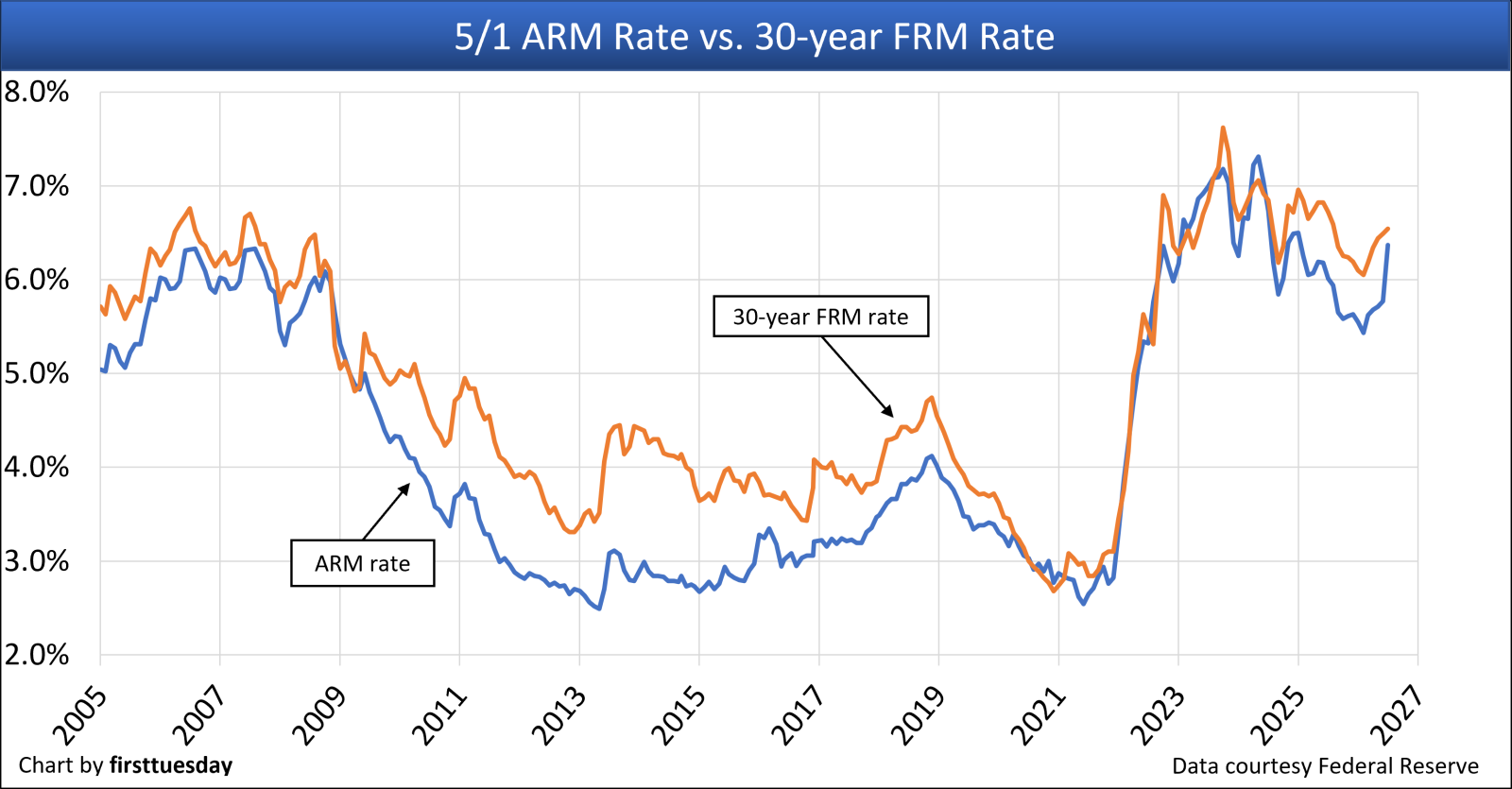
During the low interest rates of 2021, the average adjustable rate mortgage (ARM) rate tangled with the more stable (but typically higher) 30-year fixed rate mortgage (FRM) rate. After both skyrocketed up in 2022, the average adjustable rate mortgage (ARM) rate leapt to an average rate of 6.37% in July 2026, up from 6.01% a year earlier.
ARM rates have held high after peaking in May 2024 alongside FRM rates. The average 30-year fixed rate mortgage (FRM) rate averaged 6.54% in July 2026, down from 6.72% a year earlier.
When both rates circle near each other, the push for riskier ARM products loses its appeal. When 30-year FRM rates are higher, homebuyers look to gain purchasing power by taking on the typically lower ARM rate.
The expectation is they can handle any increases to their monthly mortgage payment or sell before the adjusted monthly payments get out of hand. Here, during times where the ARM rate is adjusted to near the FRM rate or the fair market value (FMV) of the home has declined, demonstrates the risk of loss homebuyers take on with ARM financing.
ARM rates are volatile as they are directly tied to the Fed’s benchmark rate which is unconcerned by the ownership of property. Today in mid-2026, the Fed has not ruled out increasing the Fed Rate to deal with consumer inflation in the coming years.
In application, when the Fed raises rates to lean on consumer inflation, ARM rates rise an equal amount. In contrast, FRM rates are based on the 10-year Treasury bond market which tends to accept lower long-term yields during times of economic uncertainty as the Fed rate is lowered to lean into declining inflation.
As the four-year ongoing undeclared real estate recession in 2026 struggles in the months ahead, expect the bond market to keep FRM rates near 2026 heights with fluctuations in ARM rates as it remains the subject of political discourse. Thus, this spread in rates is likely to stay, causing overanxious homebuyers to consider an ARM to increase their purchasing power — risks ignored.
Updated August 17, 2026.
Chart 1 Chart update 08/17/22
| |
July 2026 | June 2026 | July 2025 |
| Average 5/1 ARM rate | 6.37% |
5.77% |
6.01% |
| Average 30-year FRM rate | 6.54% | 6.49% |
6.72% |
ARM rates rise from bottom
ARM rates peaked in 2006 at just over 6% — a rate that has become more familiar since 2023. However, homeowners and lenders today are not seeing as high a default rate and foreclosures as during the Great Recession.
Important factors protecting homeowners include changes mandated for MLOs to evaluate potential borrowers’ financial readiness to take on mortgage debt — especially once an ARM’s below-market introductory rate (also known as a teaser rate) expires.
Additionally, homebuyers are much more knowledgeable about mortgage math than they were twenty years ago. The extreme fallout during the Great Recession made potential homebuyers wary about applying for an ARM.
ARM use (the ratio of ARMs to all other residential mortgage loans) in 2006 was extremely elevated: three out of every four mortgages originated as ARMs, a recipe of disaster for the future housing market.
The ARM rate is tied to a specified index that varies based on market factors. On each periodic adjustment, the new ARM rate equals the current figure in the index specified in the ARM note plus the lender’s profit margin. Common indices used to periodically adjust the ARM rate include the:
ARMs are riskier than FRMs because the rate reset often results in substantially higher payments, and payment shock. This was experienced on a wide scale during the Millennium Boom as payments rose beyond homebuyers’ ability to pay. California’s massive 2008-2009 foreclosure crisis was driven in large part by these rate resets.
Further, new federal underwriting standards (the qualified mortgage rules) require ARMs underwritten at the maximum allowable interest rate during the five years following the date of the first payment. These rules seriously mitigate the risk of payment shock. These underwriting standards work when the homebuyer takes out the ARM using the reset rate as the test for qualification rather than the initial appeal of a teaser rate. [12 Code of Federal Regulations 1026.43(c)(2)]
So, are ARMs ever beneficial to homebuyers? ARMs do work well for seasoned, short-term investors who plan to sell within the initial lower-rate period, delivering reduced carrying cost on a flip. But owner-occupant homebuyers in the low- and mid-tier price range are best advised to stay far away.
ARM use cyclically adds buyer purchasing power
ARM use is tied inescapably to buyer demand for increased buyer purchasing power. As FRM rates rise, less of the monthly mortgage payment is applied to the principal which is needed to amortize principal repayment over 30 years. Thus, homebuyers are unable to pay the same price they were able to a year earlier.
When home prices rise more quickly than the rate of consumer price inflation (CPI) — as they did during the 2013 year of the speculator and more recently during the pandemic years of 2020 and 2021 — homebuyers are unable to buy the same quality of house as, say a year earlier, unless FRM rates drop.
Here, ARMs available at rates below FRM rates come into play. Homebuyers turn to ARMs to increase their purchasing power because the initial ARM rate applies more of the payments toward paying down the principal than the higher FRM rate. This allows homebuyers to afford a more expensive home or one priced too high. A quick fix, but a faulty judgment call for the long run.
Similarly, ARM use declines when FRM rates and prices are low. This occurred in 2009 during the trough of the Great Recession, when ARM use bottomed at almost zero.
The past year has seen the difference between ARM and FRM average rates too small to sway many homebuyers into considering the risks of taking out an ARM. However, mortgage lenders have not stopped presenting the option to unprepared homebuyers applying for a mortgage with an MLO.
Prior to 2014, mortgage rates were on a steady decline since 1980. Today, the next two or so decades will bring a slow tide of rising mortgage rates as the long-term interest rate cycle shifted when mortgage rates hit their lower bound in 2013. Thus, ARMs are potentially more dangerous for homebuyers who take on the risk of payment increases without the likely ability to refinance with a lower rate FRM to avoid selling their home.







Leave a comment