
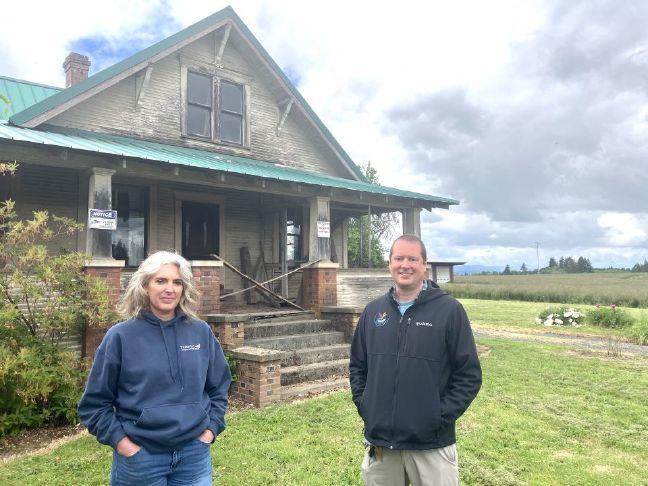
Urban development isn’t yet encroaching on Northwoods Nursery near Molalla, Ore., but owner Jim Gilbert isn’t taking any chances.
To preserve the 66-acre property as farmland in perpetuity, Gilbert is creating a conservation easement prohibiting most construction within its boundaries — regardless of potential alterations to Oregon’s land use protections.
“Legislation can be changed. I hope it never is, and I’m doing my darnedest to keep it from happening. But we could lose the protections we have. I mean, it’s already under challenge all the time in various ways,” he said. “So, a conservation easement is just a more permanent way of protecting the land. It can’t be changed by the Legislature.”
Oregon’s statewide land use system relies on a sweeping strategy for agricultural protection, restricting most development across more than 15 million acres zoned for “exclusive farm use.”
Conservation easements, on the other hand, offer a more piecemeal, personalized approach in which individual landowners decide what forms of development are forbidden.
Because Oregon law has curtailed construction on farm and forest land for more than a half-century, conservation easements on working lands have traditionally been less prevalent in the state than in many others.
Landowners can sell the value of their property’s development rights through conservation easements, but that amount is necessarily diminished if the possibility for building new homes or data centers is already limited.
For Gilbert, the prospect of preserving his property for agriculture outweighs any financial considerations, so he’s chosen to simply donate the easement to a land trust rather than try to sell it.
“If you think that down the road you’re going to develop your property, that it’s going to be possible, then probably you’d want a lot of money for an easement,” he said. “But out here where I am, the City of Molalla is not expanding anywhere near where we are.”
The legal process of creating a conservation easement is costly and time-consuming, which can affect a landowner’s willingness to engage in such a transaction, particularly if the monetary benefits are negligible.
“It’s not a simple thing to do a conservation easement, and I wish it was a little faster and easier, but it’s complicated. So that’s probably a deterrent for some folks,” Gilbert said.
Despite the obstacles and red tape involved, Oregon landowners have embraced conservation easements over the past decade, judging by their participation in programs offered by the state government and farmland preservation advocates.
“There are certainly folks who may not understand the process or may not have that trust, but there are a lot of farmers and ranchers and other landowners in the state that love their land. They want to see it protected and stay that way,” said Joe Buttafuoco, executive director of the Coalition of Oregon Land Trusts.
Benefits
Not only do easements offer an added layer of protection from development, but the reduction in land value can assist with the succession problems facing many farm families, experts say.
By decreasing the property’s price, an easement can make it more affordable for the next generation of growers to purchase.
Selling development rights can also bring an agricultural operation’s value below the $15 million threshold to qualify for Oregon’s exemption from estate taxes.
And if an easement can be sold, that cash can be used to pay off mortgage debt or buy the shares of non-farming heirs, preventing the tract from being fragmented and keeping it under the control of the farm operator.
“It’s a different way of thinking about your real estate,” said Nellie McAdams, executive director of the Oregon Agricultural Trust. “You’re selling off what you don’t need, rather than parcels that hamstring the business.”
Meanwhile, the state is effectively leaving money on the table if it doesn’t encourage such transactions: The USDA can contribute up to 50% of the value of agricultural land easements, or even up to 75% for properties of environmental significance.
“When these federal funds come into the state, it allows the farm to make an investment that they didn’t have money for. It also lowers the cost for the next farmer to come in, and federal dollars coming into the state help our economy,” said Buttafuoco of the Coalition of Oregon Land Trusts.
State, non-profit efforts
In 2017, lawmakers created the Oregon Agricultural Heritage Program to provide funding for conservation easements and help landowners navigate the transaction process, as well as develop succession plans.
The initial years were devoted to setting up the program, which is overseen by the existing Oregon Watershed Enhancement Board but has its own 12-member commission that advises on funding recommendations.
It wasn’t until 2022 that lawmakers actually allocated $5 million to the program, followed by another $5 million in 2024 and $2 million last year. Over three grant cycles, that money has gone to 12 projects that collectively protected more than 16,000 acres of farm and ranch properties.
“The program has no more funding for future years or grant cycles, but we know that there is incredible demand across the state. Lots of projects are in the hopper and just a real opportunity for legislators to invest to secure federal investments into the state,” said Karsyn Kendrick, conservation program director at the Coalition of Oregon Land Trusts.
Though farmland preservation advocates are grateful for the money the program has received, they’d prefer to have less sporadic source of funding. The pipeline of easement proposals indicates Oregon landowners are willing to protect far more land through OAHP than $12 million could accommodate.
“We could honestly add a zero to the end of that, and still not meet the full demand for these programs,” McAdams said. “We can really be protecting as much land as the state decides to fund, and that’s because there are willing landowners that want to engage in these programs.”
But the state government isn’t alone in expanding the agricultural acreage under conservation easements.
In the past three years, the Oregon Agricultural Trust has helped create six easements covering 33,800 acres. The non-profit focuses on working lands easements which allow agricultural operations to continue on the property, as opposed to conservation easements dedicated to strictly preserving wildlife habitat and environmental values.
OAT is working on 55 additional projects representing 139,000 acres and expects to complete up to nine easements this year covering up to 60,000 acres.
The non-profit has obtained funding for those projects through private donations as well as from Oregon’s sage grouse mitigation program, under which renewable energy developers and others must invest in conservation efforts for the bird species to offset impacts to its habitat.
Farmland preservation advocates are considering a similar model to pay for agricultural easements under the Oregon Agricultural Heritage Program, to reduce its dependence on unpredictable state government budgets.
Currently, for example, developers are often directly responsible for mitigating disruptions to certain natural resources, but it may be possible for them to instead pay into a fund that supports conservation easements.
“We’re exploring a number of options right now for how to fund the Oregon Agricultural Heritage Program, so we don’t have to keep going to the general fund,” McAdams said. “There are conversations about how we can be creative in funding OAHP.”
Enforcement issues
The growing popularity of agricultural easements is also spurring innovations in how they’re administered.
Because conservation easements have been relatively uncommon for agricultural lands in Oregon, the state hasn’t had a lot of experience with their enforcement.
When a landowner sells or donates an easement to a government agency or non-profit organization, they agree to permanently disallow construction or certain other uses of the property.
The easement is then generally “held” by a land trust or another organization, which must monitor conditions on the property and ensure the landowner abides by those terms.
That’s generally not a problem with landowners who initially enter into easements, as they tend to be motivated by conservation goals — but future landowners who buy or inherit the properties may not be as willing to refrain from development.
If a dispute arises between a landowner and the entity that enforces an easement’s terms, and it can’t be resolved amicably, the matter then heads to litigation.
Such court cases can pose a difficulty for soil and water conservation districts, which some landowners prefer to work with due to their familiarity with local conditions.
As government entities, SWCDs cannot obtain the insurance that will pay for the expensive process of enforcing an easement in court.
They’re also ineligible for certain USDA funding programs and can’t receive tax-deductible donations worth more than $10,000.
Finally, districts are limited in how they can invest the money in the “stewardship fund” that pays for monitoring and enforcing easement obligations.
If the amount in the stewardship fund can’t keep up with inflation, it can endanger its ability to perform those functions, said Andy Bleckinger, manager of the Yamhill Soil and Water Conservation District.
“All of those challenges amount to: long-term, the district is not a sustainable option for permanent land protection. We don’t want to be 20 years down the road and have these properties and easements, but no funding,” he said.
To provide Yamhill SWCD with more flexibility, it’s planning to jointly administer easements with a recently formed non-profit, the Yamhill Conservation Trust, which isn’t subject to the same restrictions.
“It’s really a huge benefit to our community to be able to offer this, because it’s like having double protection,” said Amie Loop-Frison, executive director of the non-profit.
Enforcement concerns are top-of-mind for organizations that hold easements, since they’re responsible for compliance in the long term and “perpetuity is a long time,” Bleckinger said.
Landowners can craft customized easement conditions for their properties, but the SWCD cannot agree to conditions that it can’t reasonably defend.
It’s reasonable for a landowner to require that a property remain “working land,” but due to the vagaries of markets and weather, it isn’t reasonable to prohibit certain types of agriculture, said Loop-Frison.
“They need to be specific but not too specific,” she said.
The complexity of easement terms also increases the potential for enforcement, and thus monitoring and litigation expenses.
For instance, an easement that simply prohibits development is much easier to enforce than one involving “sustainable forestry,” which requires ensuring that logging limits aren’t exceeded and that heavy machinery is kept out of sensitive watershed areas.
“There’s a huge difference between those and the amount of time that that takes us to carefully examine what’s happening out there on an annual basis,” Loop-Frison said.
At this point, the same landowners who entered into easement transactions with Yamhill SWCD are still living on their properties — but the district knows the situation may not always be so straightforward.
“We don’t really have to deal with issues of them violating the conservation easement that they worked to put in place,” she said. “But we’re approaching a time when many of those could change ownership over the next five or 10 years, even.”









Leave a comment