
Meta Keyword
|
JAKARTA, Investortrust.id — When President Prabowo Subianto took office promising three million new homes annually, skeptics questioned how a stretched fiscal budget could finance Southeast Asia’s most ambitious social housing experiment.
Ten months later, the answer is emerging from a dusty residential tract in Batang, Central Java, where tens of thousands of low-income workers gathered in person and online to sign their first home mortgages. The mass ceremony was not an isolated photo opportunity, but the culmination of a public-private assembly line that has mobilized commercial banks, property developers, and corporate conglomerates under the banner of “Indonesia Incorporated.”
By shifting the burden of housing delivery from pure state spending to a multi-stakeholder ecosystem, the administration is attempting to solve a chronic housing deficit that has long stymied social mobility in Asia’s third most populous democracy.
The economic implications of this push extend far beyond bricks and mortar. For decades, informal employment and rigid underwriting standards locked millions of Indonesian factory workers, informal vendors, and rural educators out of formal credit markets. By pairing government liquidity facilities with private developer incentives, the Ministry of Housing and Residential Areas (PKP) is leveraging residential real estate as a vehicle for wealth creation, local entrepreneurial growth, and financial inclusion. How effectively Jakarta maintains this momentum will test whether state-led public-private partnerships can deliver systemic social infrastructure at scale.
A Nationwide Surge Driven by Mutual Cooperation
The spirit of gotong royong (mutual cooperation) championed by President Prabowo Subianto in building Indonesia is beginning to show tangible results in the national housing sector. Through tight collaboration among the central government, state and private banking sectors, real estate developers, commercial enterprise, and local communities, the Ministry of Housing and Residential Areas has successfully executed 138,740 mass mortgage contracts under the Sejahtera Housing Liquidity Facility (FLPP) scheme over the past year.
Since the ministry officially began operations under the Prabowo administration, total construction and financing realization through various mortgage structures has reached 400,231 housing units. Out of this total, 138,740 units were finalized through three landmark mass-signing ceremonies hosted in various regions across the archipelago, bringing together tens of thousands of borrowers simultaneously.
“All of this could be realized because of the spirit of gotong royong, as frequently directed by President Prabowo Subianto,” Minister of Housing and Residential Areas Maruarar Sirait told Investortrust on Sunday, August 1, 2026. Speaking during an interview, Sirait expressed high appreciation for the broad spectrum of stakeholders—including private business figures, commercial lenders, government ministries, regional agencies, and municipal leaders—who collaborated to deliver subsidized housing for low-income citizens.
Cileungsi: The Genesis of a New National Paradigm
The milestone trajectory began on September 29, 2025, at the Pesona Kahuripan 10 residential complex in Cileungsi, Bogor Regency, West Java. There, President Prabowo personally led the mass execution of 26,000 FLPP subsidized mortgages conducted simultaneously across 33 provinces. During that inaugural event, 200 borrowers signed their agreements on-site, while approximately 25,800 additional borrowers completed their paperwork digitally across 100 service points nationwide. At the time, it stood as the largest simultaneous mortgage contract signing in Indonesian history, establishing the operational template for accelerated national housing delivery.
The Cileungsi event demonstrated that the administration’s Three Million Houses Program was designed as a vehicle for broad economic redistribution rather than a simple construction initiative. During the ceremony, President Prabowo symbolically handed over house keys to citizens representing 17 distinct occupational backgrounds, ranging from factory laborers, smallholder farmers, and primary school teachers to nurses, military officers, police personnel, online ride-hailing drivers, and domestic workers. The inclusion of these diverse professions reinforced the government’s policy mandate that access to decent housing must extend across the entire low-income demographic.
Serang Accelerates National Momentum
Building on the momentum established in West Java, the government expanded the scale of its execution three months later. On December 20, 2025, at the Pondok Banten Indah development in Serang, Banten, President Prabowo again presided over a mass-signing ceremony covering 50,030 FLPP subsidized mortgages, setting another national record.
By the time the Serang event took place, national FLPP mortgage distribution had crossed 263,000 units, supported by dozens of participating distributor banks, thousands of certified developers, and a housing delivery network spanning nearly every corner of the country. The Serang deployment highlighted tightening operational coordination between the central government, the Tapera Housing Savings Management Agency (BP Tapera), State Savings Bank (Bank BTN), regional development banks, developer associations, and municipal authorities. By streamlining administrative bottlenecks, the financing ecosystem demonstrated that large-scale subsidy distribution could achieve both speed and institutional efficiency.
Batang Shatters All Previous Records
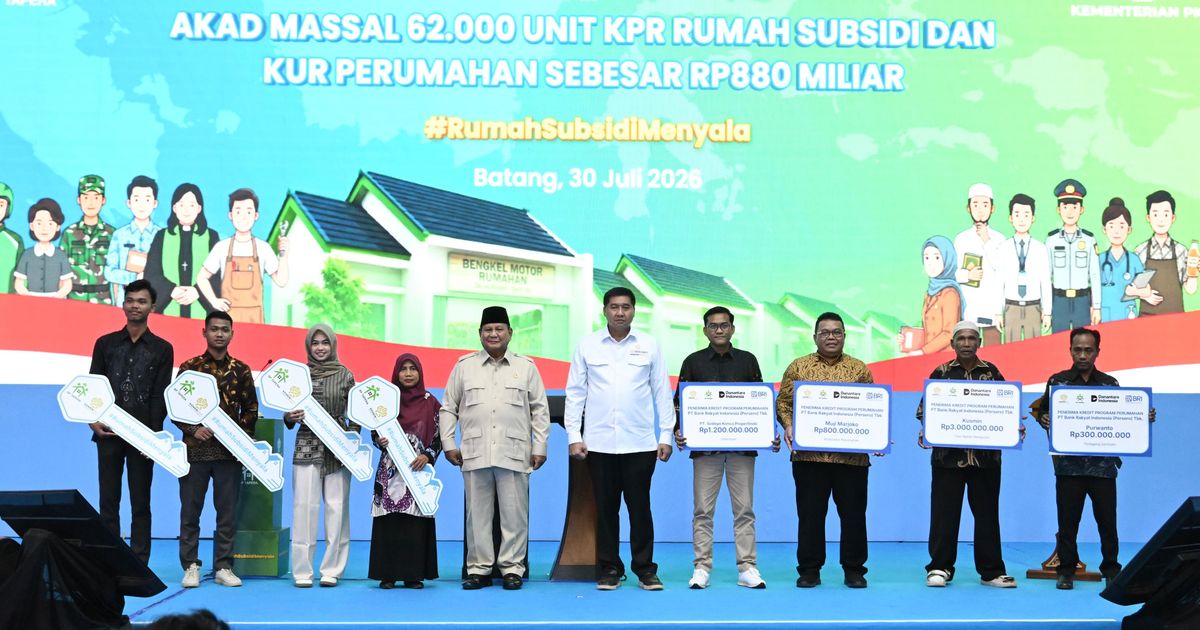
The national record was broken once again on July 30, 2026, when President Prabowo officiated the mass execution of 62,710 FLPP subsidized mortgages centered in Batang Regency, Central Java. While 200 borrowers attended the ceremony in person at the Puri Delta City Side complex, more than 62,000 borrowers participated virtually nationwide. Simultaneously, the government executed People’s Business Loans (KUR) for housing targeting 7,100 small enterprise borrowers, representing a total credit allocation of approximately Rp 880 billion ($55.3 million).
In his official report to the president in Batang, Sirait confirmed that the Batang ceremony represented the single largest subsidized mortgage signing event in Indonesia’s history. Beyond the sheer volume of contracts, Sirait drew attention to the emergence of regional developers who have built businesses from the ground up, fulfilling the president’s directive that national infrastructure spending must generate local wealth rather than enriching only capital-city conglomerates.
Sirait highlighted the story of Widodo, the master developer of the Puri Delta City Side project in Batang. Widodo began his career as an entry-level salesman before building a successful real estate enterprise that now generates approximately Rp 30 billion ($1.88 million) in annual profit. Sirait cited Widodo’s trajectory as direct proof that state housing policy is effectively democratizing commercial opportunities across secondary regional markets.
Crowdsourcing Capital Through Corporate Social Responsibility
A central driver of Sirait’s strategy has been his ability to mobilize private sector capital to supplement the national budget. Rather than relying solely on state fiscal allocations, the housing ministry has systematically engaged major corporate groups, banking executives, real estate trade groups, and state-owned enterprises to contribute directly to housing delivery through corporate social responsibility (CSR) budgets and strategic partnerships.
Through these private sector commitments, commercial enterprises are financing site preparation, utility connections, public amenity construction, and home rehabilitation for targeted vulnerable groups. This collaborative model allows residential development to proceed rapidly without placing exclusive reliance on government spending. The approach aligns directly with President Prabowo’s “Indonesia Incorporated” doctrine, which treats public institutions and private enterprise as joint partners in national development.
By combining $55.3 million in micro-enterprise loans with 62,710 new residential mortgages in Batang alone, the administration is positioning its housing policy as both a social safety net and a regional economic multiplier. As the Ministry of Housing scales this public-private framework toward its multi-year targets, the alignment between state liquidity facilities, private developer capacity, and grassroots homeownership is establishing a new structural baseline for Indonesia’s real estate economy.










Leave a comment