
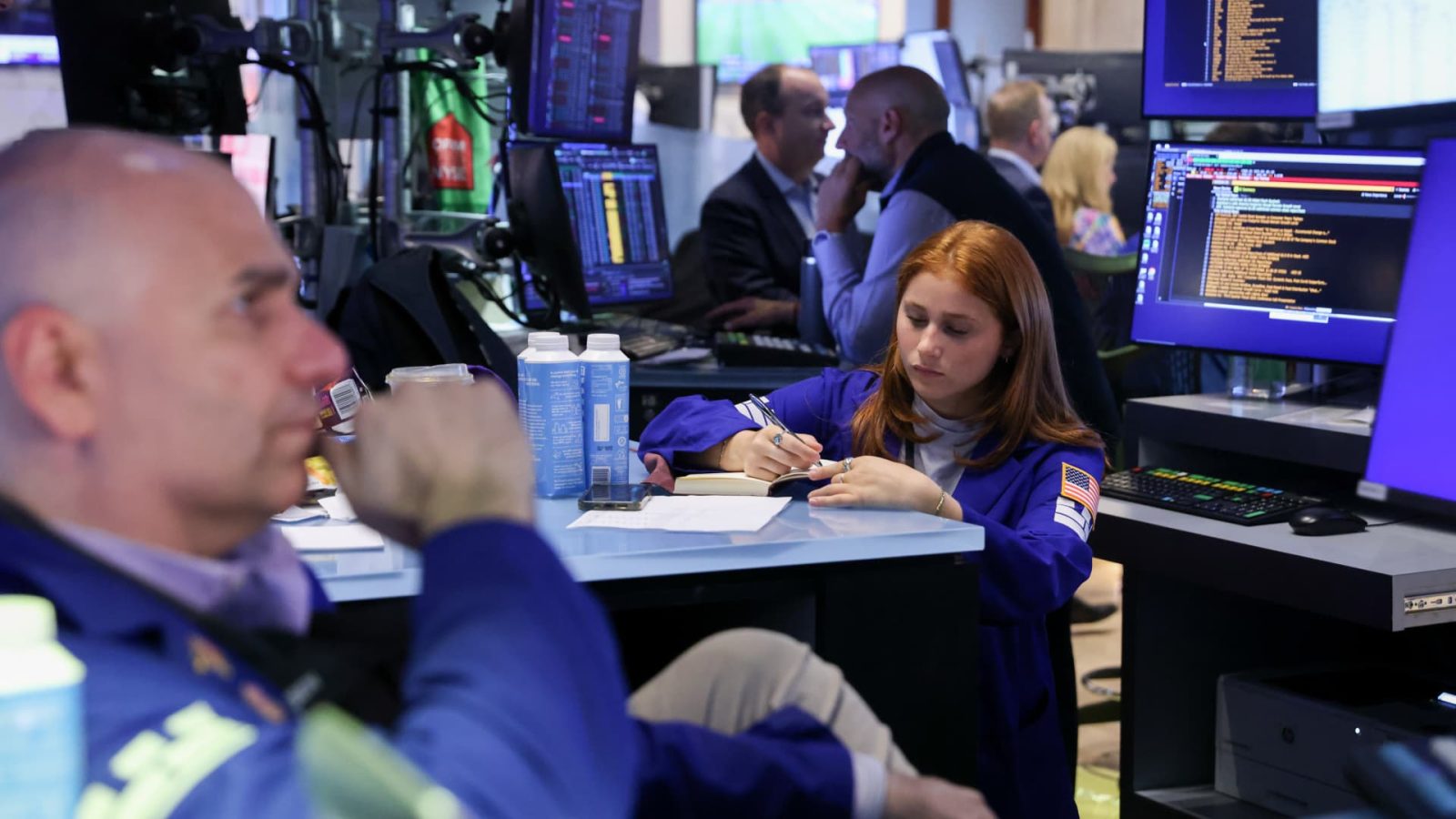
Traders work after a Federal Open Market Committee (FOMC) meeting on the floor of the New York Stock Exchange (NYSE) in New York, US, on Wednesday, June 17, 2026.
Michael Nagle | Bloomberg | Getty Images
U.S. stock futures rose on Thursday, with traders looking to recover after the Federal Reserve indicated the possibility of a rate hike this year — sparking a sell-off in equities during the previous session.
S&P 500 futures and Nasdaq 100 futures climbed 0.7% and 1.4%, respectively. Futures tied to the Dow Jones Industrial Average rose by 93 points, or 0.2%.
Intel led chip stocks higher, rising 9% after President Donald Trump said the company will partner with Apple on designing chips in the U.S. Fellow semiconductor names such as Nvidia and Micron Technology were also higher by more than 1% and more than 4%, respectively. The iShares Semiconductor ETF (SOXX) jumped more than 4%.
Asia-Pacific markets closed mostly higher, with South Korea’s Kospi and Japan’s Nikkei 225 jumping to fresh records, rising 2.3% and 1.7%, respectively. Hong Kong’s Hang Seng index fell 1.6%, while mainland China’s CSI 300 added 0.21%. Australia’s S&P/ASX 200 slid 0.62%. In Europe, the Stoxx 600 fell 0.4%.
Wall Street sold off Wednesday after the Federal Reserve’s first meeting with Kevin Warsh as chairman raised worries about monetary policy going forward.
Policymakers’ “dot plot” revealed that several Fed officials now see interest rates increasing in 2026. The median estimate for the year-end interest rate now stands at 3.8%, up from 3.4% in prior projections from March, suggesting that at least one rate hike could be in the picture in 2026. Complicating the forecast was Warsh’s decision to abstain from submitting a rate forecast.
“The Fed held rates steady but spoiled the mood with a much more hawkish dot plot. Elevated inflation makes that understandable, but the committee is far from united, with only about half still penciling in rate hikes later this year,” said Sonu Varghese, chief macro strategist at Carson Group. “The bigger point is that policy still looks loose for an economy where inflation remains a problem and the labor market is stabilizing.”
“The market doesn’t like regime change,” added David Zervos, chief market strategist at Jefferies, on CNBC’s “Closing Bell: Overtime” on Wednesday afternoon.











Leave a comment