
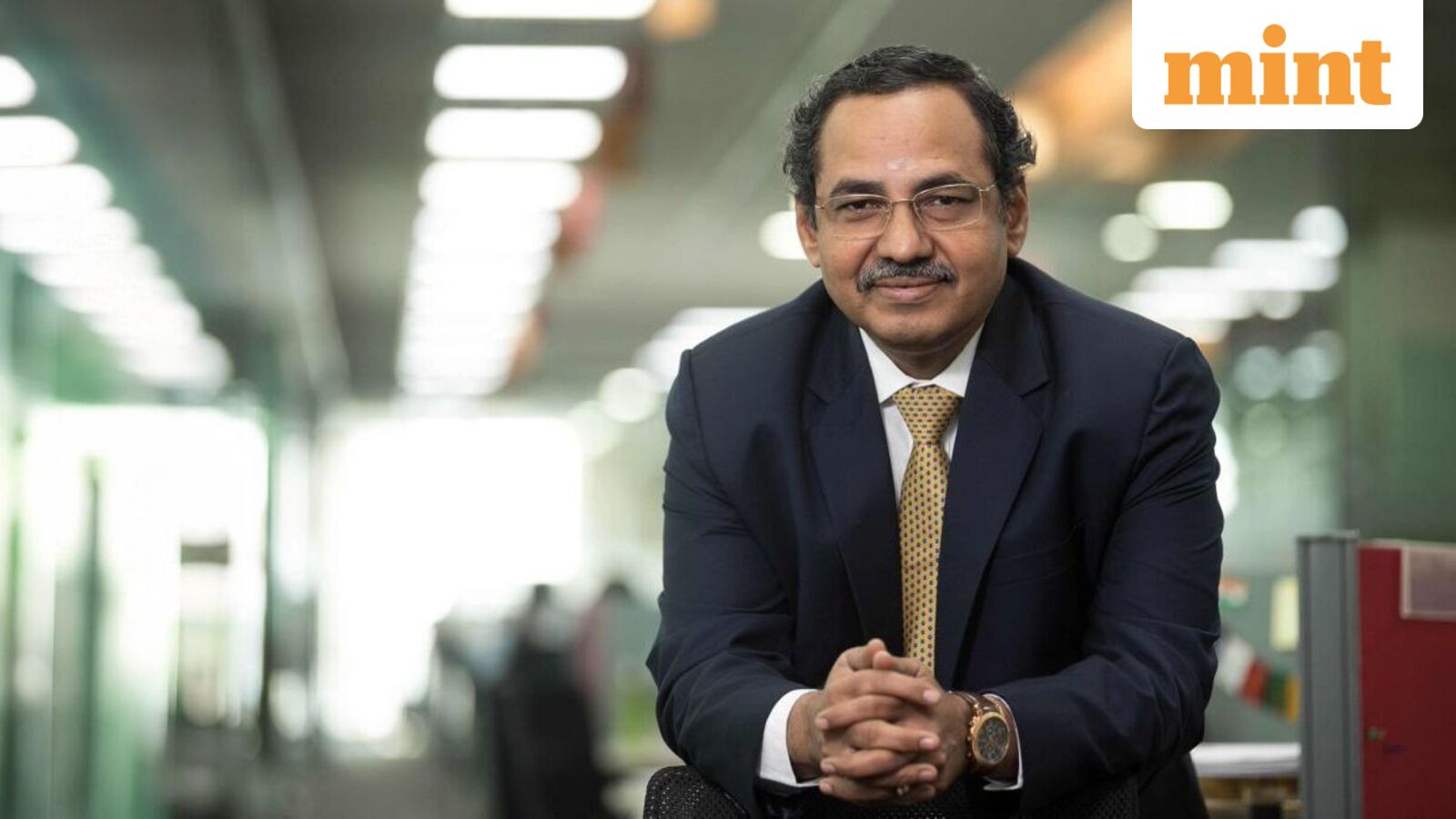
While many are worried by volatility, SIP stoppages, or geopolitical uncertainty, the ability to look beyond these ripples makes the difference and builds real returns for the investor. For A. Balasubramanian, MD and CEO of Aditya Birla Sun Life Mutual Fund, market corrections are not signals to retreat, but ‘conviction tests’ that reveal true value.
Mint spoke with Balasubramanian about deploying cash during the March slip, foray into SIFs, investing in debt, international funds, asset allocation, and more.
Here are edited excerpts from the conversation:
In the March market slip, Aditya Birla Sun Life had a relatively lower cash holding of about ₹2,400 crore, which was about 30% lower compared to the previous month. Did you view this dip as a deployment opportunity?
Absolutely. An equity manager’s primary role is to find value when others see uncertainty. Leave aside the immediate geopolitical tensions; we have been suggesting for quite some time that this year would see a marked improvement in the overall equity outlook once valuations became attractive.
During the March correction, we saw large-cap, mid-cap, and small-cap segments all pull back simultaneously. For us, the mid and small-cap segments, in particular, created a significant window. Our equity team focused on a bottom-up stock-picking approach, building positions where valuations were comfortable.
March saw the highest inflows into Flexi-cap and Small-cap categories. What do you make of this retail traction?
It’s an interesting shift. If you look at the journey over the last three or four years, small and mid-caps provided significant outperformance, which eventually led to stretched valuations. Then, with the continuous supply of IPOs last year, we saw a healthy correction. They have now returned to reasonable valuation levels.
At the same time, we saw significant corrections in large-cap sectors, specifically Banking, Financials, and IT. These are the sectors where Foreign Institutional Investors (FIIs) hold large chunks, and their continuous selling contributed to the index fall. Our job is to not get swayed by market sentiment but to look at the trajectory of economic growth.
For instance, our CIO of Equity, Harish Krishnan, who manages our Flexi-cap portfolio, has been dynamically shifting weights. He was previously overweight in large-caps, but as mid and small-caps became “cheaper” or more attractive, he reduced large-cap exposure to 55% and increased the allocation to mid and small-caps. We are also seeing credit growth in the banking sector outpacing deposit growth, which is a classic sign of economic normalization.
There has been significant chatter regarding “SIP stoppage ratios,” particularly since December. With portfolios turning red for many new investors, how concerned are you about this trend?
This is nothing new. Whenever the SIP book grows to a massive size, you naturally see a mix of investors. Experienced investors who have seen multiple cycles don’t stop, they understand that the power of compounding is reaped only by staying invested.
The concern comes from the “post-Covid” cohort, investors who entered during the bull market of the last four or five years. For them, 2025-26 was not a great year and suddenly, they see red in their portfolios. This is what I call a ‘conviction test.’
My belief is that this is a temporary issue and part of the learning curve. I have three suggestions for investors: If you are already invested and have seen value not getting generated, you should actually think about adding more to your existing SIP to lower your average cost. If you are an experienced investor, continue and increase your exposure if your wallet permits. And if you haven’t participated at all, the current market condition is the perfect entry point. India is poised for a 10-year bull market.
The fund house recently launched the Apex Hybrid Long-Short Fund, your first foray into the SIF (Specified Investment Fund) category. What is the objective here, and how has the initial interest been?
The SIF category is designed to satisfy investment styles. Traditionally, mutual funds are “long-only,” you buy a stock and hope it goes up. In a SIF, the money manager has more flexibility. They can also use the options market to protect the downside without putting 100% of the capital at risk.
We were a bit late to this category because I wanted to ensure we had the internal capability. We recruited two experts who previously worked with global hedge funds. This category isn’t for everyone; it’s for those who have already exhausted their diversified long-only, thematic, and hybrid options. It comes with added complexity, so managing risk is our top priority.
International funds had been opened and closed again between January and February 2026. What are some of the cues you look at to take these calls and what can investors expect from these funds going forward?
The country-wide $1 billion limit for mutual funds is currently exhausted, so we cannot take incremental fresh money into these schemes. However, we are now enabling this through Gift City (IFSC).
We recently received our retail license in Gift City. This is a game-changer for parents planning for their children’s education abroad or for families who travel globally. Under the Liberalized Remittance Scheme (LRS), every citizen can remit up to $250,000 per annum. Through Gift City, you can build a dollar-denominated corpus.
Two years ago, we launched a fund in Gift City that invested in China, Vietnam, Taiwan, and Korea. While China was out of favor then, it provided a diversification benefit that performed differently than India. Plus, investors got the “dual benefit” of currency; the rupee was at 85 then and is closer to 93 now.
The exit of Mahesh Patil, former CIO of Aditya Birla Sun Life MF, after two decades, made headlines. As Harish Krishnan steps into the role, how should investors view this transition for ABSL MF?
In an organization of this size, people are the key, but the process is what makes it sustainable. Mahesh spent 22 years with us and contributed immensely to bringing us to where we are today. He wanted to pursue other ambitions after three decades in the industry, and we prepared for this. We built a second line under Harish Krishnan, who joined us about three years ago.
We are a team of 52 investment professionals. Many of our current portfolio managers started here as junior analysts 10 or 15 years ago. We have a lot of home-grown talent as well. Every person who leaves, leaves a legacy of investing strategy with us.
You have been an advocate of the debt market. Do you see increased retail participation, and where should retail investors look for fixed-income opportunities?
Fixed income currently offers very attractive yields. We are seeing the 10-year yield close to 7.4% and the 30-year yield near 7.9%. Despite potential interest rate cuts, the ‘carry’ which is the interest earned from holding the bond, is excellent. If you invest in a seven-year bond at an 8% accrual, you get that 8% consistently, which provides a significant cushion of capital protection.
For retail investors who are conservative and usually stick to FDs, I recommend corporate bond funds, or short and long-duration funds. If you’re looking for tax efficiency, categories like Multi-Asset Allocation funds or Equity Savings funds are great because they mix fixed income with arbitrage and a bit of equity, providing a better post-tax return than traditional instruments.
With various global and domestic cues to watch, investors need to tailor their portfolio according to their goals. What should asset allocation look like today to ensure diversification?
The way I see it is, everyone has to take risks to create wealth. I would choose the categories of equity, fixed income, gold, silver, and real estate. Each has an expected return and a corresponding risk. Equity might give you 14-15%, real estate 11%, and debt 8%. You shouldn’t put all your money in the highest-return bucket because that also has the highest risk.
If you are 25 years old and start work, you have 40 years of work ahead of you. So 70-80% of your money should be in core equity, Flexi-caps, Multi-caps, Multi-asset allocation and Mid-caps. As you age, you move toward Balance Advantage Funds. BAFs are a beautiful solution because they leave the worry of market fluctuations to the money manager.
Ultimately, wealth creation is about the weighted average. Build a model where 60% is in equity, 15% in gold or real estate, and 15% in fixed income.












Leave a comment