By Lucy Raitano and Kate Holton
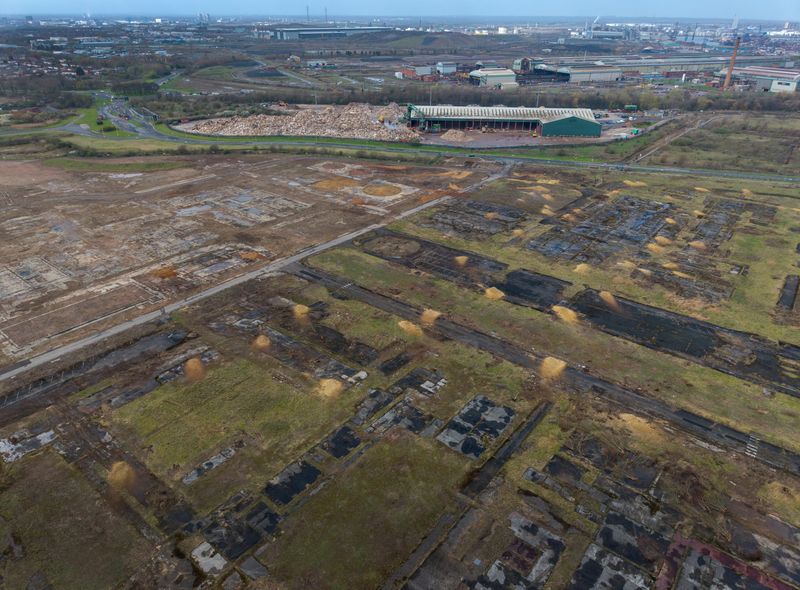
WILTON, England, April 24 (Reuters) – Land left dormant by the decline of the chemical industry in northeastern England has taken on a new lustre. Blessed with power plants, water and a grid connection, the site has just what it takes to house a start-of-the-art AI data center campus.
That’s what the owners of the Wilton International site in Teesside hope at least, but they are not alone.
Across Britain, owners of industrial sites, speculative investors, property developers and even farmers are burnishing the credentials of their land to cash in on the billions of dollars tech giants plan to spend on AI data centers.
According to construction analytics group Barbour ABI, plans for 119 data centers have been submitted, on sites as varied as a disused car plant, an old paint factory, a former Travelodge hotel and a retail centre near Heathrow Airport.
Momentum grew last year after King Charles hosted Donald Trump and tech bosses at a banquet during the U.S. president’s visit, with companies including Google, Microsoft and Nvidia all pledging to invest billions in Britain’s digital infrastructure.
The AI gold rush has spawned a whole new industry around data center wannabees, upended land valuations and created a logjam in the lengthy queue for grid connections, according to more than 20 interviews with data center operators, advisers, lawyers and investors.
“The demand that’s come through in the last couple of years – really because of AI – has exploded,” said Andrew Groves at real estate adviser Bidwells. “Speculators and promoters have obviously seen it as an opportunity to make greater returns.”
While the financial services industry needs data centers to be nearby for the sake of speed, when it comes to artificial intelligence, the main requirement is processing power – which means AI data centers can be based further afield.
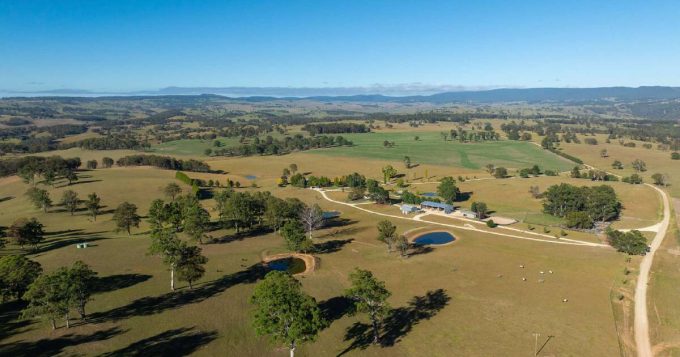
That has the potential to breathe life into cheaper industrial sites in Britain far from London’s elevated property prices and has also piqued the interest of rural landowners hoping a data center might pay better than farming.
‘POWERED LAND’
Wilton is one such site. The majority owner, utilities company Sembcorp UK, has been serving petrochemical customers for decades but the decline of the industry has now left it with spare land – and power.
The site is what’s being dubbed “powered land” – a plot that either has its own power generation or an existing high-voltage grid connection, or both.
Working with data center developer Digital Reef, Sembcorp hopes to land a big tech firm – maybe a so-called hyperscaler – as a tenant to help build out a data center on the site, which is in one of the most economically deprived parts of Britain.
“We’re trying to develop something quite quickly, and bring jobs and industry and investment back,” said Mike Patrick, CEO of Sembcorp UK, a subsidiary of Singapore’s Sembcorp Industries.
Hyperscalers are companies offering huge amounts of cloud computing capacity, including for AI, such as Amazon, Apple, Google, Meta and Microsoft – and they need a lot of power.
“Wilton is almost uniquely placed in that it already has a large grid connection and on-site power assets,” said Sembcorp UK Business Development Director Peter Ireton. “We think we can attract a large off-taker.”
But many sites with data center ambitions have no power.
That’s why there has been an explosion in applications for grid connections. Coupled with the need for upgrades to transmission circuits, the demand has pushed wait times for a connection out to 12 to 15 years.
Britain’s energy department said demand for connections leapt 460% in the first six months of 2025. Requests to join the high-voltage network rocketed to 96 gigawatts of capacity – with another 29 GW of demands to join local networks.
For context, Britain’s total generation capacity is estimated to be about 72 GW, though last year’s peak demand was just under 46 GW.
The National Energy System Operator said in March it had identified 140 data centers in the main queue, representing about 50 GW of capacity.
It said that suggested speculative activity was boosting demand far beyond what the network can support and, in turn, delaying viable projects and slowing the energy transition.
Some requests are from owners of land which has neither power, planning permission nor a potential end user. Dubbed “zombie projects”, they’re clogging up the system.
“You’ve been seeing an awful lot of people speculating, spending time trying to get power onto a site,” said Tom Glover, head of data centers for EMEA at U.S. real estate firm JLL.
Aware of the issue, NESO launched plans in March to amend its application process to weed out speculative applications and prioritise strategic sectors, including data centers. A similar move last year to tidy up the queue for clean power projects wanting to join the grid cut those requests by half.
GETTING CREATIVE WITH POWER
Brokers said land with a power supply suitable for a data center has long carried a premium but AI demand and grid congestion has pushed it higher over the past few years.
According to British real estate company Savills, London industrial land can sell for between 4.5 and 6 million pounds an acre. Savills and two other sources said that jumps to between 8 and 15 million pounds for land suitable for a data center.
It’s a similar story in the United States.
According to a March report by real estate adviser Colliers, powered land is being sold for up to two and half times more than other industrial land – and that multiple jumps to over three times in northern Virginia and northern California.
Other developers have had to be creative when it comes to getting power in Britain.
The developer behind a site north of London bought by U.S. data center operator Equinix had to join forces with a group with an allocated connection for a battery storage project and then switch it to a demand connection suitable for a data center before the deal went through.
“Acquiring a development that has outline planning and a confirmed grid connection just effectively removes the risk,” James Tyler, UK managing director at Equinix, told Reuters.
The company plans to plough 3.9 billion pounds ($5.3 billion) into the development – its largest investment outside the United States. It hopes to break ground in early 2027 and have an operational data center in 2031.
For others, even a guaranteed connection date is not always a cause for celebration.
Dawn Childs, president of data center developer and operator Pure DC, said the offer of a connection date for one of its London projects was delayed about two years ago.
About a third of the power on offer was unexpectedly pushed back by more than a decade and they had to figure out an alternative solution to make the site commercially viable, she said.
‘IT’S HAPPENING’
Data compiled for Reuters by DC Byte shows Britain is falling behind rival data center markets. Out of the 61 projects it has tracked in Britain since late 2022, only 7% are being built or have been completed.
By contrast, 46% of Germany projects tracked by DC Byte are under construction or finished, it’s 40% in France and 24% in the United States.
That’s a problem for the government, companies and big tech, all of which see major data centers as a way to modernise the economy and turn Britain into an AI Superpower
The ballooning queue for a grid connection is not the only challenge. Britain also has some of the world’s highest industrial electricity prices.
OpenAI, which makes ChatGPT, hit pause this month on plans to build a large data center in northeastern England about 50 miles from the Wilton site due to concerns over high energy costs and regulation.
Nevertheless, the industry consensus is that demand for AI remains genuine and the potential for sites offering power, planning and land is huge.
All of which could be good news for Wilton. It has an existing 240 MW grid connection and its own on-site generation assets including gas, biomass and waste-to-energy plants.
Sembcorp expects to be able to integrate nearby solar and wind power into its Wilton power mix as the data center development progresses and ultimately reach 1 GW. Digital Reef’s founder Piers Slater said getting there would imply an investment of about 15 billion pounds over eight to 10 years.
Discussions with potential data center operators were described by the partners as positive.
“Obviously there’s a lot of talk, is it a dot com? Is it a bubble?” Slater said. “But what we’re seeing is the adoption of AI – and it’s happening.”
($1 = 0.7412 pounds)
(Reporting by Lucy Raitano in Wilton and Kate Holton in London; Additional reporting by Susanna Twidale in London; Editing by David Clarke)












Leave a comment