
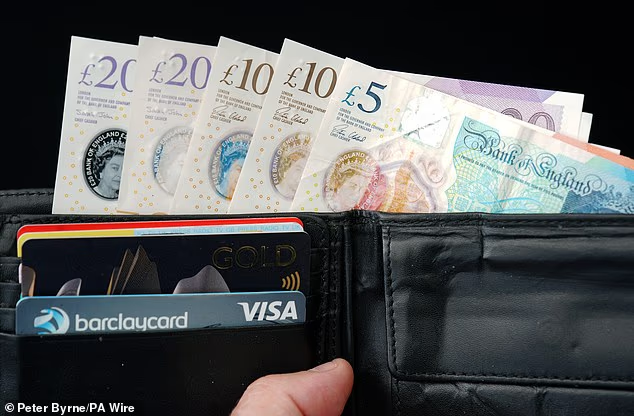
When it comes to payments, digital is the easiest and preferred method for many people.
So much so that more than half of people would leave their physical wallet behind when leaving the house.
But increased reliance on digital payment methods could leave people exposed.
Recent high-profile technology failures have left consumers exposed across payments, banking and broader services.
Adrian Roberts, deputy chief executive of Link, discusses why, despite digital payments being the go-to, cash still has a key role to play in today’s society…
As the UK’s main cash machine operator, we see firsthand how things are changing when it comes to payments across the UK.
This year is Link’s 40th anniversary, and for those who remember it, in 1985 the cost of a pint of milk was 22p (it’s 85p today), it was the year of Live Aid, the first episode of Eastenders was aired and the biggest film was Back to the Future.
That’s a flashback for many readers, but it probably won’t be of great surprise that we were very much a world of card, cash and cheques.

Less than half of people see their wallet as being essential to take with them when leaving the house
Fast forward to 2025 and the options are very different. In forty years, we’ve added bank transfers, chip-and-pin and contactless cards, but also digital wallets on our smart devices, open banking and even via QR codes.
The old saying that ‘cash is king’ may still be true for some, but one may also argue that in today’s world it is convenience that wears that crown.
We’ve published some new research today that shows just how much how things have changed and also whether increased reliance on digital payment methods could leave people exposed.
The growing payment choices offered by retailers mean that less than half of us now leave the house with our wallet or purse.
Something that would be unimaginable 10 years ago. Digital systems and connectivity were often clunky and slow at best.
It felt alien, improbable or frowned upon at times paying for things using a card, let alone your smartphone for a round of drinks, parking the car or the bus.
And yet, we are now at a point where, for many, digital is the default. Industry data shows that card payments overtook cash for the first time in 2018, but now, digital wallets on our smartphones or smartwatches have become the go-to payment option for Gen Z and millennials – those aged 18-44.
While older age groups may still prefer cards, there isn’t a huge generational divide that splits them.
Despite this, cash still plays a key part in society. It might be less prominent than it was and no longer the default option for any age group, but the research shows that more than three in five of us use cash at least once a week and we know from ATM data that last year, the average UK adult withdrew £1,250 – around £80billion in total.
We also know that digital still does not work for everyone and almost a quarter of people consider themselves to be digitally excluded from society, not least through payments and banking.
It’s why it’s no surprise that it remains the most trusted payment.
While it is understandable that people don’t tend to think about the plumbing of our payments system, we are now at a moment where we are more digitally reliant than ever and we should consider what we would do if systems were down for a sustained period?
There have been outages in the UK, but fortunately they’ve been limited and systems have been restored fairly swiftly.
However, we only need to look at the recent power outages in Portugal and Spain that demonstrate the significant vulnerabilities.
In Sweden and Finland, the Governments have discussed contingency plans on what could happen if there was an attack on their payments system.
Our research shows us that digital reliance does leave us more exposed. Two-thirds of us have experienced some form of disruption, a third of them from payment system outages.
And yet, many people don’t carry cash or even keep any at home. The median amount people carry on them is £20 with a further £10 kept at home.
This is not limited to cash either, over half of us (53 per cent) leave the house with only one bank card or 40 per cent of us only keep one card on our digital wallet.
What do you do if you come to pay for shopping and your phone battery is dead?
Or perhaps there is disruption on the card network meaning you can’t pay by card or digital wallet?
These may sound hypothetical, but there is enough evidence to show that things do go wrong.
People reading this may think that we have a vested interest. But Link isn’t here to hold back the digital tide.
Far from it. Our job is simply to ensure free access to cash for as long as people need it.
We support change that allow more people to benefit from digital products and services and we support the excellent work being led by the Bank of England to improve resilience in our digital payments systems.
But for now, we would just encourage people to think about if they have a back-up, just in case the technology isn’t working one day.
There is a famous line from 1985’s Back to the Future, which if remade today could possibly say ‘Wallets, where we’re going we don’t need wallets’.
Indeed, the digital wallet may well make the physical wallet a timepiece in future. But it certainly feels more reassuring if and when things go wrong.
SAVE MONEY, MAKE MONEY

4.76% cash Isa
4.76% cash Isa
Trading 212: 1.16% fixed 12-month bonus

Up to £500 cashback
Up to £500 cashback
£50-£500 back when investing at least £500

Internet with gift card
Internet with gift card
£100 voucher when you take out broadband

£200 with Sipp
£200 with Sipp
£200 cashback when you open a pension

£20 gift card
£20 gift card
Open a Plum Isa and hold £1,000 for 90 days
Affiliate links: If you take out a product This is Money may earn a commission. These deals are chosen by our editorial team, as we think they are worth highlighting. This does not affect our editorial independence. Terms and conditions apply on all offers.











Leave a comment