
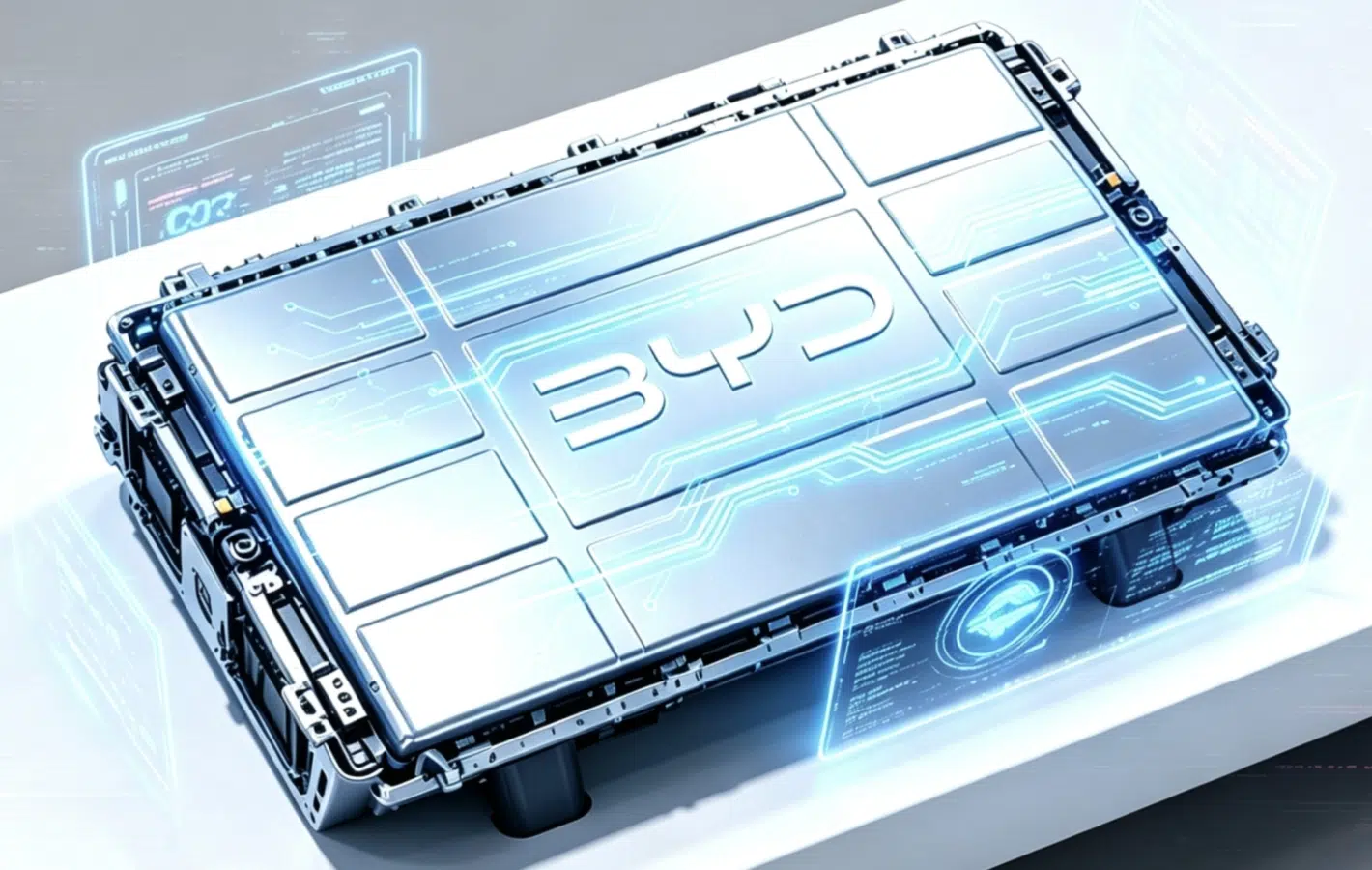
Mid-2026 market data shows a structural bifurcation in the sodium-ion battery sector, as industrial applications diverge from passenger-vehicle pathways. According to the June 12, 2026, Securities Daily report, Changan Automobile and CATL launched a mass-produced passenger vehicle featuring a 45 kWh sodium pack. In contrast, BYD is focusing its third-generation polyanion (NFPP) platform on stationary energy storage systems, targeting a stabilised manufacturing cost baseline of 0.3 yuan (0.04 USD) per watt-hour by 2027.
Overcoming the Polyanion Conductivity Paradox
The manufacturer’s grid storage strategy relies on a dedicated 189Ah, 2.9V heavy-duty cell architecture. The primary material constraint in polyanion chemistry is its three-dimensional framework, bound by strong covalent phosphate (PO₄³⁻) groups, which yields an intrinsic electronic conductivity range of 10⁻⁹ to 10⁻¹⁰ S/cm. This range characterises the un-modified material essentially as an electrical insulator.
To mitigate high-temperature degradation and internal sodium plating under operational current stress, a dual-modification methodology was introduced. Reducing particle sizes below 100 nm via nanofabrication shortens electron transit pathways, while an amorphous carbon matrix coating across grain boundaries elevates electronic conductivity by four to five orders of magnitude.
Quantifying the Structural Performance Variance
Laboratory data compiled in a June 8 industry depth report by Minmetals Securities outlines the distinct performance parameters of competing sodium-ion pathways. These long-life parameters are engineered to fulfil multi-decade stationary demand metrics rather than weight-sensitive transport configurations.
| Performance & Abuse Metric | Polyanion (NFPP) Cell Baseline | Layered Oxide Alternative | Grid/Industrial Significance |
| Max. Thermal Runaway Temp. | 273.32°C | 484.51°C | Crucial for dense, indoor commercial energy storage installations. |
| Total Volumetric Gas Evolution | 93.1 L | 123.25 L | Optimises utility-scale grid power over weight-critical passenger cars. |
| Target Field Deployment | 200Ah long-form cell | Lower-capacity, high Wh/kg cell | Optimizes utility-scale grid power over weight-critical passenger cars. |
These thermal profiles support stable grid installations. The resulting framework enables an asset life threshold of ≥ 10,000 cycles, translating to a 33-year operational span under standardised power distribution cycles. This longevity underpins the system architecture as BYD breaks ground with solid-state battery and 10,000-cycle sodium tech to anchor static grid infrastructure.
Addressing Supply Chain Hard Carbon Friction
Widespread economic displacement of lithium iron phosphate remains limited by constraints on the negative electrode. The global supply chain for hard carbon anodes remains fragmented, lacks a standardised processing pathway, and leads to ongoing cell yield variations during mass manufacturing.
Financial projections published by Minmetals Securities indicate that full-scale cost parity between scaled sodium production lines and established lithium iron phosphate lines will not materialise until 2027. This industrial transition accelerates as CATL and BYD fast-track the shift to sodium-ion batteries to mitigate structural macroeconomic resource volatility.
Market Segmentation and Symbiosis
Corporate filings from April 2026 show that the manufacturer deployed megawatt-hour-class polyanion systems during pilot phases in 2025. This specialised shift away from the automotive market occurs while the broader sector maintains a rigid volume hierarchy across mainstream transport fields.
According to May data from the China EV DataTracker, the electric vehicle battery installation landscape remains highly centralised, with CATL maintaining a dominant lead at 33.08 GWh, securing a 46.7 per cent market share. BYD holds the second position with 11.87 GWh of installations, representing a 16.8 per cent market share, while Tier-2 manufacturers like Gotion High-tech and Calb follow at 6.3 per cent and 6.1 per cent, respectively, highlighting the massive scale disparity that forces players to navigate distinct, scenario-specific chemistry niches.
Industrial data suggests a long-term multi-chemistry symbiosis. Lithium iron phosphate and high-nickel variants retain dominance in high-speed transport lines, while stable polyanion cells are allocated exclusively to heavy machinery, stationary installations, and stationary infrastructure networks, where longevity outweighs volumetric constraints.













Leave a comment