
Relevant capital flow data shows that to avoid the pullback risk of the domestic stock market, South Korean investors set off a boom of pouring into the US market in July…
Data disclosed by SEIBro under the Korea Securities Depository (KSD) shows that South Korean retail investors made a net purchase of about 4.5 billion US dollars in US stocks last month, a significant rebound from June, approaching the net purchase record of 5 billion US dollars in January this year.
Meanwhile, South Korea’s local stock market suffered a sharp sell-off in July. Prior to that, a strong bull market rally had attracted a large number of retail investors to pour into semiconductor stocks and leveraged products, but the market then pulled back sharply, and did not usher in a phased rebound and return to a technical bull market until August.
So what did South Korean investors buy in the US stock market in July?
SK Hynix ADR Ranks Second
Data from the Korea Securities Depository shows that of the 4.5 billion US dollars in US stocks net purchased by South Korean investors in July, about 840 million US dollars flowed to SK Hynix’s US-listed ADR. Even though South Korean investors can directly buy the company’s stocks locally, SK Hynix’s ADR still ranks second on the list of their net purchased US stocks.
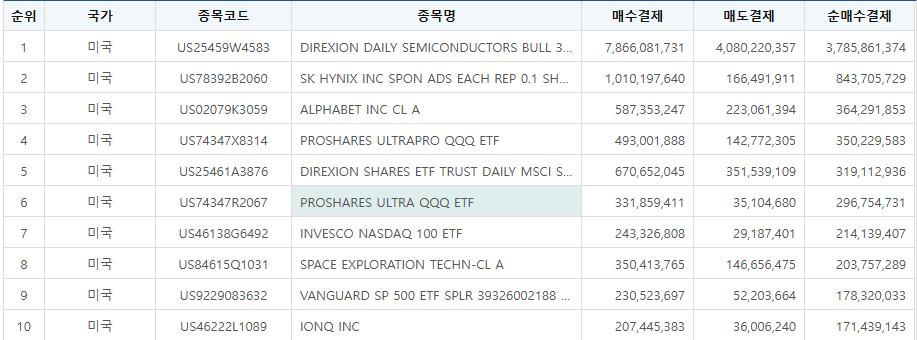
It is worth noting that the trading price of these SK Hynix ADRs has a significant premium over the company’s stocks in the South Korean local market, but these premiums do not seem to affect the enthusiasm of South Korean investors.
Owen Lamont, Senior Vice President of Acadian Asset Management, pointed out that this premium rate has recently reached about 10%, and the volatility of ADRs is also more intense.
“This is absolutely crazy,” Lamont said when talking about South Korean investors buying SK Hynix’s US-listed stocks. “There is no reason at all for South Korean investors to go to the US market to buy ADRs of local companies.”
Lamont said such price differences are rare and could be a warning sign of excessive speculation. “This is a sign of a bubble,” he pointed out that during the dot-com bubble period, companies in Taiwan, China and India also staged similar pricing distortions.
Still Fond of Leveraging?
Data from the Korea Securities Depository also shows that among the top ten US stock targets by net purchase amount of South Korean investors in July, as many as 4 are high-leverage products.
The most sought-after one is Direxion Daily Semiconductors Bull 3X Shares ETF (SOXL), which is designed to track three times the daily performance of the semiconductor index. In addition, the leveraged products ProShares UltraPro QQQ and ProShares Ultra QQQ rank fourth and sixth respectively.
Even so far this month, the highly risk-seeking South Korean investors still show no less love for leveraged products — the ProShares Ultra QQQ ETF still ranks seventh among the top ten popular US stocks for South Korean investors.
Facts have proved that although South Korean investors have switched their trading battlefield, they have not changed their core game logic.
Phillip Wool, Head of Research at Rayliant Global Advisors, pointed out: “Ironically, if you analyze the data carefully, you will find that most of what they bought are still AI hardware concept stocks, which are exactly the same sectors they sold off heavily in the local market.”
What Impact Will It Have on the US Stock Market?
Jung In Yun, founder of Fibonacci Asset Management, analyzed that some traders who had previously suffered heavy losses in South Korean semiconductor stocks or leveraged ETFs may be transferring funds to US AI leading stocks that they believe have higher asset quality and better liquidity.
“They have not cut their exposure to artificial intelligence concepts,” Yun said. “They just changed the place and channel to express the same market view.”
As for whether this influx of South Korean capital can really cause fluctuations in the much larger US market, it remains to be seen.
Wool believes this risk is minimal. He pointed out that although retail investors have a pivotal influence in the South Korean stock market, the US stock market is mainly dominated by professional institutional investors. Therefore, even the large-scale South Korean capital flow is still a drop in the bucket compared with the total trading volume of US stocks.
However, Lamont believes that the possibility of market distortion is greater in individual stocks and segments favored by retail investors. He specifically mentioned the phenomenon that South Korean investors frantically poured into US quantum computing concept stocks at the end of 2024, and pointed out that the wanton expansion of leveraged ETFs in the South Korean, Hong Kong and US stock markets “is likely to push up overall volatility and amplify sharp market swings.”
This article is from the WeChat official account “CLS”, author: Xiao Xiang, published with authorization from 36Kr.









Leave a comment