
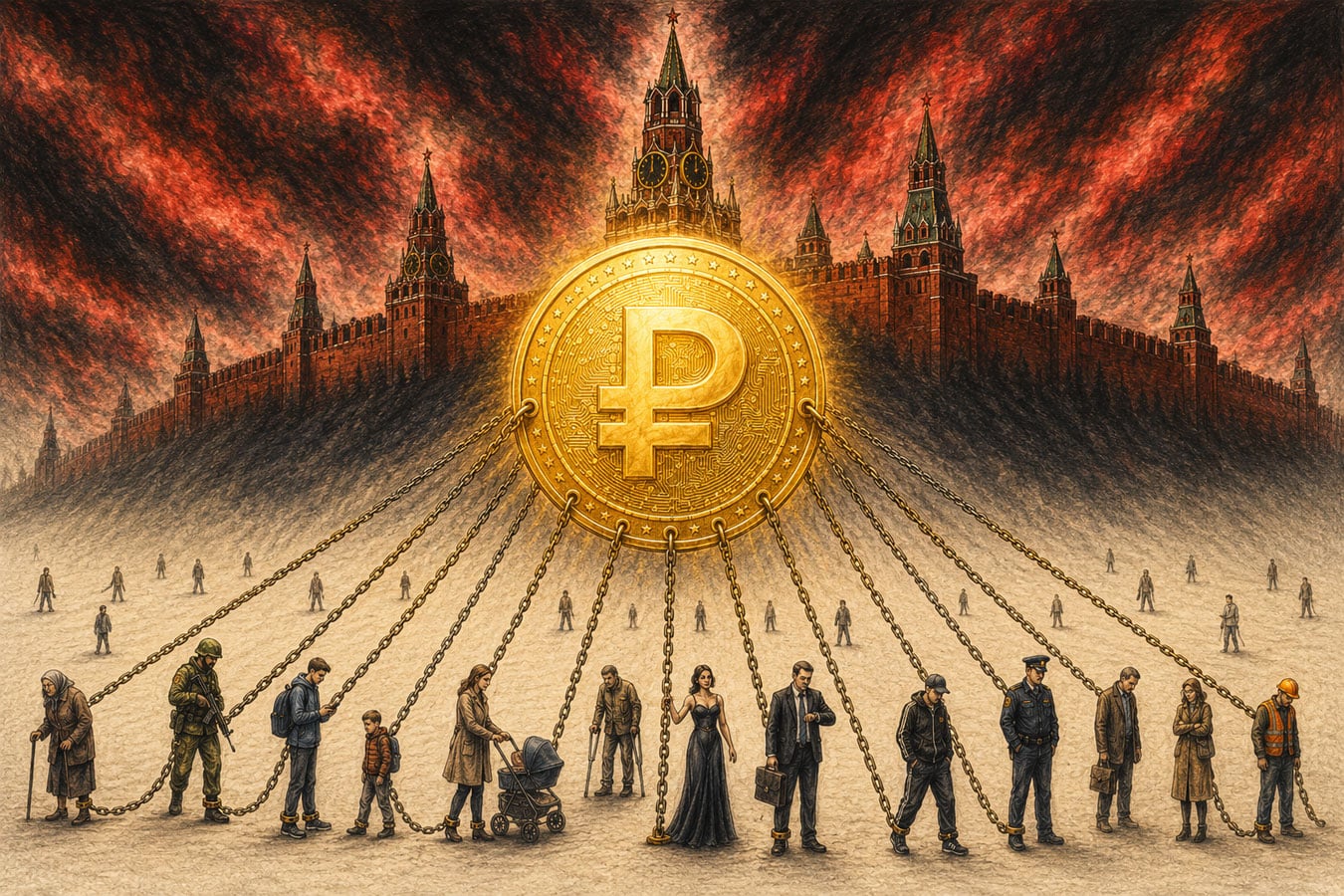
The Bank of Russia has announced the mass rollout of what it calls the “digital ruble” from September 1, 2026. From that date, Russia’s largest banks are expected to be the first to give clients the ability to use digital rubles: to open accounts, make transfers, and pay for goods and services.
On paper, this is presented as modernization: faster payments, lower costs, more efficient public spending and a new stage in Russia’s financial infrastructure. But behind the technical language lies a much deeper humanitarian question: what happens when a state does not only issue money, but can also define how citizens are allowed to use it?
This is the central issue. The digital ruble is not simply a new payment tool. It is about the future relationship between the citizen and the state.
The Russian authorities describe the digital ruble as a third form of national currency, alongside cash and non-cash bank money. But unlike ordinary bank money, the digital ruble is built around a centralized platform of the Bank of Russia. That makes it more than another banking app. It creates a direct state-controlled financial environment.
A central bank digital currency is not automatically dangerous. In a democratic system, with independent courts, strong privacy protections, public oversight and clear limits on state power, such technology can be used for convenience, anti-corruption measures and targeted social assistance.
But Russia is not introducing the digital ruble in a normal political environment. It is doing so during a war against Ukraine, under sanctions, with growing internal repression and with millions of people increasingly dependent on state payments.
That changes everything.
This is not a distant theoretical scenario. Russia has already moved through several stages. The prototype of the digital ruble platform was created in December 2021. Testing and legal preparations continued in 2022. On August 15, 2023, the pilot with real digital rubles began, initially with 13 banks and a limited number of clients. In September 2024, the pilot was expanded. In 2025, Russia connected the digital ruble to the budget process through amendments to the Budget Code. From September 1, 2026, the mass rollout is expected to begin, with further stages planned for 2027 and 2028.
That timeline matters. It means the digital ruble is no longer a vague financial experiment. It is becoming part of Russia’s official payment and budget infrastructure — the kind of infrastructure that can later be used for pensions, state salaries, social benefits, compensation payments and other money flows on which millions of people depend.
This is why NAnews — Nikk.Agency Israel News looked at the digital ruble not only as a Russian banking story, but as a political and humanitarian issue. For readers in Israel, especially those with family, pensions, property, inheritance cases or old financial links in Russia, this is not an abstract reform. It may affect real access to money.
The Core Message
The main danger is not that money becomes digital. Most money is already digital in practice. Salaries arrive on cards, bills are paid online, and people transfer money through apps every day.
The danger is that money may stop being neutral.
If the state can decide where money may be spent, to whom it may be sent, whether it may be converted into foreign currency, and whether it may leave the Russian financial system, then the citizen no longer fully controls his or her own money.
The balance may still appear on the screen. The money may still formally belong to the person. But the freedom to use it may be restricted.
That is the difference between money as property and money as permission.
This is why the digital ruble can become more than a financial reform. In the hands of the Kremlin, it can become an electronic leash.
Who Is Most Vulnerable?
The first vulnerable group is military personnel and their families.
Russia spends enormous sums on payments to contract soldiers, mobilized men, the wounded, and relatives of those killed in the war. If such payments are ever tied to digital restrictions, families may lose the ability to make independent financial decisions. They may receive compensation, but be unable to transfer it abroad, buy foreign currency, save it outside the Russian system, or use it freely.
There is no confirmed evidence that Russian military payments will be forcibly moved into the digital ruble. But the infrastructure creates that possibility. In an authoritarian system, a technical possibility can quickly become a political instrument.
The second vulnerable group is pensioners.
For millions of older Russians, a pension is the main or only source of survival. If a digital system allows automatic deductions or limits categories of purchases, pensioners may lose the ability to decide what matters most: medicine, food, housing, debt, help to relatives, or savings.
A pension is not just a payment. It is the small space of personal autonomy left to an elderly person. If the state begins to define which needs are “necessary” and which are secondary, that autonomy disappears.
The third vulnerable group is state employees and budget-sector workers.
Once salaries, subsidies, benefits and state payments move deeper into a digital state-controlled environment, every transaction can become part of a person’s financial profile. What one buys, whom one helps, whether one sends money abroad, whether one buys foreign currency — all of this can become data for the state.
The question is not whether financial control is ever needed. Every country needs tools against fraud, money laundering and corruption. The question is who controls the controller. In Russia, where independent institutions are weak or absent, financial transparency for the state may become total opacity for the citizen.
The Problem Is Not Technology. The Problem Is Power.
The digital ruble could be used for useful purposes: faster payments, targeted support, better budget control. But technology does not exist outside politics.
In a free society, digital currency can be a service.
In an authoritarian state, it can become a system of dependency.
That is the deeper warning. When technological capacity grows faster than the protection of civil rights, financial infrastructure can turn from a service for the population into an instrument for managing the population.
History also shows that restrictions introduced in extraordinary circumstances often remain after the original emergency has passed. A tool justified by war, sanctions or “national security” can later become part of everyday control.
That is why the public debate around the digital ruble is not only about finance or technology. It is about a fundamental question: should money remain the property of the citizen, or become a tool whose use is determined by the state?
Why This Matters to Israelis
At first glance, the digital ruble may seem like an internal Russian issue. It is not.
Israel has many citizens and residents whose lives are still connected to Russia: immigrants from the former Soviet Union, pensioners with Russian payments, families with relatives in Russia, people with apartments, inheritances, bank accounts, savings, business history, or legal obligations there.
For them, the digital ruble is not an abstract technological project. It may affect access to money.
This is especially relevant now because Israeli banks have already spent the years since Russia’s full-scale invasion of Ukraine dealing with sanctions, compliance questions and money transfers connected to Russia. For immigrants and families with Russian pensions, property, inheritances or savings, the digital ruble could add another layer of difficulty: not only proving where the money came from, but also explaining how it moved through a state-controlled Russian digital platform.
An Israeli living in Haifa, Bat Yam, Ashdod, Netanya or Jerusalem may still have a pension, a family apartment, an inheritance case, elderly parents, or old savings in Russia. If more of Russia’s financial life is moved into a centralized digital system, transferring, proving, converting or using these funds may become more complicated.
For Israeli families, the most sensitive issue may be relatives. Many people in Israel still support parents or children in Russia. Others may receive help from relatives there. A family transfer that should be private may become visible inside a state-controlled financial profile.
For elderly immigrants, the issue may be pensions. Even if the digital ruble is officially described as voluntary, real pressure can appear through infrastructure. Today, people may be told they have a choice. Tomorrow, certain payments may become easier through the digital channel. Later, alternatives may become inconvenient or limited.
That is how “voluntary” systems become unavoidable.
For NAnews, this is exactly where the Russian story becomes an Israeli one. The issue is not whether digital rubles will be used in Israeli shops. They will not. The issue is whether people in Israel who still have legal money, family obligations or property inside Russia may find those assets trapped in a system where movement, conversion and explanation become harder.
What Israelis Should Do
There is no need for panic. But there is a need for preparation.
Anyone in Israel who still has financial links to Russia should understand exactly what remains there: pensions, bank accounts, property, inheritance rights, savings, business interests, debts, or family obligations.
Documents matter. Israeli banks do not work with emotions; they work with proof. Contracts, inheritance papers, tax documents, bank statements, pension documents, proof of sale of property, powers of attorney and translations should be collected before a crisis begins.
People should also speak with their Israeli bank before trying to transfer large sums. It is better to know in advance what documents are required than to discover it when the money is already stuck.
And most importantly, people should avoid gray schemes: random intermediaries, other people’s cards, unclear currency exchanges, suspicious crypto routes or “helpers” who promise to solve everything without documents. Even legal money can become a banking problem if the route looks suspicious.
The Larger Lesson
The digital ruble is a warning about the political meaning of digital money.
Money is not only a means of payment. Money is also the ability to choose.
To buy medicine. To help a child. To support parents. To save. To leave. To protect oneself. To decide what matters most.
If the state can program, limit and monitor money, money stops being only money. It becomes an instrument of power.
This is the fundamental question: should money remain the property of the citizen, or become a tool whose use is determined by the state?
The answer will decide whether the digital ruble becomes a convenient payment instrument of a new generation — or a step toward an unprecedented level of control over everyday life.
In Russia today, that risk is real.
And for Israelis with Russian roots, Russian pensions, Russian relatives, Russian property or Russian financial history, it is not just Russia’s problem. It is a warning.












Leave a comment