

Ripple (XRP) extends its bearish roll near $1.12 support on Friday, reflecting intense headwinds in the broader crypto market largely attributable to macroeconomic pressure.
XRP under pressure amid capital outflows
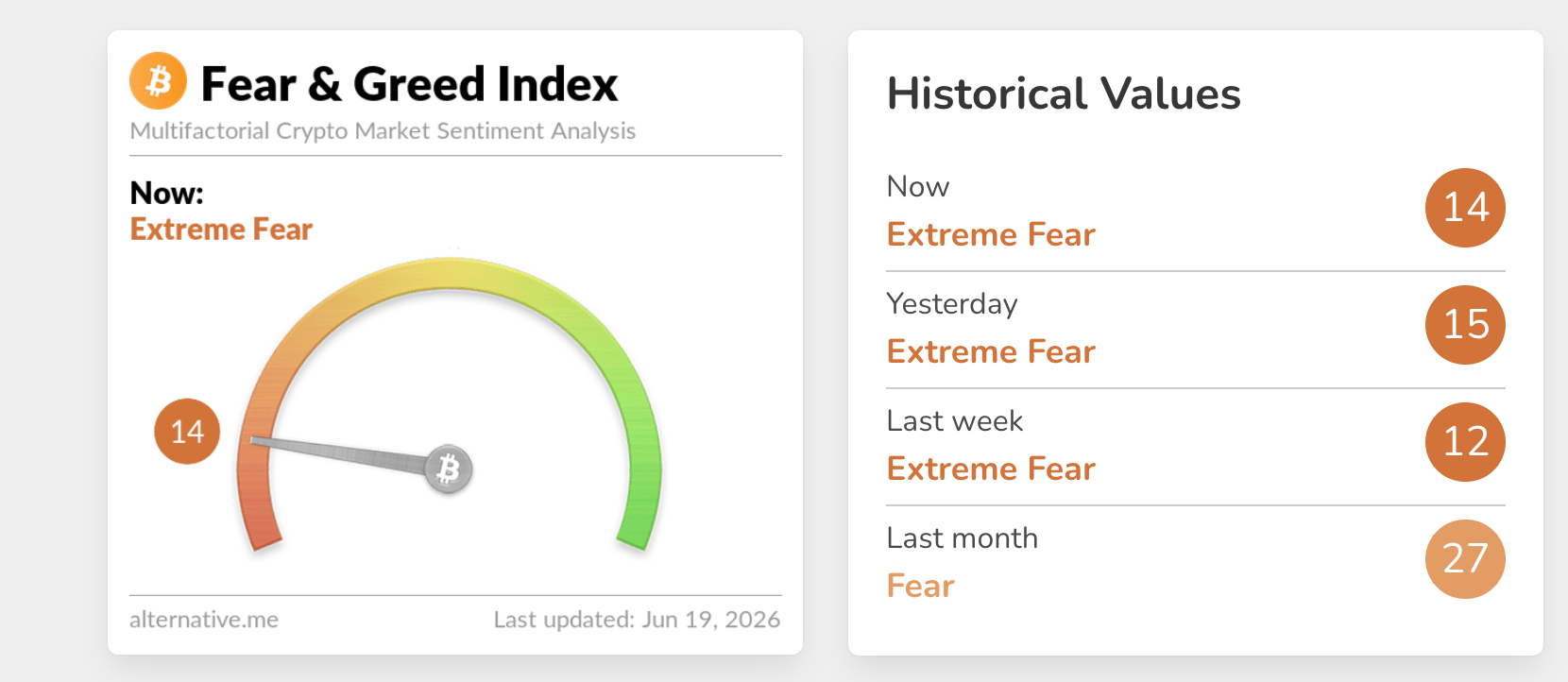
Derivatives and institutional digital asset products are seeing diminished engagement, reflecting persistent risk aversion across the crypto markets. The Crypto Fear & Greed Index, holding at 15 in the Extreme Fear zone on Friday, underscores this cautious investor sentiment.
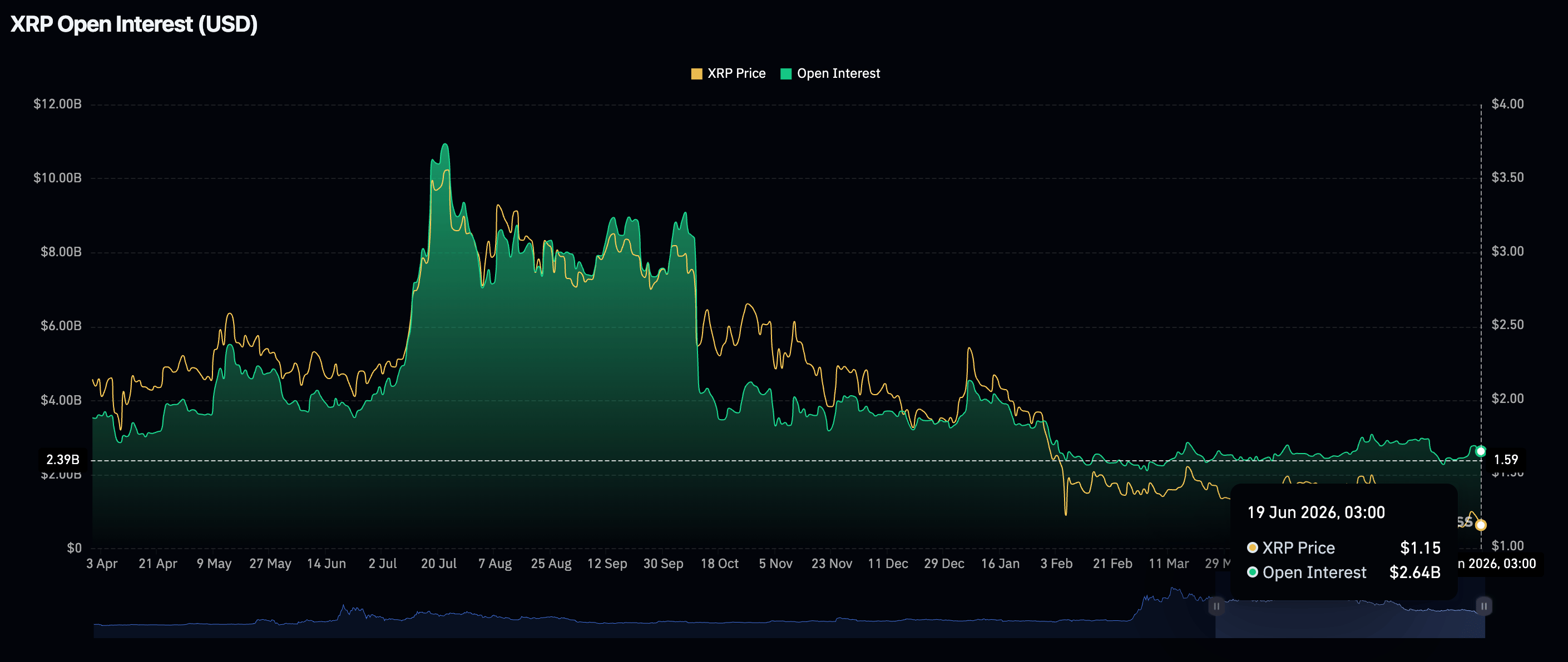
Open Interest (OI) in XRP futures holds at $2.64 billion on Friday, marking a slight decrease from $2.66 billion the previous day. This contraction signals a continued pullback in risk appetite among market participants.
Ongoing weakness in derivatives demand underscores waning confidence in XRP’s short-term prospects. Consequently, traders are increasingly closing existing positions instead of opening new longs, intensifying downward pressure on the asset.
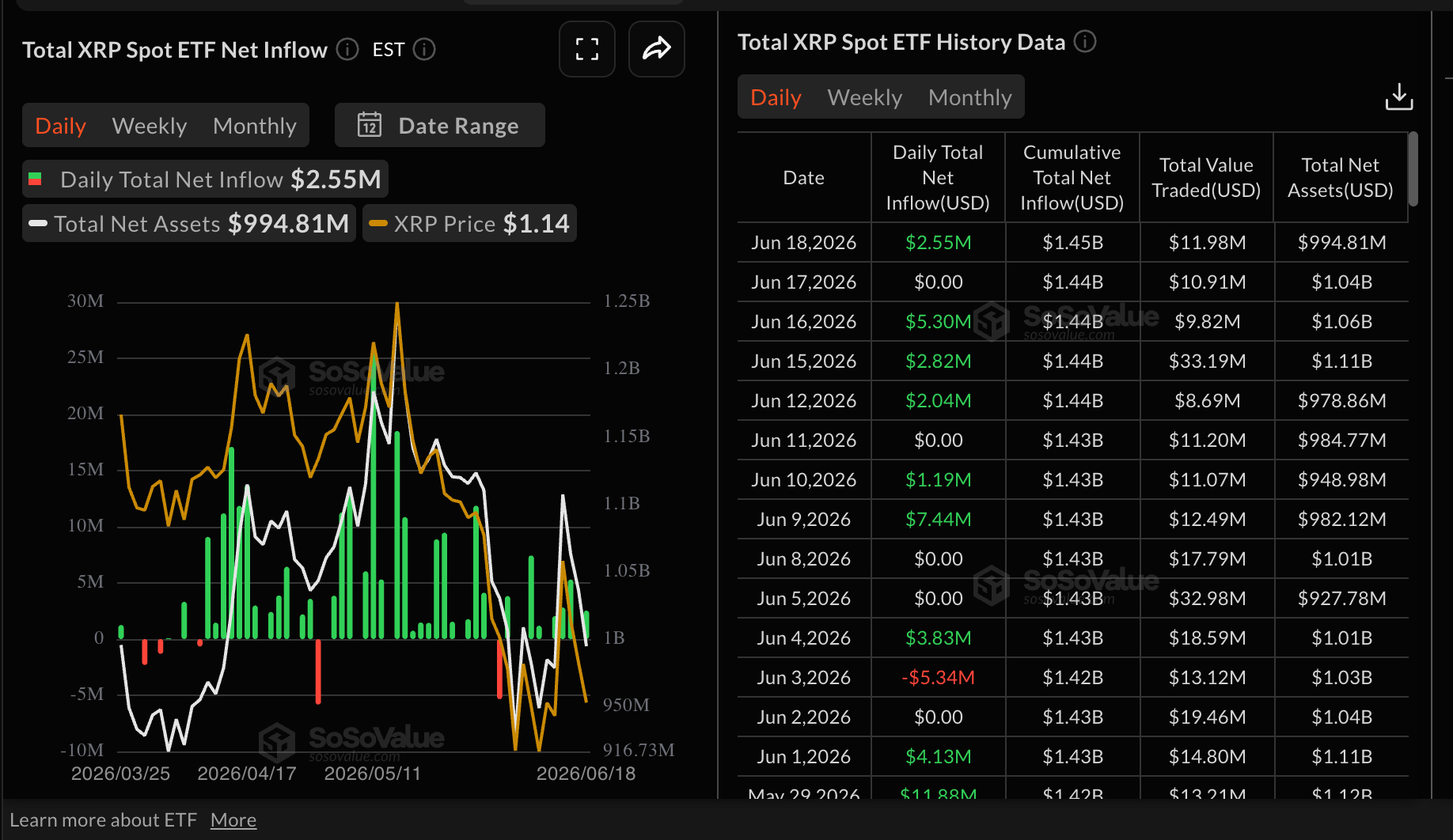
Meanwhile, mild inflows into XRP spot Exchange-Traded Funds (ETFs) failed to trigger a bullish reversal. SoSoValue data shows inflows totaled $2.55 million on Friday, following muted activity the previous day.
If headwinds persist and outweigh demand, a sustained bearish trend could accelerate losses toward recent lows of $1.05 and the psychological support level at $1.00.
Price analysis: XRP bearish roll persists
XRP trades above $1.12, maintaining a bearish near-term bias. The spot price holds below the 50-day, 100-day and 200-day Exponential Moving Averages (EMAs) clustered above $1.26, $1.36 and $1.58 respectively.
Although the broader market correction persists, the Moving Average Convergence Divergence *(MACD) histogram remains in positive territory but is steadily contracting, signaling that bullish momentum is waning. Additionally, the pair is unable to recover key trend levels, with the elevated Stochastic Relative Strength Index (RSI) retreating from overbought territory, further highlighting diminishing buyer strength.
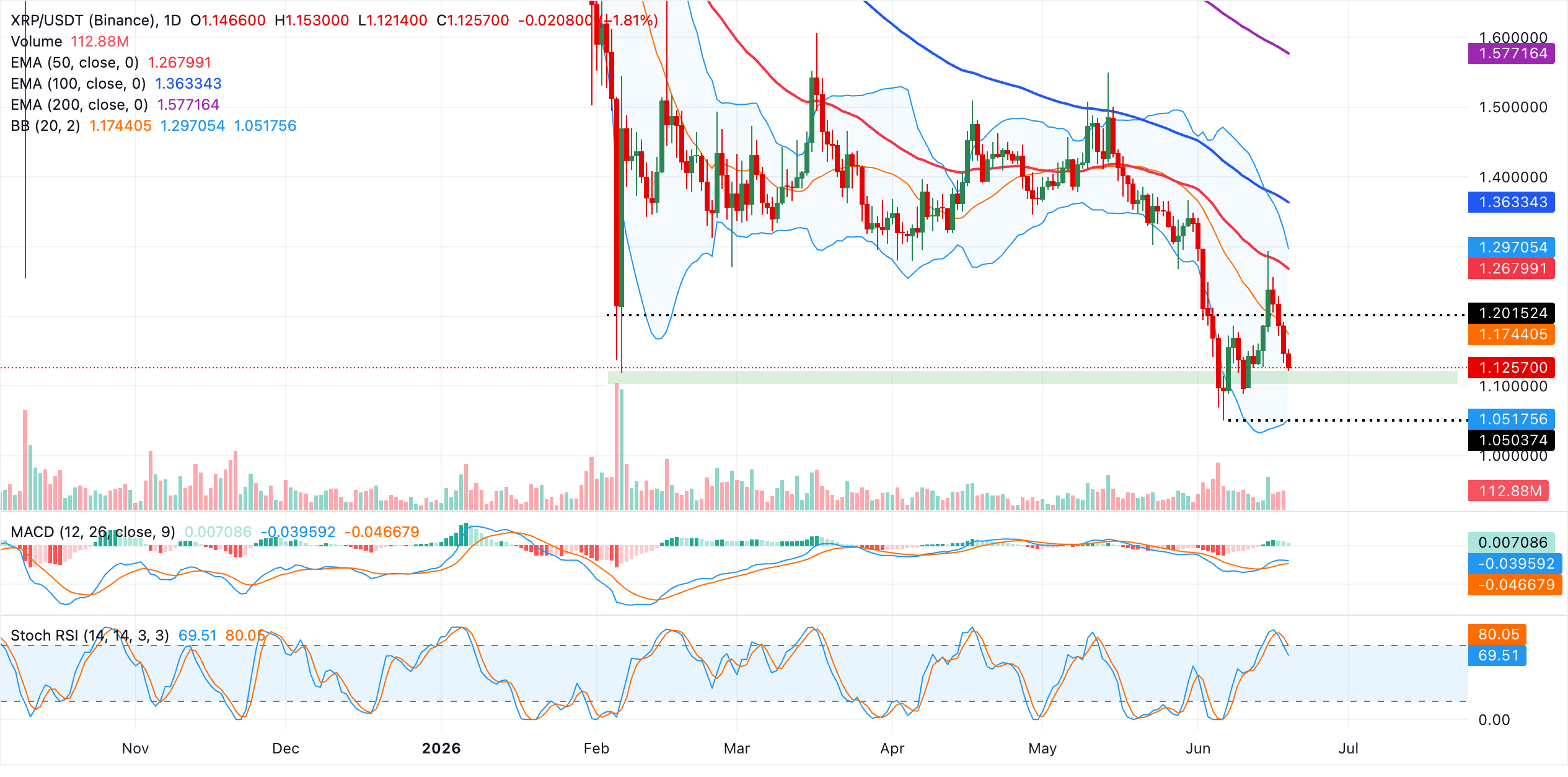
XRP faces initial resistance at the Bollinger middle band around $1.17, with further hurdles at the 50-day EMA ($1.27) and the upper Bollinger band ($1.30). Stronger resistance levels are observed at the 100-day EMA around $1.36 and 200-day EMA at $1.58.
To the downside, the lower Bollinger band near $1.05 acts as key support. A sustained move below this threshold could accelerate losses toward the psychologically significant $1.00 level, maintaining a bearish bias for the broader technical outlook.
(The technical analysis of this story was written with the help of an AI tool.)
Bitcoin, altcoins, stablecoins FAQs
Bitcoin is the largest cryptocurrency by market capitalization, a virtual currency designed to serve as money. This form of payment cannot be controlled by any one person, group, or entity, which eliminates the need for third-party participation during financial transactions.
Altcoins are any cryptocurrency apart from Bitcoin, but some also regard Ethereum as a non-altcoin because it is from these two cryptocurrencies that forking happens. If this is true, then Litecoin is the first altcoin, forked from the Bitcoin protocol and, therefore, an “improved” version of it.
Stablecoins are cryptocurrencies designed to have a stable price, with their value backed by a reserve of the asset it represents. To achieve this, the value of any one stablecoin is pegged to a commodity or financial instrument, such as the US Dollar (USD), with its supply regulated by an algorithm or demand. The main goal of stablecoins is to provide an on/off-ramp for investors willing to trade and invest in cryptocurrencies. Stablecoins also allow investors to store value since cryptocurrencies, in general, are subject to volatility.
Bitcoin dominance is the ratio of Bitcoin’s market capitalization to the total market capitalization of all cryptocurrencies combined. It provides a clear picture of Bitcoin’s interest among investors. A high BTC dominance typically happens before and during a bull run, in which investors resort to investing in relatively stable and high market capitalization cryptocurrency like Bitcoin. A drop in BTC dominance usually means that investors are moving their capital and/or profits to altcoins in a quest for higher returns, which usually triggers an explosion of altcoin rallies.












Leave a comment