
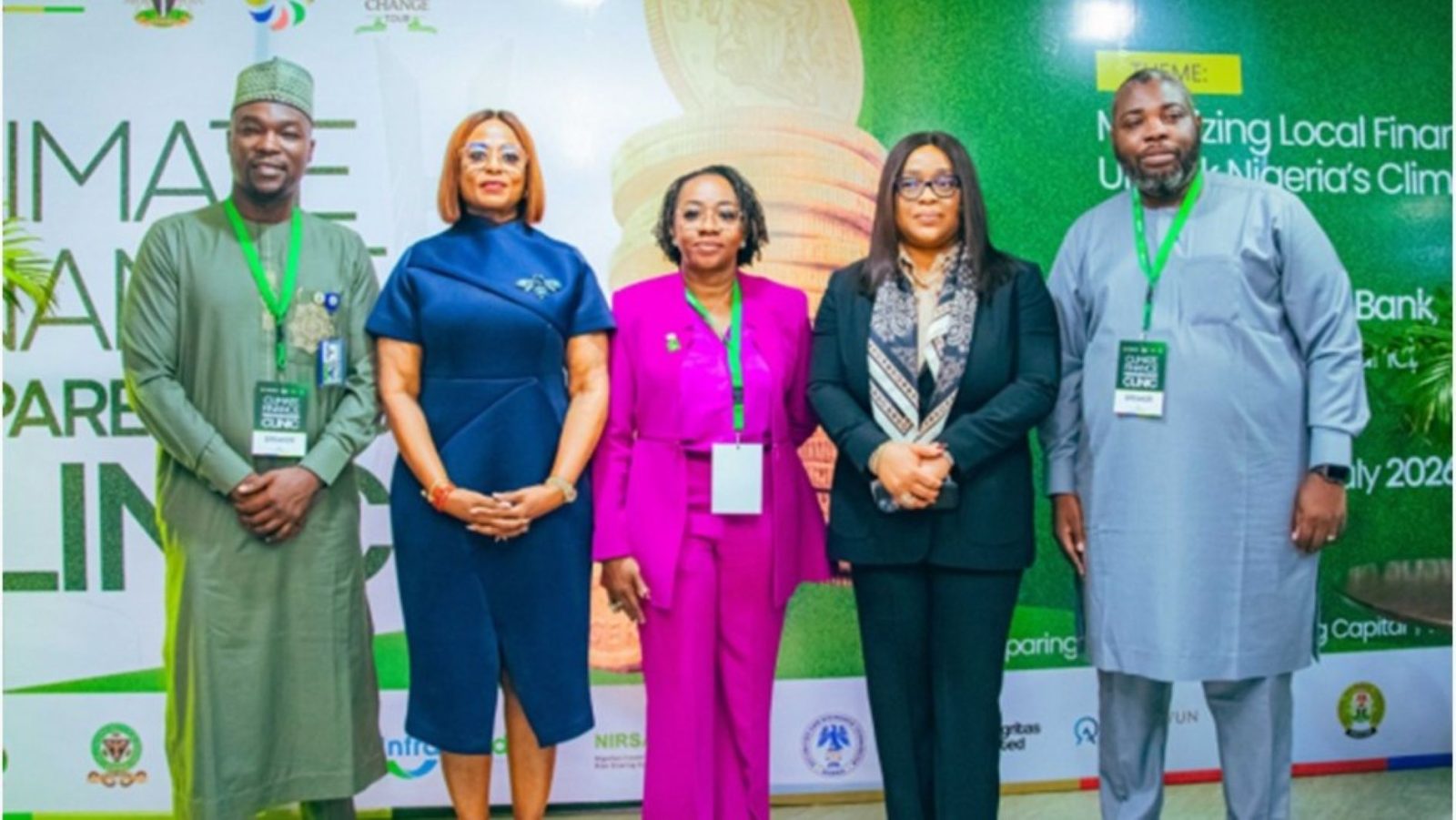
The Lagos State Government has intensified efforts to translate its climate commitments into tangible investments, convening its inaugural Climate Finance Preparedness Clinic (CFPC) to strengthen institutional capacity and attract funding for low-carbon and climate-resilient projects.
The initiative comes weeks after the state unveiled its State-Determined Contributions (SDC) Framework and signed a Memorandum of Understanding with the Under2 Coalition during the London Climate Action Week, as it seeks to accelerate implementation of its Net Zero Lagos by 2050 Vision.
Organised by the Lagos State Office of Climate Change and Circular Economy (OCCE), the clinic brought together financial institutions, regulators, development partners, government agencies and private sector operators to develop the systems, partnerships and governance structures needed to mobilise climate finance and scale sustainable investments.
Speaking at the event, the Special Adviser to the Governor on Climate Change and Circular Economy, Titilayo Oshodi, said access to climate finance remains the missing link between policy formulation and project execution.
According to her, while governments have developed climate strategies and ambitious emissions reduction targets, delivering resilient infrastructure, renewable energy projects and sustainable economic growth will depend largely on the ability to attract long-term financing.
“Policies alone do not build resilient infrastructure. Commitments alone do not deliver renewable energy. Strategies alone do not protect communities or strengthen economies. It is finance that transforms ideas into projects, projects into investments and investments into measurable impact,” Oshodi said.
She noted that climate change has evolved beyond an environmental challenge into an economic and financial issue with implications for infrastructure, agriculture, businesses, public health and livelihoods.
Oshodi explained that the newly introduced SDC Framework is designed to convert Lagos’ climate ambitions into bankable investment opportunities by aligning sub-national priorities with Nigeria’s national climate commitments.
She said the framework would create structured investment pipelines across clean energy, sustainable transportation, circular economy initiatives, carbon markets, climate resilience and nature-based solutions.
According to her, the challenge facing governments is no longer the availability of climate capital globally but the readiness of projects and institutions to attract investment.
“The challenge is no longer capital. It is bankability. Investors require confidence that projects are credible, measurable and scalable. Through the Climate Finance Preparedness Clinic, Lagos is deliberately building the enabling systems that allow climate finance to flow where it is needed most,” she stated.
To strengthen investor confidence, Oshodi disclosed that the state is integrating a digital Monitoring, Reporting, Verification and Management (DMRV) architecture powered by the DeCarbonIQ platform to improve transparency, accountability and environmental asset tracking.
She explained that the platform would enable the aggregation of climate projects under common governance, reporting and investment frameworks, thereby reducing transaction costs and making projects more attractive to institutional investors, development finance institutions and participants in carbon markets.
She added that climate investments represent significant economic opportunities capable of stimulating innovation, creating jobs and improving livelihoods while supporting the state’s transition to a low-carbon economy.
“The climate economy is not simply about reducing emissions; it is about building a stronger, more resilient and more competitive economy. From clean energy and circular economy solutions to carbon markets and green enterprise, climate investments have the potential to create jobs, stimulate innovation and improve livelihoods,” she said.
Oshodi urged domestic financial institutions, pension fund administrators, insurers and banks to play a more active role in financing climate-related investments, describing them as critical to the development of a sustainable and resilient economy.
Industry analysts have identified access to climate finance as one of the biggest constraints facing sub-national governments seeking to implement climate adaptation and mitigation projects, despite growing pools of global green capital.
With the establishment of the Climate Finance Preparedness Clinic, Lagos is positioning itself to improve project readiness, strengthen investor confidence and attract financing needed to deliver its long-term climate and sustainable development objectives









Leave a comment