

Bitcoin enters July at one of the most uncertain points of the current market cycle.
After suffering a steep decline during the second quarter of 2026, the world’s largest cryptocurrency has stabilized around the $61,000-$62,000 range, leaving investors wondering whether the worst of the correction is over or if another leg lower still lies ahead.
To gauge market expectations, we asked four leading artificial intelligence models, ChatGPT, Gemini, Claude, and Grok, to forecast Bitcoin’s direction through the end of July.
While none of the models can predict future prices with certainty, their responses reveal a striking consensus: most expect Bitcoin to trade sideways to moderately higher, but all acknowledge significant downside risks if macroeconomic conditions deteriorate.
Here’s how each AI sees Bitcoin’s next move.
Three Models Expect Bitcoin to Finish July Above Current Prices
Despite differences in methodology, ChatGPT, Gemini, and Grok all point toward a modest recovery over the remainder of the month.
ChatGPT offers the clearest base-case forecast, projecting Bitcoin to close July around $66,500. It assigns a 50% probability to BTC finishing between $64,000 and $68,000, while giving a 25% chance to a stronger rally toward $70,000-$75,000 and another 25% probability to a decline into the $54,000-$58,000 range.
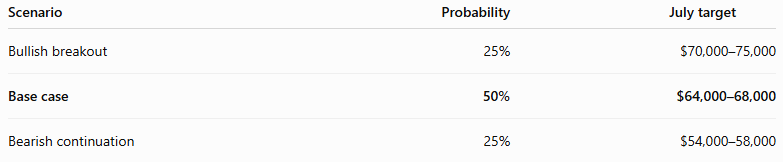
The model argues that Bitcoin may benefit from easing inflation concerns, improving institutional infrastructure, and extremely bearish market sentiment that could set the stage for a relief rally.
However, it also warns that persistent ETF outflows and continued capital rotation into artificial intelligence stocks remain significant headwinds.
Gemini reaches a similar conclusion but presents a wider range of possible outcomes.
Its bullish scenario targets $65,000-$70,000, provided Bitcoin maintains support above $58,000 and reclaims its 20-day exponential moving average near $62,000. The model believes softer US employment data and growing expectations of Federal Reserve rate cuts could revive demand for risk assets.
However, Gemini also outlines one of the most bearish scenarios among the four models. If Bitcoin falls below key technical support around $55,300, it warns that a head-and-shoulders pattern could trigger a deeper decline toward $53,000, with an extreme downside case extending to $42,000.
Grok also leans cautiously bullish.
The xAI chatbot expects Bitcoin to trade between $58,000 and $68,000 throughout July, with the most likely average price falling between $62,000 and $65,000.
According to Grok, renewed ETF inflows, supportive Federal Reserve signals, and improving market sentiment could allow Bitcoin to challenge the $66,000-$70,000 region before month-end.
Claude Refuses to Pick a Price Target
Unlike the other models, Claude deliberately avoids issuing a numerical prediction.
Instead, Anthropic’s AI argues that short-term Bitcoin forecasts are inherently unreliable and focuses on presenting the range currently discussed by analysts rather than producing its own estimate.
Claude highlights several of the same risks identified by the other models, including record spot Bitcoin ETF outflows during June, Citigroup’s reduced long-term Bitcoin target, and the Federal Reserve’s July policy meeting as one of the month’s most important catalysts.
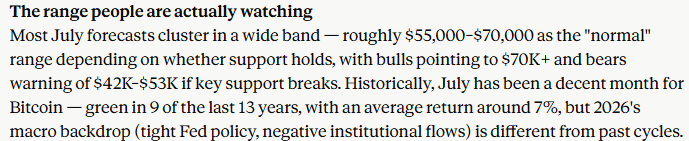
Rather than forecasting a specific closing price, Claude notes that most market participants currently expect Bitcoin to remain within a broad $55,000-$70,000 range unless a major macroeconomic surprise changes sentiment.
The model also reminds investors that July has historically been one of Bitcoin’s stronger months, generating positive returns in nine of the past 13 years.
However, it cautions that 2026 differs significantly from previous cycles because of tighter monetary policy and sustained institutional selling pressure.
ETF Flows and the Federal Reserve Dominate Every Forecast
Although the four AI models differ in their specific price targets, they agree on the variables most likely to determine Bitcoin’s direction over the coming weeks.
The first is institutional demand.
All four models identify spot Bitcoin ETF flows as the single most important indicator to monitor.
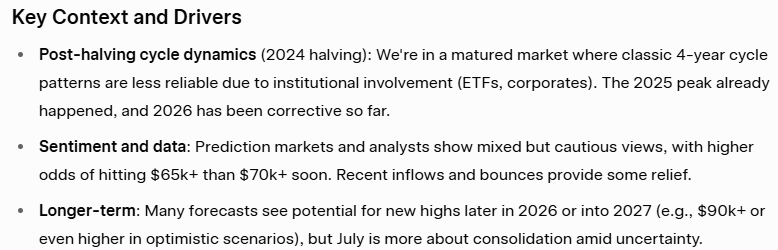
June recorded some of the largest ETF outflows since US spot Bitcoin funds launched, raising concerns that institutional investors remain cautious despite Bitcoin’s substantial correction. A return to positive ETF inflows could provide the catalyst needed for a broader recovery.
The second factor is US monetary policy.
Each model points to expectations surrounding the Federal Reserve, particularly the July Federal Open Market Committee meeting, as another key driver.
Softer inflation data or dovish comments from policymakers could improve appetite for risk assets, while signs that interest rates will remain elevated for longer may renew selling pressure across cryptocurrencies.
Technical levels also feature prominently across every forecast. Support between $58,000 and $60,000 appears repeatedly as the level bulls must defend, while $65,000-$70,000 represents the primary resistance zone that would need to break before a stronger recovery could develop.










Leave a comment