

Revenue,
2025
USD 425.00 Bn

Forecast Year,
2035
USD 1,321.26 Bn


Digital Infrastructure Market Size and Forecast 2026 to 2035
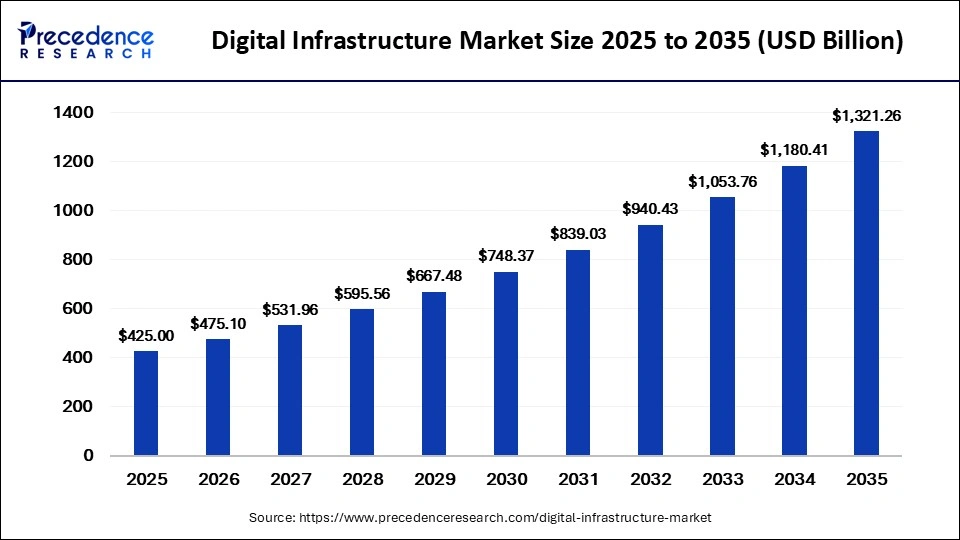
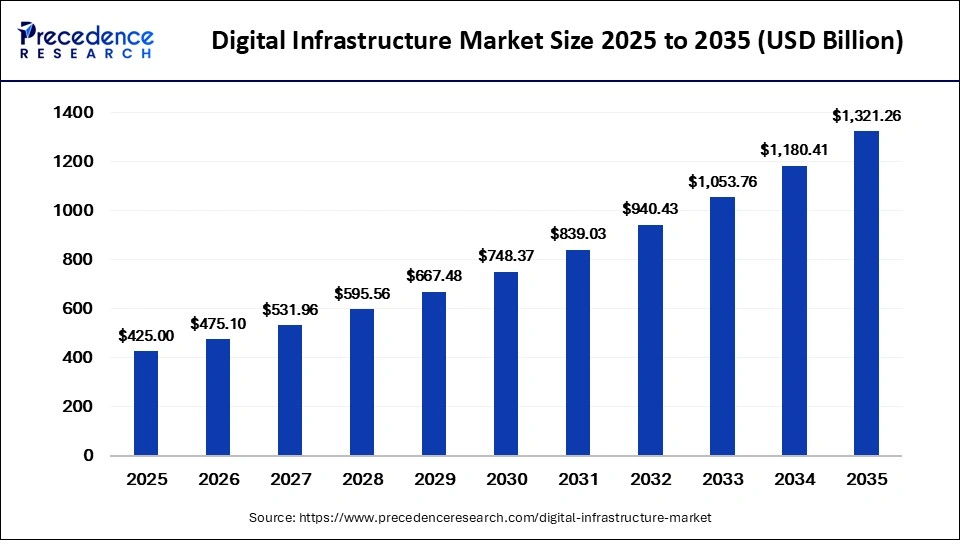
The global digital infrastructure market size accounted for USD 425.00 billion in 2025 and is predicted to increase from USD 475.10 billion in 2026 to approximately USD 1,321.26 billion by 2035, expanding at a CAGR of 11.80% from 2026 to 2035. The market is driven by the increasing AI and machine learning workloads. These advanced technologies demand massive parallel processing power, thus forcing data centers to upgrade to specialized hardware, high-density server racks, and even advanced liquid cooling systems.
Key Takeaways
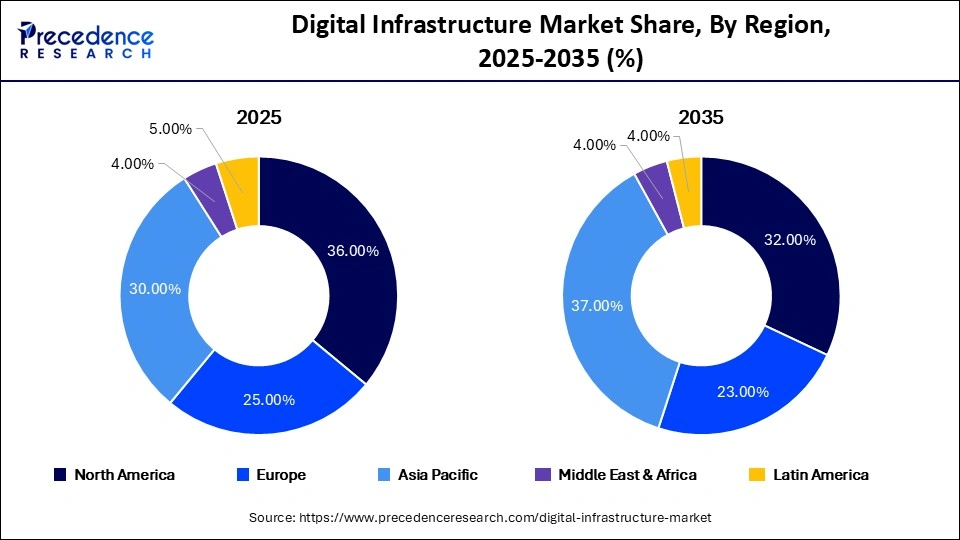
- North America dominated the market with a share of 36.00% in 2025.
- Asia Pacific is expected to grow at the fastest CAGR of 14.5% during the forecast period.
- By infrastructure type, the data center infrastructure segment led the market with a share of 31.00% in 2025.
- By infrastructure type, the edge infrastructure segment is expected to grow at a 15.2% CAGR between 2026 and 2035.
- By component, the hardware segment accounted for the largest market share of 58.00% in 2025.
- By component, the software segment is expected to grow at a 13.8% CAGR between 2026 and 2035.
- By deployment model, the cloud-based segment held the market share of 44.00% in 2025.
- By deployment model, the on-premise segment held the second-largest market share in 2025 and is expected to grow at a 7.9% CAGR between 2026 and 2035.
- By end-use industry, the IT & telecommunications segment accounted for a revenue share of 27.00% in the market in 2025.
- By end-use industry, the retail & e-commerce segment is expected to grow at the fastest CAGR of 13.2% between 2026 and 2035.
- By technology, the 5G infrastructure segment held a major market share of 24.00% in 2025.
- By technology, the artificial intelligence infrastructure segment is expected to grow at the fastest CAGR of 18.7% between 2026 and 2025.
Market Overview
The digital infrastructure market centers on building, maintaining, and providing the foundational physical and virtual technologies that enable data to be stored, processed, transmitted, and secured. It is considered the backbone of the modern internet, cloud computing, and digital business operations. The market is mainly driven by exponential data consumption, the widespread adoption of AI and cloud computing, the rollout of 5G, and the growth of edge data centers. This significantly drives massive investments in resilient and scalable connectivity worldwide.
How is AI Influencing the Digital Infrastructure Market?
Artificial intelligence is significantly transforming the digital infrastructure market by changing the focus from standard compute scaling to high-density, power-hungry ecosystems. It is driving massive capital investments into specialized data centers, forcing a vast surge in energy demand, and necessitating smart, AI-based infrastructure management. AI is also being deployed to manage data center resources, using predictive analytics for temperature regulation and even predictive maintenance to reduce downtime and improve efficiency.
Digital Infrastructure Market Trends
- The rapid growth of AI workloads is driving data center development beyond major metropolitan areas with greater power availability and lower energy constraints.
- Traditional air-cooling systems are becoming insufficient for high-density AI infrastructure, accelerating the deployment of direct-to-chip liquid cooling solutions to improve thermal management and energy efficiency.
- Increasing data sovereignty and privacy regulations across Europe, the Middle East, and India are encouraging the development of localized and decentralized data center facilities.
- Data center operators are increasingly investing in renewable energy sources and battery storage systems to reduce carbon emissions, enhance sustainability, and address grid reliability challenges.
- Rising demand for low-latency applications, including autonomous vehicles, industrial automation, and real-time analytics, is driving significant investment in smaller, strategically located edge data centers.
Market Report Coverage and Key Metrics
| Report Coverage | Details |
| Market Size in 2025 | USD 425.00 Billion |
| Market Size in 2026 | USD 475.10 Billion |
| Market Size by 2035 | USD 1,321.26 Billion |
| Market Growth Rate from 2026 to 2035 | CAGR of 11.80% |
| Dominating Region | North America |
| Fastest Growing Region | Asia Paicfic |
| Base Year | 2025 |
| Forecast Period | 2026 to 2035 |
| Segments Covered | Infrastructure Type, Component, Deployment Model, End-Use Industry, Technology, and Region |
| Regions Covered | North America, Europe, Asia-Pacific, Latin America, and Middle East & Africa |
Market Dynamics
Drivers
Widespread Cloud Adoption
Widespread enterprise adoption of public and hybrid cloud platforms is a major driver of the digital infrastructure market, increasing demand for scalable computing infrastructure, secure networks, and advanced data storage facilities. The growing use of advanced analytics, generative AI, and 5G-enabled applications is further accelerating the need for high-density server deployments and next-generation cooling technologies. As organizations process increasingly large datasets and AI workloads, investments in modern, high-performance data center infrastructure continue to rise.
Restraint
Strict Sovereign Data Regulations
Stringent data sovereignty regulations are restraining the digital infrastructure market by requiring organizations to store and process data within specific geographic jurisdictions. These requirements increase infrastructure development costs, limit the efficient use of global hyperscale networks, and necessitate localized operational control. As a result, companies face higher compliance expenses, longer deployment timelines, and increased operational complexity.
Opportunity
Demand for Data Centers & AI Computing
The rising demand for data centers and AI computing represents the most significant growth catalyst for the digital infrastructure market because AI workloads need exponentially higher computing power and entirely new energy profiles compared to conventional enterprise IT. This shift is driving a massive, multi-billion-dollar infrastructure investment cycle over the hardware, software, and power layers. Training and deploying Large Language Models (LLMs) along with real-time AI agents require immense parallel processing and storage. This fuels a massive need for dedicated AI data centers.
Market Segmentation Analysis
Infrastructure Type Insights
Digital Infrastructure Market Share, By Infrastructure Type, 2025-2035 (%)
| Infrastructure Type | 2025 | 2035 | CAGR (%) |
| Data Center Infrastructure | 31.00% | 33.00% | 12.8% |
| Network Infrastructure | 24.00% | 22.00% | 10.3% |
| Cloud Infrastructure | 22.00% | 24.00% | 13.7% |
| Edge Infrastructure | 11.00% | 13.00% | 15.2% |
| Telecommunications Infrastructure | 12.00% | 8.00% | 8.7% |
The Data Center Infrastructure Segment Held a 31.00% Market Share in 2025
The data center infrastructure segment dominated the digital infrastructure market with a major share of 31.00% in 2025, owing to the increasing demand for cloud services and rising AI workloads. The increasing deployment of high-performance computing systems, AI accelerators, and specialized servers for training and running large language models (LLMs) is accelerating investments in modern data center facilities, power systems, and cooling technologies.
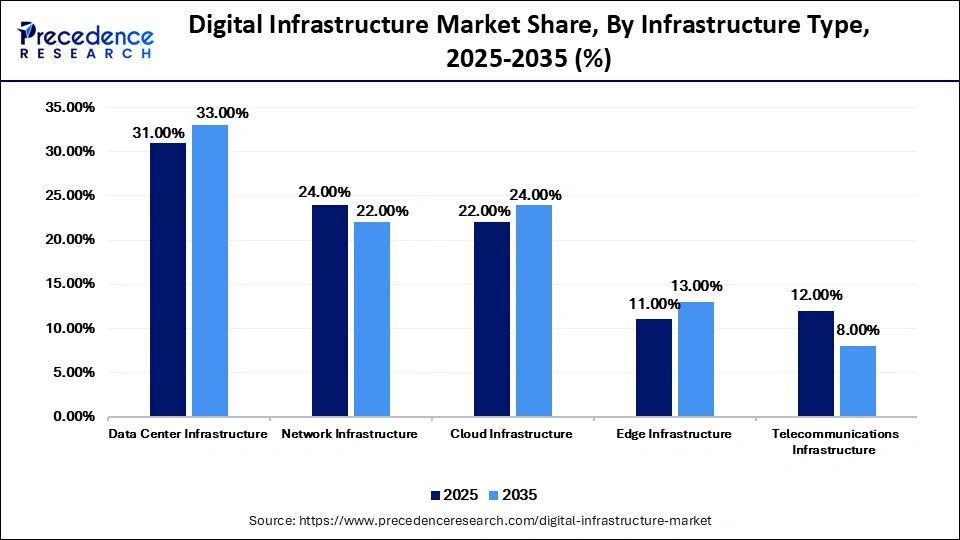
The network infrastructure segment held the second-largest market share of 24.00% in 2025 and is expected to grow at a CAGR of 10.3% during the projection period, driven by the rising enterprise connectivity demand and growth in software-defined networking. High-speed, low-latency 5G rollouts and the shift toward software-defined networks are also contributing to segmental growth.
The edge infrastructure segment held an 11.00% share of the market in 2025 and is expected to grow at the fastest CAGR of 15.2% during the projection period. This is mainly due to the increasing IoT deployments, growing demand for real-time data processing, and the expansion of latency-sensitive applications such as autonomous vehicles, industrial automation, and smart city solutions. Edge infrastructure enables data processing closer to the source, reducing latency, lowering bandwidth costs, and improving operational efficiency.
Component Insights
Digital Infrastructure Market Share, By Component, 2025-2035 (%)
| Component | 2025 | 2035 | CAGR (%) |
| Hardware | 58.00% | 54.00% | 10.4% |
| Software | 24.00% | 28.00% | 13.8% |
| Services | 18.00% | 18.00% | 12.0% |
The Hardware Segment Led the Digital Infrastructure Market in 2025
The hardware segment dominated the digital infrastructure market with the highest share of 58.00% in 2025, driven by increasing deployments of AI accelerators, rapid data center construction, and modernization of legacy infrastructure. Growing demand for high-performance computing, AI server clusters, storage systems, and advanced liquid-cooling technologies has encouraged substantial investments in physical infrastructure by enterprises and hyperscale cloud providers.
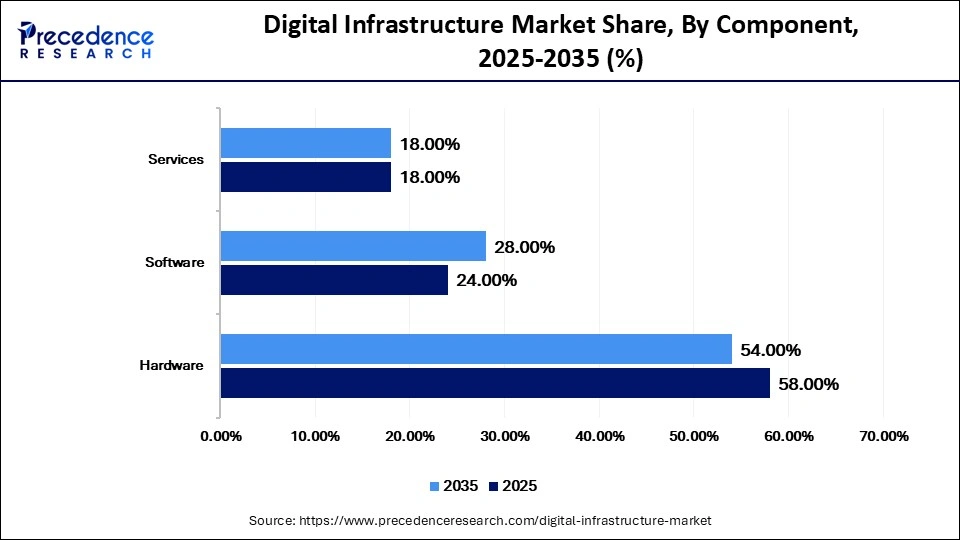
The software segment held a 24.00% share of the market in 2025 and is expected to grow at the fastest CAGR of 13.8% during the projection period. This is mainly due to the rising adoption of infrastructure management platforms, automation and orchestration tools, and software-defined infrastructure solutions. The increasing use of generative AI, predictive analytics, and cybersecurity applications is further accelerating demand for advanced software platforms that optimize infrastructure performance and management.
The services segment held an 18.00% share of the market in 2025 and is expected to grow at a CAGR of 12.0% during the projection period, driven by the increasing demand for infrastructure consulting, managed services, deployment support, and maintenance solutions. Organizations are increasingly leveraging cloud service providers and specialized infrastructure partners to scale operations, improve efficiency, and support complex AI and machine learning workloads.
Deployment Model Insights
Digital Infrastructure Market Share, By Deployment Model, 2025-2035 (%)
| Deployment Model | 2025 | 2035 | CAGR (%) |
| On-premises | 33.00% | 24.00% | 7.9% |
| Cloud-based | 44.00% | 51.00% | 14.1% |
| Hybrid | 23.00% | 25.00% | 12.6% |
Why Did the Cloud-Based Segment Dominate the Market in 2025?
The cloud-based segment dominated the digital infrastructure market with the largest share of 44.00% in 2025. This is mainly due to rapid cloud adoption across enterprises seeking scalable and flexible IT environments. Organizations increasingly preferred cloud infrastructure because it reduces upfront ownership and maintenance costs while supporting the growing deployment of cloud-native applications. Additionally, the rise of remote and hybrid work models accelerated demand for cloud-based platforms that enable secure, anytime-anywhere access to business applications and data.
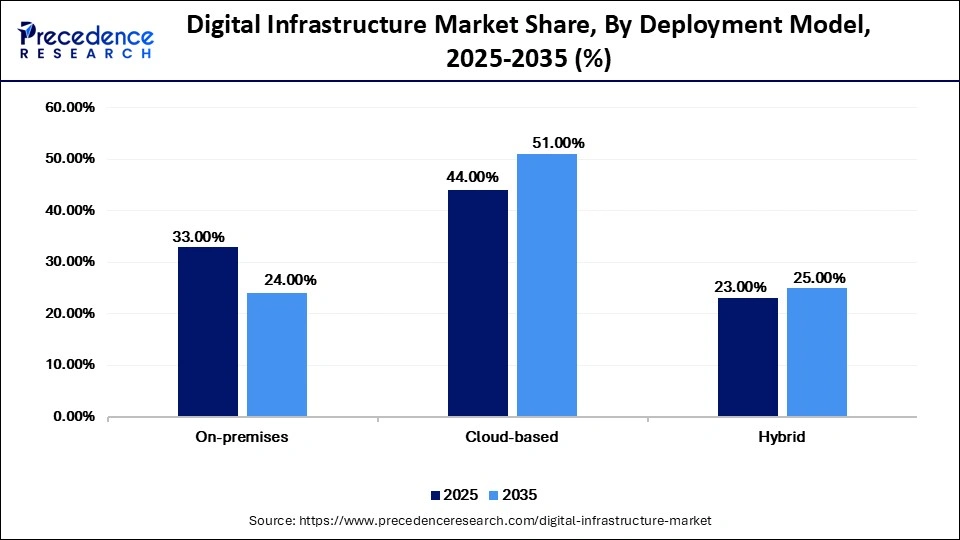
The on-premises segment held a 33.00% share of the market in 2025 and is expected to grow at a 7.9% CAGR in the coming years, driven by increasing data security and compliance requirements, particularly in highly regulated industries that require greater control over sensitive information. Continued investments in legacy infrastructure, the need to manage mission-critical workloads, industry-specific regulatory obligations, and organizational preferences for internal control are further supporting demand for on-premises deployments.
The hybrid segment held a 23.00% share of the market in 2025 and is expected to expand rapidly with a CAGR of 12.6% during the projection period. The segment growth is driven by the increasing adoption of multi-environment IT strategies that combine the benefits of cloud and on-premises infrastructure. Organizations are leveraging hybrid deployments to achieve greater workload flexibility, improve business continuity, integrate legacy and modern systems, and optimize resource allocation across diverse computing environments.
End-Use Industry Insights
The IT & Telecommunications Segment Led the Market in 2025
The IT & telecommunications segment held a dominant position in the digital infrastructure market with a share of 27.00% in 2025, driven by the expansion of 5G networks and the growing demand for high-speed, low-latency connectivity. Telecom operators are investing heavily in fiber networks, data transmission infrastructure, and network modernization to support increasing data traffic, cloud services, and next-generation communication technologies, ensuring the long-term growth of the segment.
Digital Infrastructure Market Share, By End-use Industry, 2025-2035 (%)
| End-use Industry | 2025 | 2035 | CAGR (%) |
| IT & Telecommunications | 27.00% | 28.00% | 12.9% |
| BFSI | 16.00% | 15.00% | 11.0% |
| Government | 12.00% | 11.00% | 10.7% |
| Healthcare | 10.00% | 11.00% | 13.1% |
| Manufacturing | 14.00% | 14.00% | 12.4% |
| Retail & E-commerce | 9.00% | 10.00% | 13.2% |
| Energy & Utilities | 7.00% | 7.00% | 11.5% |
| Others | 5.00% | 4.00% | 10.3% |
The retail & e-commerce segment held a 9.00% share of the market in 2025 and is expected to grow at the fastest CAGR of 13.2% during the projection period. This is mainly due to the rising demand for real-time financial transactions, enhanced cybersecurity, regulatory compliance, and digital banking services. Financial institutions are increasingly upgrading their IT infrastructure and adopting cloud-based and API-driven platforms to deliver secure, personalized, and always-on customer experiences, supporting segmental growth.
The BFSI segment held a 16.00% share of the market in 2025 and is expected to grow at a CAGR of 11.0% during the projection period. This segment’s growth is driven by the rapid expansion of online commerce platforms, increasing digital customer engagement, and growing adoption of digital payment solutions. Retailers are investing in advanced digital infrastructure to support seamless transactions, personalized shopping experiences, and real-time inventory and supply chain management.
Technology Insights
What Made 5G Infrastructure the Dominant Segment in the Digital Infrastructure Market?
The 5G infrastructure segment dominated the digital infrastructure market with a major share of 24.00% in 2025. This is due to the growth of connected devices, increasing telecom network investments, and rising demand for low-latency connectivity. The expansion of smart cities, autonomous vehicles, industrial IoT, and advanced communication networks has accelerated the deployment of 5G infrastructure worldwide.
Digital Infrastructure Market Share, By Technology, 2025-2035 (%)
| Technology | 2025 | 2035 | CAGR (%) |
| 5G Infrastructure | 24.00% | 20.00% | 9.8% |
| Artificial Intelligence Infrastructure | 19.00% | 27.00% | 18.7% |
| Internet of Things (IoT) Infrastructure | 21.00% | 20.00% | 11.6% |
| Edge Computing Infrastructure | 14.00% | 17.00% | 16.1% |
| Software-Defined Infrastructure | 22.00% | 16.00% | 10.5% |
The artificial intelligence infrastructure segment held a 19.00% share of the market in 2025 and is expected to grow at the fastest CAGR of 18.7% during the projection period. This is mainly due to the increasing infrastructure automation initiatives, broader adoption of virtualization technologies, and the expansion of cloud-native environments. By decoupling hardware from software, organizations can improve resource utilization, accelerate application deployment, and enhance operational efficiency.
The software-defined infrastructure segment held a 22.00% share of the market in 2025 and is expected to grow at a CAGR of 10.5% during the projection period. This is primarily due to the rapid adoption of generative AI applications, increasing deployment of GPUs and AI accelerators, and rising demand for high-performance computing infrastructure. Cloud providers and enterprises are investing heavily in scalable AI infrastructure to support machine learning, advanced analytics, and data-intensive workloads.
Market Regional Analysis: North America, Europe, Asia-Pacific
U.S. Digital Infrastructure Market Size and Growth 2026 to 2035
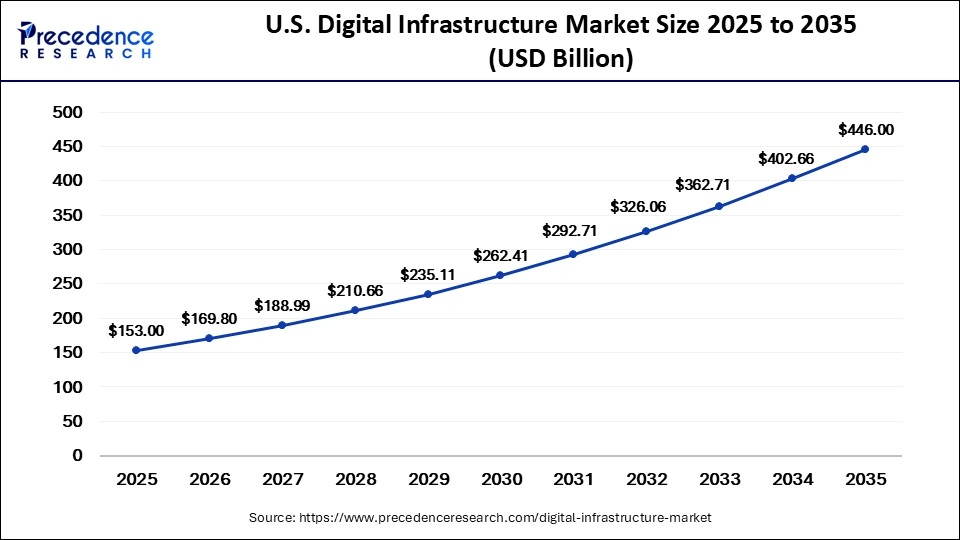
The U.S. digital infrastructure market size was evaluated at USD 153.00 billion in 2025 and is projected to reach around USD 446.00 billion by 2035, growing at a CAGR of 10.88% from 2026 to 2035.
What Makes North America the Leading Region in the Digital Infrastructure Market?
North America led the digital infrastructure market by holding a major share of 36.00% in 2025, driven by rapid expansion of hyperscale data centers, increasing cloud computing adoption, and substantial investments in AI infrastructure. The growing deployment of artificial intelligence, machine learning, and high-performance computing (HPC) workloads is accelerating demand for advanced data centers, high-capacity networking systems, and next-generation cooling technologies. Additionally, strong investments from technology companies, cloud service providers, and telecom operators continue to strengthen the region’s digital infrastructure ecosystem.
U.S. Market Analysis
The U.S. is the major contributor to the North American digital infrastructure market, supported by rising demand for AI computing, cloud services, and data center colocation. Increasing investments in hyperscale facilities, high-performance computing infrastructure, and advanced networking technologies are driving market growth.
Asia Pacific: The Fastest-Growing Region
Asia Pacific held a 30.00% share of the market in 2025 and is expected to grow at the fastest CAGR of 14.5% during the projection period, driven by large-scale investments in cloud computing, telecom networks, AI infrastructure, and IoT ecosystems, supported by government-led smart city and digital transformation initiatives. The rapid adoption of smartphones, expanding internet penetration, and increasing use of digital services such as e-commerce, digital payments, and online platforms are further accelerating demand for digital infrastructure across the region.
China Market Analysis
China’s digital infrastructure market is growing, driven by substantial government investments under the Digital China strategy, widespread 5G deployment, and expanding AI computing capabilities. The country is witnessing significant growth in hyperscale data centers, cloud infrastructure, and high-performance computing facilities to support increasing AI workloads and digitalization initiatives. Additionally, ongoing investments in renewable energy-powered data centers and next-generation networking infrastructure continue to strengthen China’s position as a major digital infrastructure hub.
Europe: The Significant Region
Europe is considered a significant region, holding a 25.00% share in 2025 and is expected to grow at a notable CAGR of 10.8% during the projection period, driven primarily by expanding 5G network deployments, increasing cloud adoption, and strong regulatory support for digital transformation and infrastructure development. The rising demand for generative AI, high-performance computing, and data-intensive applications is encouraging significant investments in data centers, fiber-optic networks, and advanced digital infrastructure across the region.
UK Market Analysis
The UK digital infrastructure market is growing due to increasing adoption of artificial intelligence, accelerating enterprise cloud migration, and expanding Internet of Things (IoT) connectivity. These trends are driving demand for hyperscale data centers, edge computing facilities, and high-speed fiber networks to support growing data traffic and low-latency applications. Additionally, ongoing investments in digital transformation initiatives and next-generation connectivity infrastructure continue to strengthen market growth in the country.
What Drives the Market in Latin America?
Latin America held a 5.00% share of the market in 2025 and is expected to grow at a CAGR of 10.7% during the projection period, driven by increasing enterprise digitalization, rising telecom modernization investments, and expanding adoption of cloud services across key economies. High social media usage and growing digital consumption, particularly in Brazil, are significantly increasing data traffic and accelerating demand for scalable digital infrastructure. The entry of global cloud providers and the rapid deployment of AI workloads are further boosting data center expansion across the region.
Brazil Market Analysis
Brazil’s market is rapidly expanding due to strong hyperscale data center investments, rapid 5G rollout, and increasing adoption of cloud and AI technologies. The country has also reached significant milestones in data center capacity, exceeding 1 GW, reflecting its growing role as a regional digital hub. Additionally, Brazil’s abundant renewable energy resources are enabling the development of sustainable and energy-efficient data center infrastructure, further strengthening long-term market growth.
How is the Opportunistic Rise of the Middle East & Africa in the Digital Infrastructure Market?
The Middle East & Africa (MEA) held a 4.00% share of the market in 2025 and is expected to grow at a strong CAGR of 11.2% during the forecast period, driven by increasing cloud adoption, government-led digital transformation initiatives, and rising investments in artificial intelligence and high-performance computing infrastructure. The expansion of hyperscale and colocation data centers, along with growing demand for localized data storage, is further accelerating market development across key economies in the region.
UAE Market Analysis
The UAE is emerging as a leading digital infrastructure hub in MEA, supported by its strategic shift toward AI, cloud computing, and digital economy development. Strong government initiatives aimed at diversifying the economy away from oil dependency are driving investments in sovereign cloud platforms, AI data centers, and advanced digital ecosystems. Additionally, partnerships with global technology providers and rapid deployment of next-generation infrastructure are positioning the UAE as a key regional leader in digital transformation.
Market Competitive Landscape: Leading Companies and Strategies
The digital infrastructure market is highly competitive, driven by the rising need for cloud computing, edge computing, data storage, artificial intelligence (AI), and high-speed connectivity. Major technology firms such as Microsoft, Amazon Web Services, and Google dominate the cloud infrastructure segment via extensive global data center networks and continuous innovation. Colocation and data center providers, which include Equinix and Digital Realty, compete by expanding capacity, improving interconnection services, and supporting hybrid cloud environments.
Telecommunications firms are investing in fiber-optic networks, 5G infrastructure, and edge computing facilities to strengthen their market positions. Competition is characterized by strategic partnerships, sustainability initiatives, mergers and acquisitions, and investments in AI-ready infrastructure. As digital transformation accelerates across industries, market participants aim for scalability, security, energy efficiency, and even geographic expansion to gain a competitive advantage and thus meet evolving customer requirements.
Digital Infrastructure Market Companies
- Cisco Systems
- Huawei Technologies
- Nokia
- Ericsson
- Dell Technologies
- Hewlett Packard Enterprise
- Lenovo
- Super Micro Computer
- Arista Networks
- Juniper Networks
- Schneider Electric
- Vertiv
- Fujitsu
- NEC Corporation
- ZTE Corporation
Recent Developments Digital Infrastructure Market (2025-2026)
- In May 2026, Dell Technologies declared a broad set of advancements to the Dell AI Factory with NVIDIA, thus delivering the foundation enterprises demand to move from AI ambition to realized outcomes. These portfolio additions are designed to assist organizations in adopting AI with confidence and scale with purpose. (Source: https://www.dell.com)
- In March 2026, Huawei released a series of all-scenario U6 GHz products to assist carriers in unlocking the full potential of 5G-A and also set the stage for a seamless transition to 6G. The firm also launched improved AI-Centric Network solutions that will assist carriers in preparing for the agentic era by allowing intelligent services, networks, and network elements (NEs). (Source: https://www.huawei.com)
Segments Covered in the Report
By Infrastructure Type
- Data Center Infrastructure
- Network Infrastructure
- Cloud Infrastructure
- Edge Infrastructure
- Telecommunications Infrastructure
By Component
- Hardware
- Software
- Services
By Deployment Model
- On-premises
- Cloud-based
- Hybrid
By End-use Industry
- IT & Telecommunications
- BFSI
- Government
- Healthcare
- Manufacturing
- Retail & E-commerce
- Energy & Utilities
- Others
By Technology
- 5G Infrastructure
- Artificial Intelligence Infrastructure
- Internet of Things (IoT) Infrastructure
- Edge Computing Infrastructure
- Software-Defined Infrastructure
By Region
- North America
- Latin America
- Europe
- Asia-pacific
- Middle and East Africa











Leave a comment