
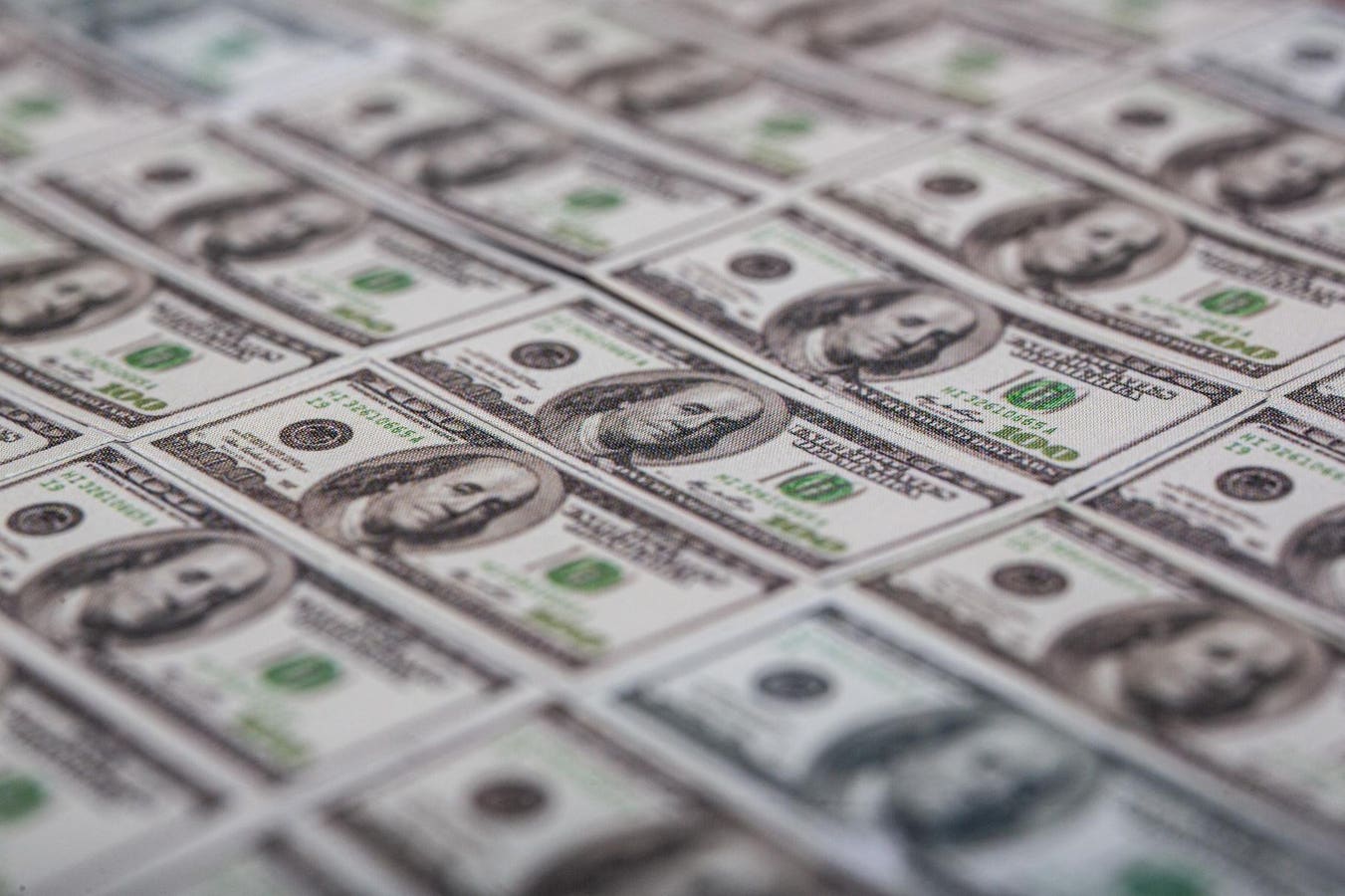

100 US dollar banknotes symbols of the global economy spread out on a table in Clermont-Ferrand France on June 12 2025. (Photo by Romain Costaseca / Hans Lucas via AFP) (Photo by ROMAIN COSTASECA/Hans Lucas/AFP via Getty Images)
Hans Lucas/AFP via Getty Images
How soon we forget that bitcoin and cryptocurrencies were billed as a response to centuries worth of fiat currency instability. The latter is worth noting for a variety of reasons, including a recent interview of Milken Institute senior advisor Michael Piwowar about money. Let’s start with Piwowar on bitcoin.
Piwowar observed that “The problem with Bitcoin is price volatility. Bitcoin’s price can swing dramatically—sometimes within minutes. That volatility may be attractive to traders and investors, but it makes Bitcoin poorly suited for everyday payments. If you’re trying to send money across the world, you don’t want the value changing materially between the moment you send it and the moment it’s received.”
Yes, he’s right. While it’s routinely ignored by the various economic religions on the left and right, no one buys, sells, borrows, or lends with “money.” Instead, products buy products while borrowing and lending are an exchange of products over longer stretches of time in return for more products (interest). Money is just the referee. Bitcoin lacks the properties of money precisely because what bitcoin exchange for is very much a moving target such that trade with the so-called currency is anything but.
Piwowar’s error is in his description of stablecoins, which derive their exchangeable value through their 1:1 relationship with the dollar. In Piwowar’s words, the problems with bitcoin “gave rise to stablecoins. The basic idea was simple: why not create a digital token whose value is anchored to the U.S. dollar and backed by highly liquid, low-risk assets such as Treasuries?”
Implied in Piwowar’s analysis is that the dollar is a fixed measure relative to the moving measure that is bitcoin, and that Treasury yields reflect the latter. There’s no truth to this.
No doubt it’s true that as evidenced by the dollar’s acceptance and usage around the world, it can claim stable qualities that bitcoin plainly cannot. Just the same, there’s a reason there’s roughly $10 trillion in daily currency trading with the U.S. dollar factoring into most of the trades. The latter isn’t a sign that the dollar is trusted in the market, but that it’s not.
Further evidence supporting the above claim can be found in the fact that before 1971, there was no currency trading. There wasn’t because there was no need. Without getting into a debate about the merits or demerits of the gold exchange standard that prevailed before 1971, evidence that it imbued the dollar with stability could not just be found in the fact that much of the world’s currencies had explicit or implicit pegs to a dollar defined as 1/35th of a gold ounce, but that there were no markets for currency trading.
Which means President Nixon’s decision to sever the dollar’s link to gold wasn’t just an explicit policy of devaluation, it was also a policy meant to deprive the dollar of properties associated with constancy as a measure. Yes, Nixon floated the dollar.
Which means stablecoins, while once again derivatives of the dollar, are not stable in theory or reality. Piwowar misspoke in suggesting otherwise.
Why is this important for reasons beyond the challenges of currency-price instability? The answer can be found in crypto exchanges that warehouse stablecoins, and that pay “rewards” on stablecoin deposits despite past legislation meant to limit crypt warehouses from acting as banks.
Without defending the regulations banks endure, crypto exchanges justify their efforts to act as banks minus the myriad rules through the alleged stability of stablecoins measured in dollars, and the alleged stability of Treasuries to fund customer “rewards.” Except that the dollar isn’t stable, and by extension neither are Treasuries that pay out dollars.
The existence of the cryptocurrency industry is evidence of just this truth. See this piece’s opening line if you’re still confused.







Leave a comment