
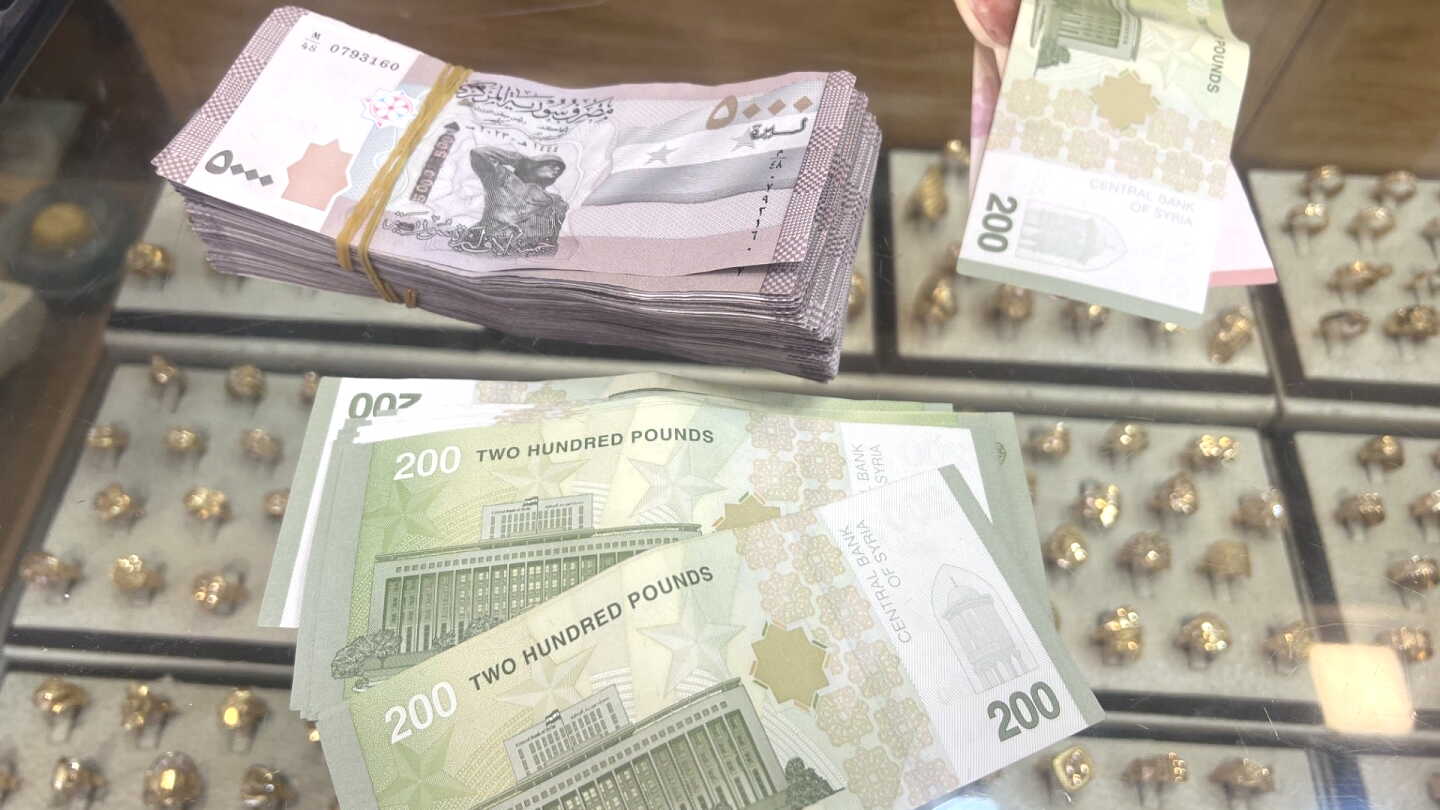
𐌹t has now been six months or so since the Syrian government introduced a new version of the Syrian pound: essentially a re-domination of the currency under the Assad regime that removes two zeros. For example, 5000 old Syrian pounds (the highest monetary note under the old regime, featuring on one side a Syrian soldier saluting next to the old Syrian flag) would equal 50 Syrian pounds under the new currency. Meanwhile, the highest monetary note under the new government is 500 Syrian pounds, equivalent to 50000 Syrian pounds under the old regime.
But what do transactions look like on the ground? Moreover, has the re-denomination led to any improvement in people’s daily lives?
Firstly, although a number of months have passed since the introduction of the new currency, in most instances I have observed in markets and stores, in areas that were controlled by the Assad regime, the habit of stating prices in the old currency persists, while in areas that were controlled by the rebels such as the town of Azaz on the border with Turkey, stating prices in the Turkish lira (the primary currency that was used in those areas before the regime fell) remains common. Receipts and listing of prices in the new currency do exist, but they have not yet become the norm. For example, prices for mobile phone data and call packages are now listed in the new Syrian pound. Similarly, the bill below for a meal at a restaurant at the Aleppo Sheraton Hotel in Aleppo city gives the price in new Syrian pounds (with equivalent in US dollars), but restaurants I have visited in the city still give prices in the old currency.

Meanwhile, purchases, sales and exchanges of currency, are readily being conducted with a combination of the new and old monetary units. For example, let us say that a fruit and vegetable seller sells me various items at a price of 60,000 Syrian pounds in the old denomination, it would be generally accepted for me to give him a 500 new Syrian pound note and then two 5000 old notes. Similarly, when I have gone and exchanged U.S. dollars for Syrian pounds, I might be given the equivalent only in new Syrian pounds, the equivalent only in old Syrian pounds, or a combination of the two. Part of the reason for this combined use of old and new notes is a matter of availability. Some of the newer notes (e.g. the new 25 Syrian pound note) still seem rare in comparison with older equivalents that remain common and are more convenient to use (e.g. the old 2000 Syrian pound note, which features Bashar al-Assad’s portrait, and the old 500 Syrian pound note).


And what about the impact of the new currency on people’s lives? Certainly, the re-denomination generally makes larger transactions more convenient: no need to learn a specific technique of holding and counting a wad of notes when purchasing goods at a price of e.g. 250,000 old Syrian pounds (50 old 5000 Syrian notes, but just 5 new 500 Syrian pound notes by comparison).
However, the introduction of the new currency has not somehow led to an improvement in the broader cost of living crisis in Syria. The simple fact is that both before and after the fall of the Assad regime, people’s incomes here have generally been insufficient to meet living expenses. Moreover, over the past year or so, there has been a noticeable and continuous decline in the value of the Syrian pound against the U.S. dollar. Around this time last year, following President Trump’s intent to announce the lifting of sanctions on Syria, the Syrian pound experienced a notable surge on the black market, coming to under 10,000 old Syrian pounds against the dollar. Today, the black market rate is hovering at around 14,000-14,500 old Syrian pounds against the dollar, not too far from what the rate was under the Assad regime. To illustrate the extent of the decline by way of practical example: I purchased a house for 100,000,000 old Syrian pounds around this time last year with the owner asking for the money to be paid in old Syrian pounds. This was equivalent to just over $10,000. Today, that same sum I gave him in Syrian pounds would only be worth around $6500-7000. This undoubtedly reflects a substantial loss for him.
The official exchange rate (which is used on the restaurant bill given above, for example), remains well below the black market rate, hovering at around 11,000 old Syrian pounds. The gap in the official exchange rate is undoubtedly one factor behind the observed decline in the value of the Syrian pound on the black market. Other cited factors include an increase in imports into the country versus weak export levels.
Besides the decline in the value of the currency, some services and commodities have also become more expensive. A clear case is the price of gasoline per litre, which gasoline stations generally prefer to set and sell in dollars. Previously, this price was set at $0.85 per litre. It is now $1.10 per litre (see below).

In the long run, satisfaction with the new government among the wider populace will depend on whether the government can bring about a tangible improvement in living standards for large sections of it. So far, the hoped-for improvements have generally not materialised.
Published originally on June 11, 2026.









Leave a comment