

Since the beginning of this year, US Treasury bond yields have risen by more than 40 basis points for thirty-year maturities. Hovering around the 5.2 percent mark, they have reached the highest levels since 2007.
This trend comes as leverage across the financial market continues to build, increasing the potential for higher rates to expose vulnerabilities and amplify losses. History offers several examples of this dynamic. In fact, losses on bond portfolios of leveraged institutions have, at times, spilled over into broader market crises.
There is no sign of such turmoil yet. Fixed-income markets have remained orderly, with the bellwether secured overnight financing rate in repo markets stable around 3.6 percent. But the combination of rising yields, elevated leverage, and an ongoing correction in AI stocks warrants close attention. Authorities and market participants should be prepared to take precautionary measures before potential financial stability risks escalate.
Rising yields, rising risks
Several factors have driven the rise in bond yields, including higher inflation expectations amid elevated energy prices following the Iran war and uncertainty surrounding a new Federal Reserve Chair. But the more fundamental concern is the US fiscal position: persistently high budget deficits have reached 6 percent of GDP, while government debt now exceeds the size of the US economy.
In Fiscal Year 2026, which ends in September, the US Treasury is expected to issue around $2 trillion of securities on a net basis. Gross issuance, meanwhile, could reach a staggering $20 trillion according to the Securities Industry and Financial Markets Association. That gap reflects the sheer volume of debt that needs to be rolled over, much of it resulting from the Treasury’s decision under former Secretary Janet Yellen to favor shorter maturities when rates were lower and curves were upward sloping.
US Treasury Secretary Scott Bessent has been attentive to the resulting borrowing costs and their impact on the budget deficit, which is why the Treasury has sought to limit pressure on the US bond market from foreign central banks that need dollars. During a recent joint FX market intervention with Japan, the Treasury sold euros for yen rather than dollars, avoiding transactions that would have required selling Treasuries. It has also asked the Fed to raise the limit on its Foreign and International Monetary Authorities repo facility, allowing the Bank of Japan and other foreign central banks to borrow short-term dollars against Treasuries rather than sell them in the open market, which could put further upward pressure on yields.

Rising bond yields have also produced mark-to-market losses for bondholders. US banks, in particular, held $325 billion in unrealized losses on securities in the first quarter of 2026, up 6.2 percent from the previous quarter, although well below the more than $600 billion recorded in 2022. Most of these losses sit in held-to-maturity securities, meaning they do not flow through banks’ financial statements unless the bonds are sold. But that does not make them irrelevant. If banks face heavy deposit withdrawals, they may be forced to sell securities at a loss—as in the case of Silicon Valley Bank in 2023. This risk deserves particular attention as semiconductor and AI companies have lost more than $3 trillion in market capitalization this year, according to the Global Semiconductor Index.
Leverage remains elevated
At the same time, leverage has increased across the US financial system. JPMorgan’s Jamie Dimon has cautioned that this could trigger a sudden disruption. The warning comes as customer margin debt at brokerage firms has reached a record $1.5 trillion in June, according to the Financial Industry Regulatory Authority, up 49 percent from a year earlier.
Hedge funds are another source of growing leverage. They have become major buyers of US Treasuries, holding $2.4 trillion at the end of 2025, while using $1.8 trillion in net repo borrowing to finance leveraged Treasury cash-futures basis and swap trades. At the same time, volatility in the US Treasury market has increased over the past month, making these trades riskier.
And then there is leverage that is harder to monitor, for instance in the private credit market, where largely privately held companies have issued increasingly risky debt with weak covenants, payment-in-kind structures, opaque financials, and interconnected lending—raising concerns at the Federal Reserve. The Fed also continues to identify the commercial real estate market as a vulnerability. Moreover, off-balance-sheet exposures involving synthetic derivatives, total return swaps, and layered private credit can create significant market risks that do not show up as conventional debt. The same problem extends to retail financial products, including leveraged and inverse exchange-traded funds, structured notes, and retail funds with embedded options.
Preparation, not panic
The combination of rising yields, increased volatility, an ongoing correction in technology stocks, and elevated leverage is making the financial system more fragile. These vulnerabilities are emerging against a backdrop of heightened uncertainty from geopolitical conflicts and potential supply chain disruptions, further increasing the risk of market turmoil. Dollar funding markets have functioned normally so far this year. But that should not obscure the steady buildup of financial stability risks.
The appropriate response is preparation, not panic. Financial authorities and market participants should take precautionary measures to ensure that vulnerabilities do not become systemic. Regulators should remain vigilant in their supervisory discussions with institutions they oversee and scrutinize Securities and Exchange Commission Form PFs, which hedge fund advisers use to report information on their private funds. If those filings reveal highly leveraged activities, authorities should encourage firms to strengthen risk management and, where appropriate, increase capital to limit spillover risks to counterparties.
Banks warrant particular attention. Authorities should engage with banks that have substantial exposures to highly leveraged hedge funds and other vehicles, whether through direct lending or participation in repo markets. They should also examine how unrealized losses on held-to-maturity bond portfolios could affect banks’ ability to withstand market stress. The objective is straightforward: strengthen risk management and capital buffers before concerns about weaker balance sheets turn into deposit withdrawals and, ultimately, bank runs.
The risks should also be made clearer to the public. Regulators and senior managers of private financial institutions should be forthright about the dangers of high leverage, especially the possibility that it could produce large and unexpected losses. Research arms such as the Office for Financial Research should use anonymized and aggregated information to provide up-to-date analysis of leverage levels and trends across institutions and activities. Better information would help market participants assess and manage their exposure. Meanwhile, retail investors should be encouraged to consider the potential for significant losses in their portfolios, particularly when using borrowed money, and to manage their investments accordingly.
Hung Tran is a nonresident senior fellow at the Atlantic Council’s GeoEconomics Center, a senior fellow at the Policy Center for the New South, a former executive managing director at the Institute of International Finance, and a former deputy director at the International Monetary Fund.
Further reading

Mon, Aug 10, 2026
When a few stocks become the market
Econographics
By
Bart Piasecki
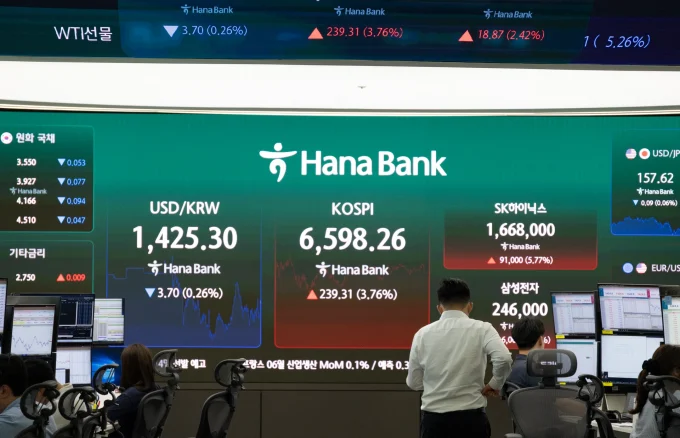
Stock market concentration is rising as a small group of companies increasingly drives major indexes. South Korea’s KOSPI shows how quickly strong returns can become a market vulnerability.
Image: View of the exterior of the US Department of the Treasury building in Washington, DC. Source: iStock/Hapabapa.











Leave a comment